Maximizing Profits: The Power of a Hybrid Business Model
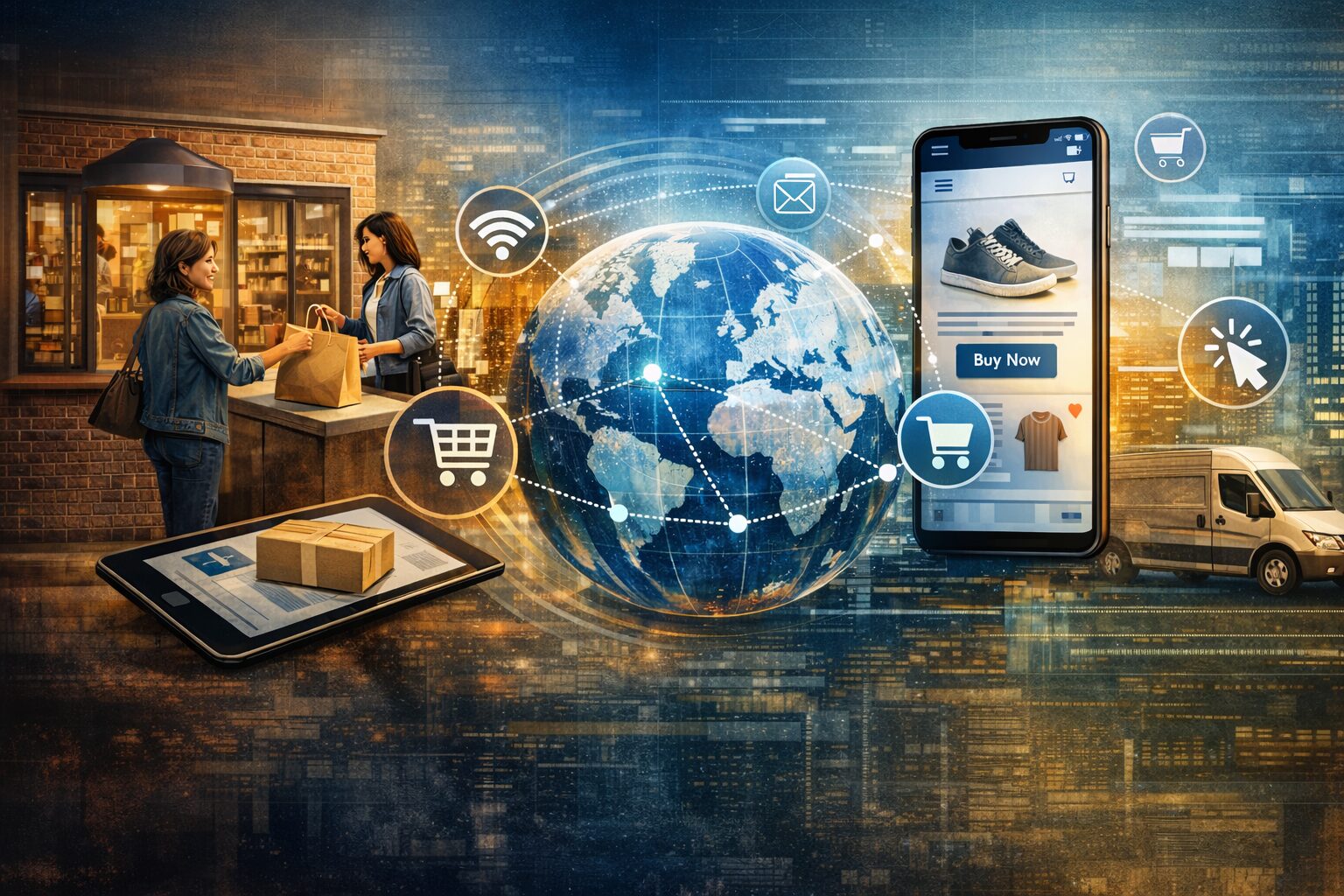
The hybrid business model integrates physical retail operations with digital commerce platforms, allowing organizations to serve customers across channels without forcing a single “preferred” path. By linking in-store experiences with online purchasing and fulfillment, firms can expand accessibility while improving continuity and operational performance.
This dual-channel architecture preserves brick-and-mortar storefronts while building robust digital infrastructure, supporting shoppers who want tactile, in-person evaluation as well as those who prioritize remote convenience. When executed well, omnichannel integration becomes a core capability, enabling faster responses to shifting consumer behavior than single-channel approaches.
As e-commerce growth continues to reshape retail strategy, evidence suggests that hybrid strategies capture larger market segments by accommodating diverse preferences and shopping habits. Bookstores, for instance, can preserve the browsing value of physical locations while extending reach through online catalogues—an approach associated with stronger customer retention and acquisition across demographics.
Beyond market reach, hybrid design supports multiple revenue streams and greater resilience in competitive markets, particularly when paired with data-driven marketing, flexible pricing, cross-promotion, and streamlined operations. Together, these elements form the operational logic that makes hybrid models a durable pathway for sustained performance.
Strategic Foundations of the Hybrid Business Model
Integration is not the same as coexistence. A business that “has a store and a website” may still deliver fragmented experiences unless it is guided by strategic intent—a deliberate plan for how each channel creates value and reinforces the same advantage.
To build that intent into execution, leaders must define where value is created, align the core building blocks, and design journeys that feel continuous rather than channel-bound. The sections below outline these foundations and how they work together.
Defining Dual-Channel Value Creation
Before turning to technology stacks or store layouts, it helps to clarify where value is actually produced when physical and digital channels operate together. Understanding that value logic reduces channel conflict and improves unit economics by assigning each touchpoint a distinct role.
In strong hybrid designs, the store is not treated as a cost center, and the digital channel is not treated as a side project. Each contributes to the overall value proposition: stores reduce uncertainty (fit, quality, immediacy), while online systems expand assortment and convenience (search, comparison, fulfillment options). The advantage emerges when these roles connect intentionally—using in-store expertise to lift online conversion, or using online demand signals to improve local merchandising.
That connection often appears in improved conversion when shoppers can move between touchpoints seamlessly. The “BOPIS” effect (buy online, pick up in store), for example, frequently drives add-on sales during pickup visits, increasing basket size even when the order begins digitally. According to National Retail Federation (NRF) reporting on omnichannel behaviors, retailers continue to prioritize pickup and flexible fulfillment because it supports both customer convenience and store productivity.
- Risk reduction: in-person inspection and immediate support lower perceived purchase risk for high-consideration items.
- Demand amplification: digital discovery and retargeting increase store visits and appointment bookings.
- Asset leverage: stores double as micro-fulfillment points, returns hubs, or service centers—improving last-mile economics.
- Data compounding: combined behavioral signals create more accurate forecasting than single-channel data alone.
Core Components: Physical Storefronts and Digital Commerce Platforms
Once the value logic is clear, execution depends on assembling the right components and aligning them operationally. The goal is not to “add digital” or “keep stores,” but to connect storefronts and platforms through integration points that reduce friction and build trust.
High-performing physical locations are designed for experience and service throughput, not just shelf capacity. Guided selling, demonstrations, consultations, repair desks, and fast pickup counters help stores function as confidence builders and service hubs. In a bookstore, for example, the floor can operate as a curated showroom while online inventory satisfies long-tail demand—preserving browsing without sacrificing selection.
On the digital side, the “platform” is more than a storefront page; it functions as a system of record and coordination. Beyond the commerce engine (catalog, pricing, checkout), hybrid operators typically require consistent order management, inventory visibility, and customer identity across touchpoints. When these elements are fragmented, customers encounter false stockouts, inconsistent promotions, and slow returns—failures that quickly erode trust.
- Unified inventory signals across stores, warehouses, and in-transit stock (reducing oversells and missed sales).
- Order management system (OMS) capable of routing orders to the lowest-cost or fastest node.
- Returns and exchanges orchestration that supports in-store returns for online purchases and vice versa.
- Governance and incentives (e.g., crediting stores for digital sales influenced locally) to prevent channel competition.
Omnichannel Customer Journeys and Unified Brand Experience
With components in place, the strategic challenge becomes choreography: enabling customers to move across touchpoints without noticing internal boundaries. Achieving that flow requires shared data, consistent policies, and disciplined brand execution.
Rather than moving through a single linear funnel, many shoppers follow loops—research online, validate in-store, purchase via mobile, return through a pickup point. Supporting these loops depends on journey continuity: carts persist across devices, loyalty benefits apply universally, and service teams have the same context regardless of channel. In practice, that continuity requires a shared customer profile and consistent rules for promotions, shipping thresholds, and returns.
Brand consistency is also operational. Tone, imagery, product information, and service standards must align across touchpoints; otherwise, mismatches—such as premium positioning in-store paired with discount-heavy messaging online—can dilute perception and reduce willingness to pay. As Jeff Bezos has noted:
“Your brand is what other people say about you when you’re not in the room.” — Jeff Bezos
To keep experiences aligned, many firms rely on a small set of omnichannel design principles:
- One promise, many paths: identical service guarantees regardless of where the transaction begins.
- Frictionless handoffs: pickup, appointment booking, and returns engineered as first-class journeys, not exceptions.
- Personalization with restraint: using predictive analytics to tailor offers while maintaining transparency and consent.
- Closed-loop measurement: attributing influence across touchpoints to optimize spend and staffing realistically.
With these foundations established, the hybrid model stops being a set of channels and becomes a coherent operating system—capable of scaling, adapting, and competing on both experience and efficiency.
Benefits and Revenue Architecture in a Hybrid Business Model
Hybrid models deliver value only when their economics are designed as deliberately as their customer journeys. Strong operators treat stores as assets to be leveraged, not liabilities to be minimized, and they connect channels in ways that expand demand while stabilizing cash flow.
This section focuses on the economic upside of hybrid execution, moving from reach to resilience and then to differentiated offerings that lift lifetime value.
Expanding Market Reach Through Online and Offline Presence
Reach is more than geography; it also reflects availability, timing, and customer intent. Combining touchpoints increases addressable demand by capturing more moments of consideration—especially when shoppers shift between research and purchase.
Stores often win the “confidence” stage, while digital channels dominate “discovery,” and the reach gain appears when those stages connect. Enabling online appointment booking for in-store consultations, for example, converts high-intent traffic that might otherwise drift to a competitor. In categories such as eyewear, Warby Parker’s showrooms show how try-on environments reduce hesitation while the website supports broader assortment and replenishment.
Expanded reach also includes serving customers outside peak store hours and beyond typical trade areas, while still using local inventory for speed. According to Pitney Bowes Shipping Index reporting on parcel volumes, e-commerce penetration has remained structurally high post-pandemic—making online availability a baseline expectation rather than an add-on.
- Geographic extension: online catalogues and shipping unlock demand beyond the radius of any single location.
- Temporal extension: digital storefronts capture late-night and mobile-driven purchase intent.
- Intent capture: store events, demos, and consultations become lead generators for online follow-up.
- Local speed advantage: nearby locations enable same-day pickup or faster delivery at lower last-mile cost.
Leveraging Multiple Revenue Streams for Financial Resilience
As market conditions shift—through supply shocks, demand swings, or rising acquisition costs—revenue architecture becomes a stabilizer rather than an afterthought. Hybrid operators can diversify income sources and protect margins by balancing transactional revenue with recurring and service-based earnings.
Reliance on one channel makes disruptions more dangerous; diversified streams allow the business to re-weight effort and inventory. During periods of reduced foot traffic, online orders can sustain throughput; when digital ads become expensive, in-store conversion and community-driven demand can offset rising customer acquisition cost. The benefit is not simply higher sales, but lower volatility in cash flow.
Hybrid structures also support higher-margin layers—subscriptions, memberships, warranties, financing, classes, and paid support. A bookstore, for example, may combine online sales with ticketed author events, membership perks, and corporate bulk orders to smooth seasonality while deepening engagement.
- Transactional sales: in-store purchases, web orders, mobile checkout.
- Service revenue: repairs, installation, consultations, training sessions.
- Recurring income: subscriptions, replenishment programs, memberships with benefits.
- Secondary monetization: marketplace commissions, affiliate partnerships, in-store media placements.
“Revenue is a consequence of value creation, not an objective of itself.” — Peter Drucker
Integrating Products and Services to Strengthen the Value Proposition
After reach and resilience come into focus, differentiation becomes the next pressure point. Pairing products with services can reduce price sensitivity and make the hybrid experience harder to replicate.
Pure product competition often collapses into price matching, especially online where comparison is effortless. Adding services—setup, onboarding, personalization, maintenance, lessons—shifts competition from unit price to outcomes. In consumer electronics, for example, offering in-store setup alongside remote troubleshooting creates end-to-end assurance that a low-cost online rival may not provide.
Service integration also improves unit economics by making stores delivery points for expertise, not just inventory. In home improvement, selling tools alongside paid installation or workshops increases trust and reduces returns by helping customers choose correctly the first time. Similar effects appear when software is paired with training: stronger adoption makes the product “stickier,” supporting retention and higher customer lifetime value.
- Bundled solutions: product + installation/repair + ongoing support under one price or subscription.
- Experience add-ons: demos, classes, fittings, or curation that justify premium positioning.
- Service-led upsell: consultations that recommend the right tier, accessories, or maintenance plan.
- Returns prevention: guided selection and post-purchase assistance reduce costly reverse logistics.
Operational Execution: Systems, Pricing, and Adaptability
Strategy sets direction, but daily execution determines whether hybrid advantages materialize. Once real orders, inventory, and customers move between channels, teams face constant trade-offs: speed versus cost, availability versus accuracy, and automation versus human service.
This section examines the operational levers that keep the model coherent at scale—inventory and fulfillment discipline, pricing governance, adaptability, and the analytics that reduce variability.
Balancing Inventory, Fulfillment, and Service Across Channels
Operational credibility hinges on a simple promise: what customers see as available must truly be available. Aligning inventory, fulfillment, and service prevents cancellations, disappointed store visits, and margin leakage from inefficient routing and high-cost returns.
Stores are increasingly managed as inventory nodes, not just selling floors. That shift demands real-time inventory accuracy (cycle counts, RFID, exception alerts), since small errors can cascade into oversells and service failures. RFID adoption has accelerated in apparel, and industry coverage from Retail Dive often notes that item-level visibility improves both on-shelf availability and omnichannel fulfillment reliability.
Fulfillment choices then depend on orchestration: ship-from-store, centralized DCs, third-party logistics, or micro-fulfillment. Each option carries a distinct cost curve, so leading operators use an OMS to route orders based on promised delivery date, labor capacity, and markdown risk.
- Node rationalization: allocate SKUs to stores that can move them profitably and fulfill efficiently.
- Returns discipline: channel-agnostic returns with structured inspection, resale, and refurbishment paths.
- Service handoffs: equip associates with order context so support feels continuous, not “re-explained.”
- Capacity planning: schedule labor for pickup/packing waves, not only foot-traffic peaks.
Flexible Pricing Strategies and Dynamic Offer Design
Hybrid pricing is less about finding a single “right price” and more about applying coherent rules across contexts. Flexibility can lift performance, but inconsistency can quickly undermine trust if shoppers repeatedly see unexplained mismatches.
Dynamic pricing can succeed when customers perceive it as fair and predictable. Airlines normalized demand-based pricing long ago; retail applications typically rely on guardrails such as price floors, promotion calendars, and competitor thresholds. Analysis published by Harvard Business Review also notes that poorly governed personalization can backfire when customers sense “surveillance-like” discrimination, which is why many brands emphasize a transparent value exchange (for example, discounts tied to membership or subscription commitment).
More durable gains often come from offer design rather than constant repricing. Instead of discounting the core item, hybrid operators add value through services, convenience, and exclusives—particularly important where online price comparison is frictionless.
- Channel-neutral guarantees: consistent price-match and return rules to protect perceived fairness.
- Bundles: product + setup + support as a single outcome-based offer, reducing pure price comparison.
- Tiered benefits: memberships that convert frequency into margin (free shipping, priority pickup, repairs).
- Localized promotions: store-specific offers tied to regional demand or excess stock, governed centrally.
Adapting to Market Changes and Shifts in Consumer Behavior
Even strong operating plans degrade when market conditions change. Hybrid leaders treat adaptability as a capability—sensing shifts early and rebalancing assortment, staffing, and fulfillment logic before performance declines.
Optionality is often built into the system through multiple carriers, flexible pickup formats, and configurable routing rules. During COVID-era disruptions, many retailers expanded curbside pickup and ship-from-store quickly; the lasting lesson was that speed of reconfiguration can function as a moat, not only a crisis response.
Customer behavior shifts can also appear in subtler signals—rising return rates, shorter decision cycles, or increased “research online, buy offline” patterns. Capturing those signals requires cross-channel measurement so teams adjust the levers that matter most: allocation, lead times, and service levels, not just marketing creative.
- Scenario planning: stress-test supply and demand shocks (carrier constraints, vendor delays, weather events).
- Assortment agility: use local demand and online search data to tune store mixes and reorder points.
- Experience rebalancing: shift floor space toward service/pickup when fulfillment demand rises.
- Policy calibration: adjust return windows, restocking fees, or exchanges to manage abuse without friction.
“In times of change, learners inherit the earth; while the learned find themselves beautifully equipped to deal with a world that no longer exists.” — Eric Hoffer
Streamlining Operations with Data Analytics and Automation
As complexity grows across channels, intuition alone becomes costly. Analytics and automation help reduce variability—improving accuracy, labor productivity, and decision speed—while supporting consistent execution at scale.
Most analytics programs start with a single view of demand that combines web traffic, store sell-through, returns, and customer service signals. From there, forecasting and optimization increasingly rely on machine learning. McKinsey has reported that advanced analytics in retail can materially improve outcomes such as forecasting and availability; their summaries at McKinsey (QuantumBlack insights) frequently highlight performance lifts tied to better prediction and decision automation.
Automation then targets repeatable workflows such as fraud screening, replenishment triggers, pick-path optimization, and self-service support. When those systems function well, associates spend less time handling exceptions and more time on high-value human work such as consultation and service recovery.
- Demand sensing: integrate online search, promotions, weather, and local events to reduce forecast error.
- Workforce optimization: schedule labor using pickup/packing volume forecasts alongside traffic patterns.
- Process automation: auto-route orders, generate shipping labels, and flag inventory discrepancies.
- Governed experimentation: A/B test offers and fulfillment promises with clear KPI ownership and stop rules.
Customer Growth and Performance: Scaling the Hybrid Business Model
Operational excellence creates capacity, but growth determines how that capacity compounds over time. In hybrid environments, sustainable expansion is rarely achieved by adding touchpoints; it comes from turning each one into a reinforcing customer relationship and measuring performance in ways that reflect cross-channel reality.
This section connects customer development to performance discipline—covering loyalty, cross-selling, and KPIs that capture contribution across journeys rather than within isolated silos.
Building a Strong Customer Base with Loyalty and Personalization
Retention changes shape when customers alternate between store visits, mobile browsing, and delivery. For hybrid operators, loyalty design and responsible personalization create continuity across contexts—without triggering backlash from intrusive targeting.
Well-designed loyalty programs reward behaviors that matter operationally, not just spend. Many brands now incentivize BOPIS adoption, consolidated shipments, or auto-replenishment enrollment—actions that can reduce last-mile costs and improve forecasting. Starbucks’ Rewards program illustrates the pattern: app-driven ordering and payment increase convenience while generating high-frequency behavioral data that supports targeted offers and staffing decisions.
Personalization tends to work best when positioned as a fair quid pro quo: customers share preferences and receive clearer value (early access, relevant recommendations, faster service). Governance remains central—many firms adopt “privacy-by-design” controls and preference centers to align with expectations and regulations. Guidance referenced in Harvard Business Review notes that personalization can erode trust when customers perceive price or offer discrimination, which is why transparent rules (such as member-only pricing) often outperform opaque targeting.
- Unified loyalty ID: one account across POS, app, and web to prevent fragmented rewards.
- Next-best-action offers: recommendations based on lifecycle stage (new buyer, replenisher, lapsed).
- Value-exchange clarity: explicit benefits for data sharing (points, services, convenience).
- Service recovery: proactive credits when pickup delays or inventory errors occur—protecting trust.
“The purpose of a business is to create and keep a customer.” — Peter F. Drucker
Cross-Promotion and Cross-Selling Across Touchpoints
After acquisition, scaling depends on increasing value per relationship without relying on constant discounting. Hybrid environments make that easier by allowing physical and digital channels to “hand off” intent at the right moment.
Cross-selling works best when it follows the customer’s task, not the retailer’s catalog. Someone who books an in-store fitting online is naturally primed for add-ons at pickup, while an in-store buyer can be guided into replenishment through email or app reminders. Sequencing matters: digital touchpoints build consideration, and stores close with high-trust recommendations and immediate fulfillment.
Cross-promotion benefits from channel-specific strengths as well. Stores can host demonstrations, launches, and community events that generate content for social and email campaigns; digital channels then convert that attention into appointments and reserved inventory. This “event-to-order” loop appears in bookstores (author talks + online preorders) and cosmetics (tutorials + in-store shade matching + subscription replenishment).
- Cart-to-store prompts: “Pick up today—add these accessories at checkout.”
- Receipt retargeting: QR codes on in-store receipts that link to compatible items or tutorials.
- Service-led bundles: consultation + product + follow-up support as a single outcome-based offer.
- Localized cross-promo: online ads that highlight store inventory for high-intent searches nearby.
KPIs and Measurement Framework for Hybrid Performance
Hybrid initiatives often underperform when teams use the wrong scoreboard. Because channels share influence, measurement must capture incrementality, profitability, and experience quality across touchpoints rather than treating each channel as an isolated outcome.
Leading operators separate “what happened” from “what caused it.” Outcome metrics (revenue, margin) are paired with diagnostic measures (availability accuracy, promise reliability), while attribution reflects real journeys. A store visit influenced by paid search, for example, should not be evaluated as “store-only” performance; it should be assessed as cross-channel contribution.
A balanced hybrid dashboard typically includes a small set of executive KPIs supported by operational indicators:
- Customer lifetime value (CLV) and repeat rate by acquisition source (store, web, marketplace).
- Omnichannel conversion: % of customers who use 2+ touchpoints before purchase.
- Fulfillment promise accuracy: on-time pickup readiness and delivery SLA adherence.
- Return rate and return recovery (resell/refurbish yield), critical for margin protection.
- Inventory record accuracy and cancellation rate (direct indicators of system trust).
When measurement discipline is paired with stronger forecasting, performance compounds; coverage from McKinsey (QuantumBlack insights) frequently highlights improvements tied to demand prediction and decision automation, especially in availability and labor planning.
Case Studies of Successful Hybrid Implementations
Execution patterns become easier to see through well-documented implementations. The examples below highlight specific hybrid “moves” that made these models defensible—not simply visible across channels.
Warby Parker built momentum by using showrooms to reduce purchase anxiety (fit and style) while keeping broader selection and reorder convenience online. Its strength lies in deliberate division of labor: stores act as confidence accelerators and service points, while the digital platform supports assortment, scheduling, and follow-up.
Starbucks shows how digital can increase store throughput rather than cannibalize it. Mobile order-ahead shifts demand into predictable production queues, loyalty connects behavior across touchpoints, and personalization stays within clear membership rules. The outcome is a system where convenience becomes a margin lever through shorter lines, higher frequency, and more targeted promotions.
Walmart provides another playbook by treating stores as a nationwide fulfillment network. Investments in pickup, ship-from-store, and marketplace capabilities support competition on both speed and assortment. Public reporting and industry analysis frequently point to store-based fulfillment as a structural last-mile advantage when inventory accuracy and routing are tightly managed.
Building a Coherent Hybrid Operating System
Hybrid commerce is increasingly a design choice, not a compromise. Bringing stores and e-commerce together into one system requires clear roles for each channel and disciplined integration through shared data, consistent policies, and aligned incentives.
At its best, the model functions as a measurable growth engine, where operational reliability and customer development reinforce one another across touchpoints. In markets defined by continual change, the organizations that integrate quickly and learn continuously are best positioned to sustain performance.
Bibliography
Bezos, Jeff. “Your brand is what other people say about you when you’re not in the room.” BrainyQuote. Accessed February 13, 2026. https://www.brainyquote.com/quotes/jeff_bezos_499369.
Drucker, Peter F. “Revenue is a consequence of value creation, not an objective of itself.” In The Effective Executive. New York: Harper & Row, 1967.
Drucker, Peter F. “The purpose of a business is to create and keep a customer.” In Management: Tasks, Responsibilities, Practices. New York: Harper & Row, 1973.
Hoffer, Eric. The True Believer: Thoughts on the Nature of Mass Movements. New York: Harper & Brothers, 1951.