How to Create a Small Business Marketing Plan: Step-by-Step Marketing Strategies for Entrepreneurs
How to Create a Small Business Marketing Plan: Step-by-Step Strategies for Entrepreneurs
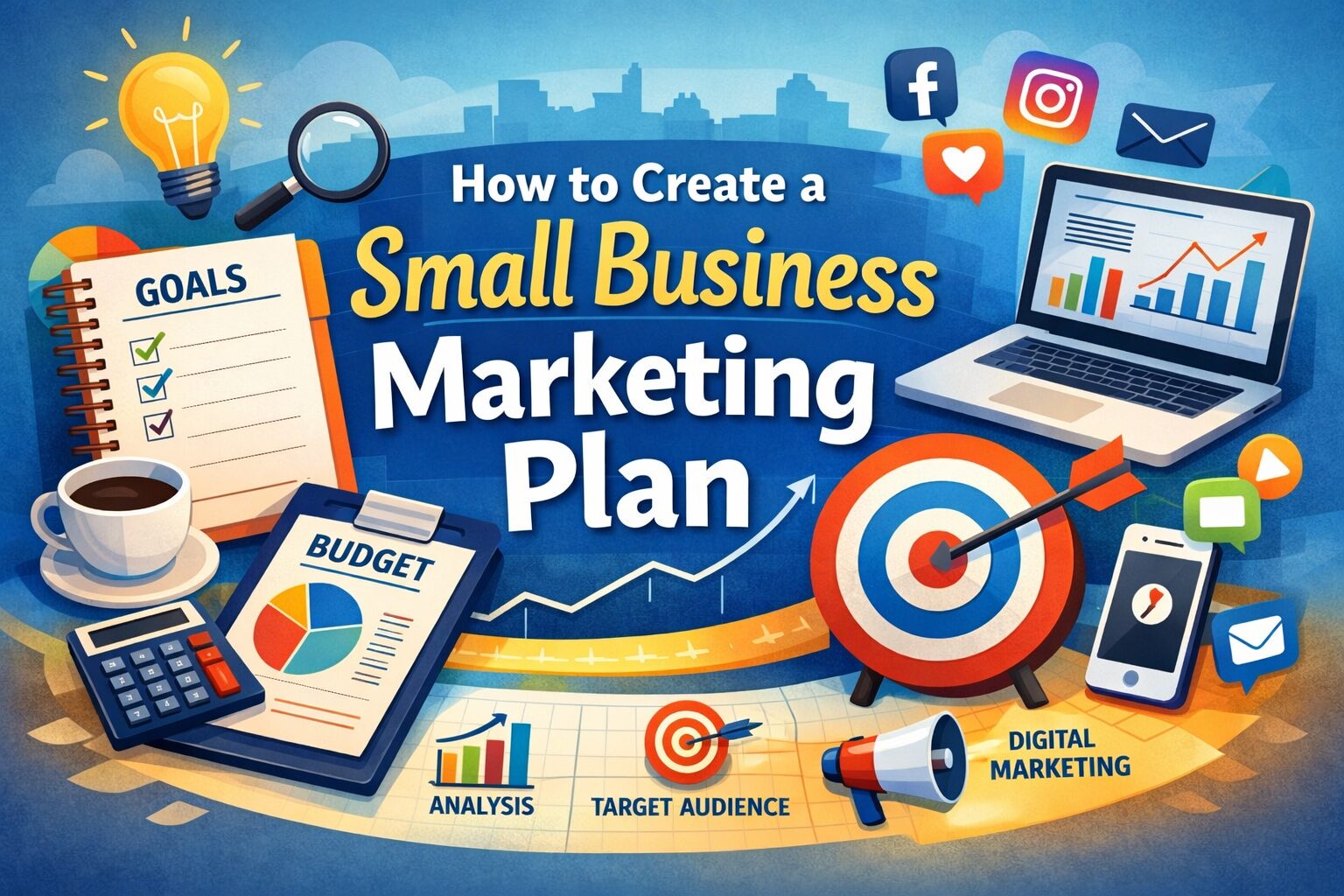
Launching a new venture is exciting, but without a clear marketing plan, even great products and services can struggle to find traction. This guide shows small business owners how to create a marketing plan from scratch, translate business goals into actionable marketing strategies, and manage marketing efforts with confidence. Whether you need a marketing plan for your small startup, a first business marketing plan for a local shop, or a reusable marketing plan template for future growth, you will learn how to align a business plan with effective marketing, select the right marketing tools, and build a successful marketing plan that fits your target audience and target market.
What is a marketing plan and why does a small business need a business marketing plan?
How a marketing plan guides marketing strategies and marketing efforts
A marketing plan is a structured roadmap that outlines your marketing objectives, target audience, positioning, marketing tactics, and measurement approach. It guides daily marketing efforts and ensures each marketing activity supports clear business goals. For a small business, a business marketing plan acts like an operating system for business marketing: it clarifies the value proposition for each product or service, establishes which marketing channels—such as social media marketing or email marketing—are most effective, and sequences campaigns on a timeline with budgets. By documenting strategy, the marketing plan ensures that developing a marketing calendar, content, and promotions become disciplined, repeatable processes rather than ad hoc tasks. This alignment helps small business owners prioritize marketing tools that deliver ROI and avoid scattered spending.
Key differences between a small business marketing plan and a corporate plan
While a corporate plan often spans multiple markets, divisions, and large budgets, a small business marketing plan is focused, nimble, and resource-aware. Small business marketing typically operates with limited funds, lean teams, and a need for rapid validation, so the plan emphasizes essential marketing strategies that can be tested quickly and scaled if effective. A corporate plan might include complex segmentation, multiple product lines, and extensive research, whereas a marketing plan for your small business sharpens a few core customer personas, prioritizes one or two primary marketing channels, and uses low-cost or free marketing tactics to learn fast. The small business administration often highlights agility and cash flow discipline; a small business marketing plan reflects this by defining minimum viable campaigns, tight feedback loops, and simple attribution to connect spend to sales.
Marketing plan example components for products and services
A practical marketing plan example for products and services usually includes: an executive summary; situation analysis; a clear articulation of strengths and weaknesses; market and competitor overview; target market and target audience profiles; brand positioning and value proposition; marketing objectives; marketing strategies and marketing tactics; channel mix across social media marketing, email marketing, and other marketing channels; budget and timeline; and a measurement plan. For a product-focused company, the plan might include launch phases, feature messaging by segment, and promotions tied to inventory cycles. For a service business, it might emphasize referral programs, content marketing that demonstrates expertise, and local SEO. In both cases, the plan should allocate resources per product or service priority, specify the offer and pricing strategy, and define the customer journey from awareness to retention.
How do you create a marketing plan for your business from scratch?
Defining business goals and marketing objectives that align
Begin by translating your overarching business goals into specific marketing objectives. If your business plan targets $250,000 in first-year revenue, convert that into pipeline and lead goals, then into channel targets. Marketing objectives should be SMART: for example, generate 1,000 qualified leads in six months, achieve a 5% email marketing click-through rate, or increase social media marketing reach by 50% quarter-over-quarter. This alignment ensures that when you create a marketing plan, every campaign contributes to sales, retention, or brand equity, rather than vanity metrics. Tie each objective to the associated product or service so you can later assess performance by line of business.
Identifying your target audience and target market
Define who you serve and where you compete. Describe your target audience in detail: demographics, psychographics, jobs-to-be-done, pain points, buying triggers, and objections. Map the target market’s size, growth, and competitive alternatives. For a small business, clarity beats breadth; narrow your focus to high-intent segments where your value proposition outperforms. Create two to three personas per product or service, then specify which marketing channels they prefer. For example, home service customers may respond to local search and reviews, while B2B buyers might prefer email marketing and LinkedIn social media marketing. This precision lets you deploy effective marketing with fewer resources and a stronger message-to-market fit.
Choosing effective marketing tools for business owners
With objectives and audience defined, select marketing tools that reduce manual work and amplify results. For small business owners, a lean stack might include: a website CMS, an email marketing platform with automation, a social media marketing scheduler, basic design tools, and analytics. Add a CRM to connect leads to sales outcomes, and consider free marketing options like organic social content, Google Business Profile, and community partnerships. Choose tools that integrate, scale, and fit your budget. When you create a small business marketing toolkit, focus on features that support segmentation, personalization, campaign tracking, and reporting tied to your marketing plan template.
What does a successful marketing plan include for a small business?
Clear value proposition, strengths and weaknesses, and positioning
A successful marketing plan articulates a sharp value proposition: why your products and services solve a problem better than alternatives. Use a situation analysis to surface strengths and weaknesses, then position your small business to emphasize strengths and mitigate weaknesses. For instance, a boutique can highlight curated quality and local service, even if prices are higher. Document proof points, testimonials, and guarantees. Define messaging pillars that ladder from the value proposition to benefits and features for each product or service, ensuring consistency across all marketing channels.
Marketing tactics across social media marketing and email marketing
Translate strategy into coordinated marketing tactics. For social media marketing, select two core platforms where your target audience is active, publish value-driven content, and engage consistently. Use a mix of educational posts, customer stories, and offers, and test formats like Reels or carousels. For email marketing, build a permission-based list, segment by persona and lifecycle stage, and set up welcome, nurture, and reactivation sequences. Combine these with content marketing, local SEO, partnerships, and events. Ensure each tactic maps to a stage in the funnel—awareness, consideration, conversion, and loyalty—and is sequenced on your timeline in the marketing plan for your business.
Budget, timelines, and metrics for effective marketing
Allocate a realistic budget by channel, linking spend to expected outcomes and conversion rates. Build a quarterly timeline with campaign themes, content deadlines, and launch dates. Define metrics for each objective: impressions and reach for awareness, CTR and time on page for engagement, form fills and qualified leads for acquisition, and repeat purchase rate for retention. Specify data sources and reporting cadence. This level of detail makes effective marketing measurable and enables fast decision-making when you need to reallocate resources or scale what works.
How to create your marketing plan timeline and marketing strategies mix
Balancing short-term and long-term marketing efforts
Balance quick-win tactics that generate cash flow with long-term brand-building. Short-term efforts might include promotions, retargeting, and referral incentives; long-term efforts include SEO, authority-building content, and community engagement. Your marketing strategies mix should dedicate budget to both so you are not trapped in perpetual discounting. When you create a marketing plan timeline, layer campaigns so awareness assets feed lead capture, and nurture programs convert leads over time, stabilizing revenue.
Selecting channels: social media marketing, email marketing, and more
Channel selection should reflect audience preferences, cost, and your strengths. Many small business owners benefit from a core trio: SEO and local listings for intent, social media marketing for engagement, and email marketing for conversion and retention. Depending on the product or service, consider marketplaces, affiliate partnerships, events, or direct mail. Document hypotheses for each channel in your marketing plan example, including expected CPMs, CPCs, or open rates, and set thresholds for scaling up or pausing spend.
Allocating resources to product or service priorities
Not all offerings are equal. Rank each product or service by margin, demand, differentiation, and strategic importance. Allocate creative, budget, and sales support accordingly in the marketing plan for your small company. For example, invest more in the flagship product’s launch content and email sequences while maintaining lighter-touch campaigns for ancillary services. This prioritization prevents dilution and focuses marketing efforts where they can create outsized impact.
How do you build a marketing plan that fits your products and services?
Tailoring strategies to different types of marketing plans
Different business models require different types of marketing plans. A subscription service needs lifecycle email marketing and churn prevention, while a retail brand emphasizes merchandising, promotions, and local reach. A B2B consultancy relies on thought leadership, case studies, and consultative follow-ups. Customize your business marketing plan to the sales cycle and buying committee: map touchpoints, proof, and offers accordingly. When you write a marketing plan, specify how tactics adapt by offering, seasonality, and region.
Segmenting your target market and personalizing messages
Segmentation multiplies effectiveness. Divide your target market by needs, behavior, value, or stage in the journey. Use your marketing tools to personalize subject lines, content blocks, and calls to action. For social ads, tailor creative to each persona’s pain points. For email marketing, use tags and triggers to deliver the right message at the right time. Your small business marketing plan should include decision trees that route prospects based on engagement, ensuring a more successful marketing outcome with less waste.
Integrating business plan insights into business marketing
Your business plan contains critical inputs—market size, pricing, competitive landscape, and operational constraints—that should inform business marketing. If your cost structure requires premium pricing, your positioning and channels must support perceived value. If your operations favor recurring revenue, your marketing objectives should emphasize retention programs. Integrate forecasts so your marketing plan template ties campaign cadence to inventory, staffing, and cash flow.
How to write a marketing plan section-by-section
Executive summary and situation analysis (SWOT: strengths and weaknesses)
Start with an executive summary that states your mission, core offering, and high-level marketing strategies. Follow with a situation analysis using SWOT to articulate strengths and weaknesses, opportunities and threats. Include competitor snapshots, customer insights, and regulatory or seasonal factors that impact a small business. This context grounds your decisions and helps stakeholders understand why the plan prioritizes specific channels and tactics.
Marketing objectives, tactics, and budget
List your marketing objectives numerically, then map tactics to each objective. For example, to increase qualified leads by 30%, deploy a lead magnet, landing pages, and a three-part email marketing sequence; to boost awareness, schedule weekly social media marketing content and local PR outreach. Assign owners, deadlines, and budgets. Keep a contingency line for testing new marketing ideas without derailing core campaigns, and note any free marketing opportunities that can extend reach at low cost.
Measurement plan and optimization roadmap
Define the KPIs, measurement cadence, and analytics setup required for a successful marketing plan. Document how you will track conversions (UTMs, pixels, CRM fields), attribute results to campaigns, and visualize performance. Create an optimization roadmap with planned A/B tests for subject lines, landing pages, offers, and creatives. Establish decision thresholds so you can iterate quickly—scale winners, pause underperformers, and reallocate budget with discipline.
What new marketing plan ideas can boost a first marketing plan?
Developing a marketing test-and-learn framework
For your first plan for your small business, adopt a test-and-learn framework to reduce risk and accelerate learning. Define hypotheses, small budgets, and clear success metrics. Run weekly or biweekly experiments across social media marketing audiences, email marketing subject lines, and landing page headlines. Capture learnings in your marketing plan template so future campaigns start from validated insights rather than guesses.
Using emerging marketing tools and platforms
Leverage emerging marketing tools to punch above your weight: AI-assisted copy and design, marketing automation, chat on your site for lead capture, and lightweight analytics dashboards. Explore new platforms selectively where your target audience is moving, such as short-form video or niche communities. Pair experimentation with guardrails in your business marketing plan—limit spend, set trial periods, and require a clear path to effective marketing before expanding investment.
Adapting to trends with agile, new marketing tactics
Build agility into your small business marketing by planning monthly sprints and quarterly strategy reviews. Track cultural and seasonal trends, competitor moves, and platform algorithm changes. Be ready to pilot new marketing tactics like collaborations with micro-influencers, live shopping streams, or interactive email modules, but measure rigorously and retire what does not contribute to your marketing objectives.
How to use a marketing plan example to create a marketing blueprint
Building a marketing plan template you can reuse
A well-structured marketing plan example can become a reusable blueprint. Create a marketing plan template with standardized sections—objectives, audience, messaging, tactics, budget, timeline, KPIs, and post-mortem notes. Include checklists for launch readiness, creative specs, and compliance. This template helps small business owners scale efforts, onboard team members, and maintain consistency across campaigns and products and services.
Customizing a business marketing plan by industry
Tailor your business marketing plan to industry dynamics. For restaurants, prioritize local SEO, reviews, and social content with daily specials. For professional services, emphasize credibility, case studies, and referral systems. For e-commerce, optimize product pages, cart recovery, and email marketing flows. Use sector benchmarks where available, including resources from the small business administration, to set realistic conversion goals and budgets.
Case snapshots of successful marketing plan structures
Consider a home-cleaning service that used a lean small business marketing plan: local search optimization, neighborhood mailers, and a referral program drove predictable bookings within 90 days. Or a niche B2B tool that combined targeted LinkedIn social media marketing, a webinar series, and a drip email marketing sequence to convert demos into trials. Each successful marketing plan shared traits: tight audience focus, clear offers per product or service, disciplined measurement, and continuous iteration.
How do you measure a successful marketing plan and iterate?
KPIs for awareness, engagement, leads, and sales
Define KPIs at each funnel stage to evaluate a marketing plan for your business. For awareness: impressions, reach, branded search volume, and share of voice. For engagement: click-through rate, dwell time, social saves, and email reply rate. For acquisition: cost per lead, lead quality score, and conversion to opportunity. For revenue: customer acquisition cost, average order value, sales cycle length, and lifetime value. Track cohort retention and referral rate to gauge long-term health.
Attribution basics for small business marketing
Use simple attribution to connect marketing efforts to outcomes. Start with first-touch and last-touch reporting through UTM tracking and CRM fields. As you mature, add position-based or data-driven models to reflect multi-touch journeys. Even basic attribution helps you compare social media marketing against email marketing and search, guiding budget shifts that improve ROI. Document your chosen model in the marketing plan template so stakeholders interpret results consistently.
Continuous improvement: reviewing results and updating the plan
Schedule monthly reviews and a quarterly retrospective to assess performance versus marketing objectives. Identify what worked, what underperformed, and why. Update forecasts, tactics, and creative based on evidence. Treat your small business marketing plan as a living document—retire weak campaigns, double down on profitable channels, and incorporate new marketing insights from tests and customer feedback.
How to launch and manage your new marketing plan sustainably
Creating a 90-day action plan to create a marketing
Translate strategy into a 90-day action plan to create a marketing engine that runs smoothly. Break work into weekly sprints with prioritized tasks: set up analytics and CRM, finalize messaging, launch core email marketing flows, publish cornerstone content, and schedule social media marketing. Establish a cadence of standups and reviews, using your marketing plan template to track progress, blockers, and results.
Team roles, workflows, and accountability for business owners
Even for small business owners wearing many hats, define roles and workflows. Assign ownership for content, design, channel management, and reporting—whether in-house or through freelancers. Use simple workflows for briefs, approvals, and publishing. Set SLAs for response times and quality checks. Tie responsibilities to specific goals in the business marketing plan so accountability is clear and performance can be measured.
Risk management and contingency planning for marketing efforts
Anticipate risks such as platform policy changes, inventory shortages, budget cuts, or campaign underperformance. In your marketing plan for your small team, include contingencies: backup creatives, alternative offers, a minimal viable channel mix that relies on free marketing if needed, and crisis communication protocols. Maintain a buffer in budget and timeline to adapt quickly. By embedding risk management, you protect momentum and keep your marketing strategies resilient.
How to Create a Small Business Marketing Plan – Frequently Asked Questions
What is a small business marketing plan and why is a marketing plan essential?
A small business marketing plan is an actionable plan that outlines how you will promote your products or services, reach your target customers, and achieve your marketing goals. A good marketing plan is essential because it helps you allocate a marketing budget, prioritize marketing initiatives, measure return on investment, and create a long-term plan that aligns business and marketing objectives. Whether you work with a marketing team, a marketing agency, or manage marketing managers in-house, having a written plan helps you execute your plan consistently and make a major difference in growth.
How do I conduct market research and a competitive analysis for my small business?
Start by identifying your target audience, customer needs of your business, and niche marketing opportunities, then gather primary and secondary data about customer behavior and preferences. Conduct a competitive analysis to compare offerings, pricing, unique selling proposition, and current marketing campaigns of competitors. Tools like surveys, social listening, and industry reports help you understand your marketing landscape and inform positioning, messaging, and the development center of your strategy so you can build an effective marketing plan.
What should be included in a good marketing plan template for small businesses?
A free marketing plan template should include sections for goals and KPIs, target market and buyer personas, unique selling proposition, marketing channels (organic, paid advertising, video marketing, word-of-mouth marketing), content calendar, marketing budget, timelines, and metrics for tracking ROI. It should guide you through developing a marketing plan step-by-step so you can create an effective, actionable plan and understand how each initiative contributes to helping businesses achieve growth.
How do I set a realistic marketing budget and measure return on investment?
Determine how much you can allocate based on revenue forecasts and business priorities, then split the marketing budget across high-impact channels like paid advertising, video marketing, SEO, and organic campaigns. Assign expected outcomes and KPIs to each initiative and track costs versus results to calculate return on investment. Regularly review performance with your marketing team or marketing managers to reallocate spend toward the best marketing tactics that help customers buy your products or services.
How can small businesses build a marketing strategy that drives customers to buy your products or services?
Start with a clear unique selling proposition and buyer persona, then choose channels that reach those customers—email, social, search, video marketing, and referrals. Combine long-term plan elements (brand building, SEO) with short-term marketing campaigns that promote offers and encourage conversions. Use niche marketing where appropriate to target specific segments, test messaging, and scale what performs best. Implement best practices for conversion tracking and continuously improve to achieve your marketing goals.
When should I consider hiring a marketing agency or expanding my marketing team?
Consider hiring a marketing agency or expanding your marketing team when you lack the in-house skills to execute key tactics, when growth demands more capacity, or when you need specialized help like video marketing production or paid advertising management. A marketing agency can help develop a professional marketing plan, conduct market research, and execute campaigns faster, while an internal marketing team helps maintain long-term consistency and ownership of brand and marketing initiatives.
What are some best practices for executing marketing campaigns and achieving consistent results?
Set clear objectives and KPIs, use an editorial calendar, A/B test messaging and creative, and track performance daily or weekly to optimize. Balance low-cost tactics like word-of-mouth marketing and content with paid advertising for scale, and invest in video marketing to increase engagement. Make sure your campaigns reflect your unique selling proposition and that the entire business understands your marketing priorities so marketing initiatives align with sales and customer service to help customers buy your products or services.
How do I create an effective long-term marketing plan while still running short-term campaigns?
Separate your strategy into a long-term plan focused on brand, SEO, and audience development and short-term campaigns designed for immediate conversions and promotions. Allocate resources and marketing budget across both horizons, set milestones for future marketing development, and document processes so you can execute your plan efficiently. This dual approach lets you achieve immediate revenue goals while building sustainable growth through development center activities and ongoing market research.
What are quick wins and long-term steps to understand your marketing and make a major difference?
Quick wins include optimizing your website for conversion, launching targeted paid advertising campaigns, creating referral incentives for word-of-mouth marketing, and using a free marketing plan template to focus efforts. Long-term steps involve conducting a competitive analysis, refining your unique selling proposition, investing in video marketing and content, and building a skilled marketing team or relationship with a marketing agency. Combining both approaches helps you understand your marketing better and steadily improve return on investment.