
Negotiating Hotel and Airline Rates: Tactics for Travel Managers
Negotiating Hotel and Airline Rates: A Practical Playbook for Travel Managers to Secure, Measure, and Enforce Corporate Rates
Negotiated travel rates can shave millions off annual T&E spend — but only when contracts, data, and enforcement align.
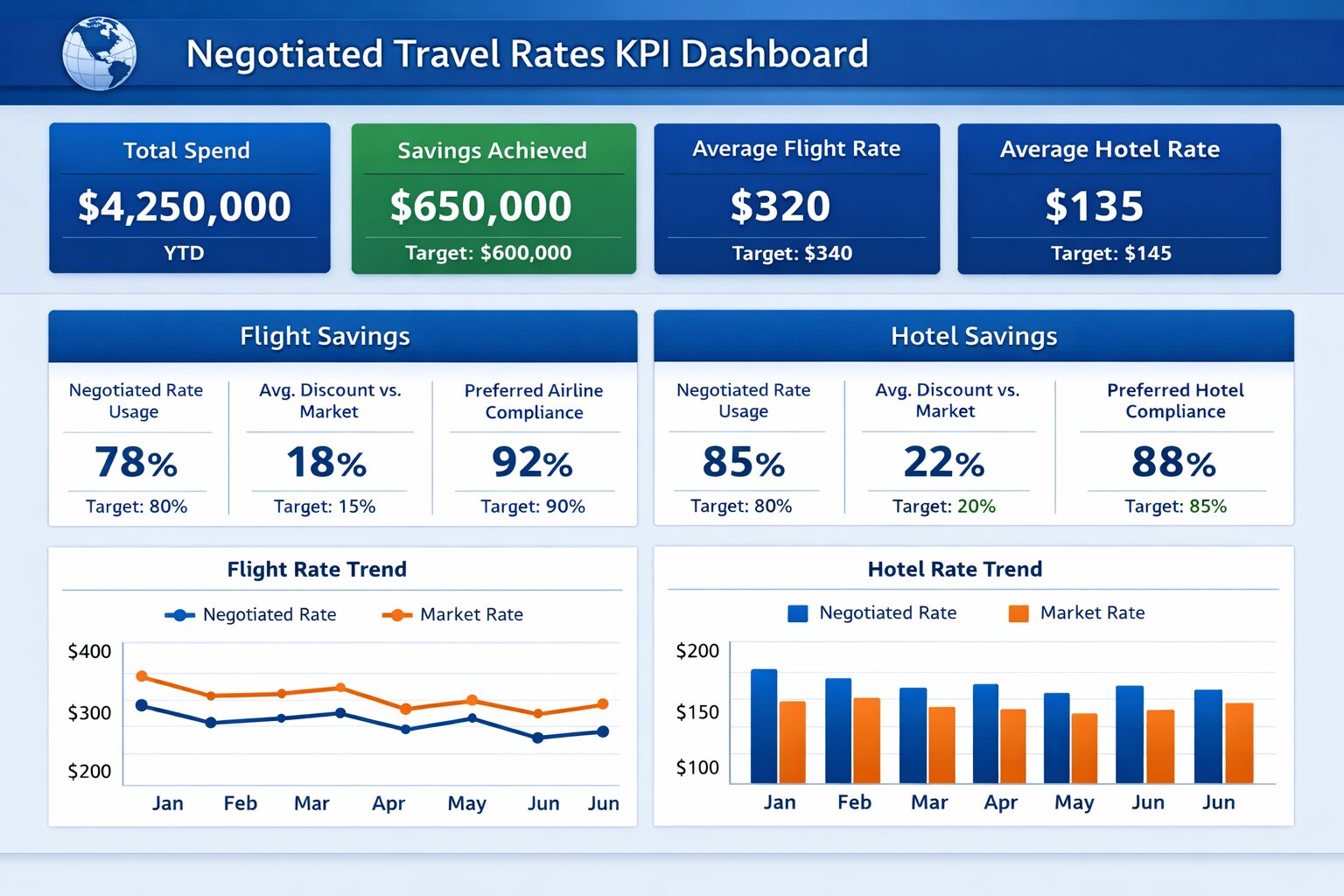
Many travel managers accept weak corporate rates, opaque airline deals, and poor compliance because they lack a tactical negotiation process, measurable KPIs, and clear contract language. This guide shows exactly how to secure negotiated travel rates across hotels and airlines, measure negotiated-rate ROI, and enforce agreements so savings stick.
What you will learn: step-by-step negotiation tactics for hotels and airlines, KPI formulas and a sample reporting cadence to measure negotiated-rate ROI, contract clauses and risk controls to insist on, plus data-driven strategies to build leverage and maximize adoption.
Negotiating Hotel and Airline Rates: Step-by-Step Playbook
Section 1 — Prepare: Data, Volume, and Timing (build leverage before you ask)
You win negotiations before the first call. Preparation means clean data, realistic volume forecasts, and knowing the right moment to reach out.
Audit your historical travel data (what to pull and how to structure it)
What to pull
– Trip-level export for the last 12–24 months: traveler ID (anonymized), booking date, travel dates, city/origin-destination, property or flight route, nights/seats, booking channel (CBT/TMC/direct/OTA), rate/fare paid, rate code/fare class, cancellation/no-show flags, ancillary spend.
– Supplier-level summary: total room nights, room-night seasonality, ADR by property, top 20 properties/routes by spend, channel share by property.
Suggested dataset columns
– City | Property | Nights | ADR/Avg Fare | Booking Channel | Booking Lead Time (days) | Rate Code/Fare Class | Cancelled? | Traveler Tier
Why structure matters
– Use 90/180/365-day booking windows to spot lead-time trends (short lead times reduce supplier willingness to give deep discounts).
– Churn metrics (how often travelers switch properties) show where loyalty incentives will move behavior.
Data context: distribution of corporate bookings by channel matters because suppliers will prioritize channels that deliver them profitable demand. According to Amadeus and Phocuswright studies, corporate programs still see substantial flows through OTAs and unmanaged channels, which is why booking-channel control is a critical negotiation lever.
Internal implementation note: run your initial data pull as a 30-day sprint and create a “top 12” list of hotels and routes by spend — use this to start outreach. For rollout and tracking, read these implementation and compliance tips.
Forecasting and setting realistic volume tiers (city-level vs global deals)
Convert history to commitments
– Annualize: monthly average × 12, then adjust for expected growth or planned travel freezes.
– Example: If City A averaged 300 room nights over the past 12 months (including seasonality), a 10% growth forecast = target 3,960 room nights/year.
Rules for city-level vs global rates
– City-level: choose when >40% of spend concentrates in top 5 cities. Works when you need market-by-market control and suppliers vary dramatically by market.
– Global: choose if travel is widely dispersed and you want operational simplicity and one contract to manage.
Sample tier thresholds (hotel rooms/month guidance)
– Bronze: 1–24 room nights/month
– Silver: 25–49 room nights/month
– Gold: 50–199 room nights/month
– Platinum: 200+ room nights/month
Tie discounts to tiers (e.g., Silver = 7% off BAR; Gold = 12%; Platinum = 18%) and make thresholds dynamic (rolling 12-month lookback) so suppliers see continued upside.
Adoption benchmarks: expect a staged adoption curve—30–50% at launch, with mature centralized programs reaching 60–80% adoption in 12–18 months, per TMC reports and vendor whitepapers.
Timing your outreach: windows that increase leverage
Best windows
– Contract renewal window: begin 120–180 days before expiry—suppliers facing renewals will engage.
– Post-peak demand troughs: after major conventions or off-season months when hotels seek forward revenue.
– Supplier budget cycles: align with supplier annual planning—often Q4 for major chains.
Tactical hooks
– Present a 90-day “test period” volume commitment for a higher introductory discount.
– Use upcoming RFP seasons (e.g., fiscal-year bidding) to push bundles across hotels and airlines.
Need scripts for that first call? Use our negotiation and outreach scripts to open the conversation with confidence.
Section 2 — Tactics: A step-by-step negotiation playbook for hotels and airlines
Negotiation is a sequence: prep → outreach → ask → trade → contract. The difference between a good and great deal is what you trade for the concession.
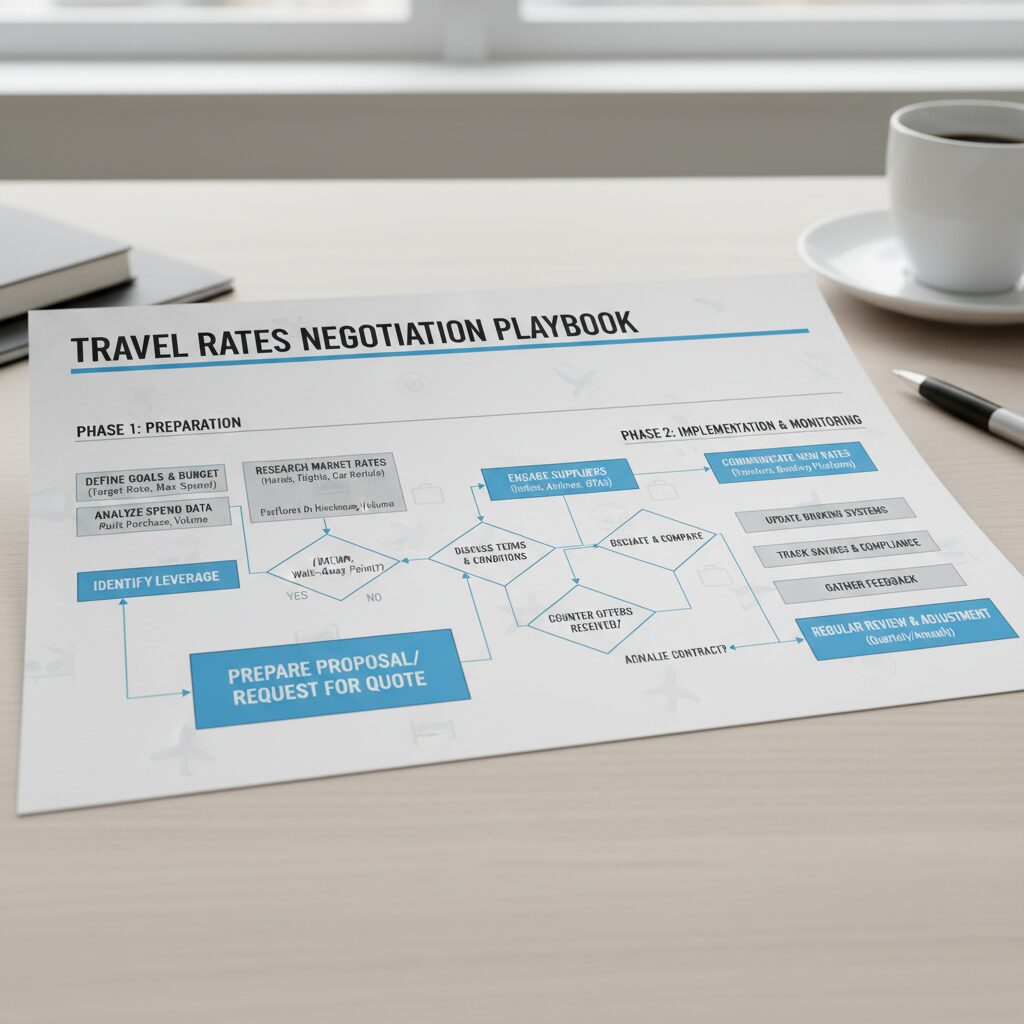
Opening the conversation and building leverage fast (scripts and prep)
What to send before the call
– Executive one-pager: top 5 markets, top 10 properties/routes, one-year spend, proposed tier target.
– Data appendix: monthly room nights or seats by market; adoption assumptions; current BAR vs net rates.
– Procurement terms: desired contract length, audit rights, parity requirement, termination terms.
Outreach script (email + call opener)
Email subject: Request to Discuss Preferred Agreement — [Your Company] Top Markets
Email body (short):
– “Hi [Name], we spend ~$[X] in [market]. We’re starting vendor talks for a preferred program and think [Hotel Group/Airline] is a top fit. Attached is a 2-page summary of our top markets and forecast. Can we book 30 minutes next week to explore a city-level agreement and a pilot?”
Call opener (30 seconds):
– “Thanks for taking this. We want a simple, measurable agreement that drives consistent volume to you and gives us a predictable rate. Our data shows we can deliver [Y] room nights/year in [market]. If you can give us a [Z]% discount during weekdays and some blackout flexibility handling, we’ll commit to a 12-month rolling threshold and drive bookings through your channel. Sound reasonable?”
For more sample scripts and outreach cadences, see negotiation and outreach scripts.
Concrete concession trades and win-win swaps (rate vs. value)
People think negotiation is “lower price only.” In practice, swaps on value, availability, and service often produce larger realized value than a headline rate.
Common concession categories
– Price: percentage off BAR, fixed corporate BAR for a market, or net rate per night.
– Availability: blackout dates limited to specific events/capacity thresholds; guaranteed room blocks.
– Service: complimentary upgrades, breakfast, free Wi‑Fi, late checkout.
– Commercial: marketing co-op, onsite meeting space credits, payment terms.
– Measurement: reporting cadence, audit rights, and rebate mechanisms.
Concession trade examples
– You want a greater discount during weekend stays. Supplier counters with free breakfast and waived resort fees. If your travellers rarely pay for breakfast, insist on an upgrade credit that travelers will use—convert to realized value.
– For airlines, a supplier may refuse a fare class discount but offer a rebate program (e.g., 5% rebate on eligible ticket spend). Model realized rebate in cash-flow vs. immediate fare reduction.
Average savings
– Hotel: industry reports commonly cite achievable negotiated hotel savings in the 7–20% range depending on market, adoption, and baseline rates.
– Airline: savings vary widely; airlines often give smaller upfront discounts but meaningful rebates or preferred inventory access that compound with booking policies.
Concession trade matrix (simple decision tool)
– If supplier resists pure discount → push for: guaranteed availability, waived fees, marketing co-investment, or performance discounts tied to adoption.
– If supplier wants exclusivity → require strict performance SLAs and clawbacks.
Airline-specific levers and caveats
Airline deals are structurally different: fare class control, ticketing rules, minimum annual spend, and rebate mechanics dominate.
Airline levers
– Corporate fare classes vs negotiated contract: decide whether you need a corporate fare code (instant discount) or a rebate program (post-invoice cash-back).
– Minimum annual spend: some airlines require minimums to unlock deeper rebates—only commit if forecast realistic.
– Inventory access: access to premium inventory or preferred seating blocks can be valuable even without deep ticket discounts.
– Fee waivers: waive change or reissue fees, particularly valuable in volatile travel windows.
Caveats
– Rebate realization lag: rebates are often recognized months later and may be contingent on netting against prior chargebacks.
– Interline/partner complexity: multinational travel can trigger partner fares and complicate measurement.
– Post-COVID flexibility: many airlines implemented more flexible change/cancellation terms—these reduce realized cost of changes but may reduce supplier willingness to discount.
Practical tip: model airline deals in two columns — upfront fare delta vs rebate realization over 12 months — and stress-test under 60/80/100% predicted adoption.
Section 3 — Contracts and Risk Management: Clauses to insist on and red lines to avoid
Contracts are where negotiations become durable. Draft clauses that are specific, measurable, and enforceable.
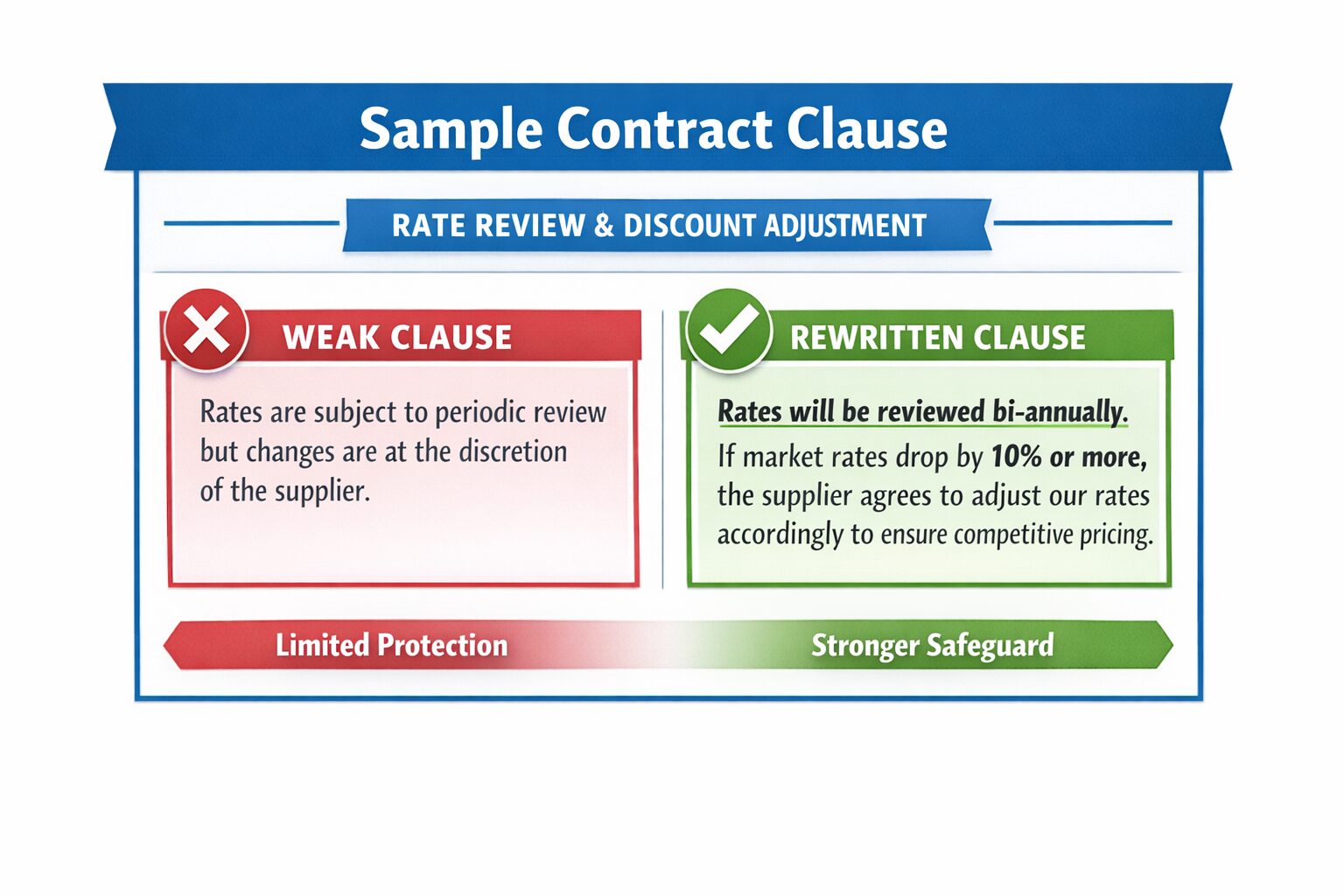
Essential clauses every travel manager must include
Must-have clauses (and suggested wording)
- Rate guarantee & parity
– Suggested: “Supplier guarantees that the net corporate rate provided to Company shall be the lowest publicly available rate for equivalent room type/board on Supplier channels and third-party channels for the same dates. Supplier will notify Company of any lower rate within 5 business days and shall adjust Company billing accordingly.”
– Why: prevents suppliers from undercutting your negotiated rate on OTAs or other channels. - Audit rights
– Suggested: “Company or an agreed third-party auditor shall have the right, upon 10 business days’ notice, to audit Supplier’s records relating to Company bookings during the term and for 12 months thereafter. Supplier shall provide required reports at no charge.”
– Why: ensures you can verify rebate calculations and compliance. - Performance SLAs and remedies
– Suggested SLA: “Availability SLA: Supplier will guarantee a minimum of X rooms on dates specified in the annual plan. Failure to meet SLA results in a penalty credit of $[amount] per missed room-night.”
– Why: ties supplier performance to measurable remediation. - Attrition/cancellation and blackout handling
– Suggested: “Blackout dates limited to city-wide major events and specific dates listed in Schedule A; Supplier shall not apply additional blackout dates without 90-day notice. Attrition: Supplier will allow up to 10% attrition on committed room-blocks; penalty for excess attrition is a 50% refund of prepaid block amount.”
– Why: keeps supplier from stealthily excluding demand. - Termination/exit and clawbacks
– Suggested: “Either party may terminate for cause with 30 days’ cure period. If Supplier materially breaches parity or audit rights, Company may terminate with pro-rata refunds and retention of accrued rebates.” - Force majeure & liability/indemnity
– Make force majeure time-limited and require prompt notice; negotiate mutual indemnity with carve-outs for gross negligence.
Benchmarks: procurement surveys indicate rate parity and audit rights are standard asks but not universally present; include audit rights explicitly rather than assuming them.
Red lines and common trap clauses (and how to rewrite them)
Common traps
– Onerous exclusivity: “Company agrees to book exclusively with Supplier.” Rewrite to “Company will prioritize Supplier for [X]% of its bookings in [defined markets], with exceptions for corporate-approved alternatives.”
– Vague blackout windows: “Supplier may impose blackout dates as needed.” Rewrite to “Blackout dates limited to the schedule in Schedule A and to city-wide events; Supplier must provide 90 days’ notice for any additional blackouts.”
– Rollback clauses: “Supplier may adjust rates downward/increase rates after 6 months.” Rewrite to remove unilateral rate rollback or require mutual agreement.
Short rewrites: include the “what to ask for” and “what suppliers will counter with” annotations—expect counters like shorter notice periods, lower initial discounts, and more limited audit scopes.
Enforcement mechanics: audits, parity monitoring, and penalties
Enforcement process (practical steps)
1. Set audit cadence: quarterly financial reconciliation and an annual third-party audit right.
2. Data feeds: require daily or weekly booking feeds (PNRs, rate codes, booking channel) in CSV or SFTP format to power parity monitoring.
3. Parity monitoring tools: use automated SaaS monitors that crawl OTA rates and compare to your negotiated inventory.
4. Escalation path: 1) raise with supplier account manager; 2) escalate to regional commercial director; 3) invoke financial remediation per contract.
5. Penalties & clawbacks: specify credits per violation (e.g., parity breach equal to 150% of the delta for affected bookings).
Practical enforcement note: audit rights are worthless without data. Require delivery of booking-level records and reconcile monthly to eliminate small leakages before they become large.
For operational rollouts and compliance, consult these implementation and compliance tips.
Section 4 — Measuring Success: KPIs, ROI formulas, and reporting cadence
If it isn’t measured, it doesn’t count. Use clear formulas and a repeatable dashboard to show realized savings.
Core KPIs and sample formulas
Core KPIs
– Negotiated vs public rate delta (%) — shows headline discount.
– Gross savings — sum of (Published avg rate – Negotiated avg rate) × nights/seats.
– Net savings after rebates and program costs — realized cash benefit after rebates, implementation costs, and incentive payouts.
– Adoption rate (%) — bookings made through negotiated channels / total eligible bookings.
– T&E cost per traveler — total T&E spend / active travelers.
Formulas (copy-paste ready)
– Negotiated delta (%) = (Published avg rate – Negotiated avg rate) / Published avg rate × 100
– Gross savings ($) = Σ (Published rate_i – Negotiated rate_i) × Quantity_i
– Net savings ($) = Gross savings + Rebates received + Avoided ancillaries – Program costs (TMC fees, tools, admin)
– Adoption rate (%) = Bookings via negotiated channel / Total eligible bookings × 100
– T&E cost per traveler = Total T&E spend / Number of travelers in period
Example interpretation
– If Published ADR in City B = $200, Negotiated ADR = $176, Negotiated delta = (200–176)/200 = 12% savings.
– If you had 2,000 room nights at that ADR → Gross savings = 24 × 2,000 = $48,000.
Benchmarks and context
– Hotel negotiated savings: commonly 7–20% depending on market and adoption, according to industry case studies.
– Adoption: mature centralized programs often achieve 60–80% adoption; new rollouts typically 30–50% in early months (vendor whitepapers and TMC reports).
For a practical cost-control and ROI mindset, review this guidance.
Sample dashboard and reporting cadence (monthly vs quarterly)
Dashboard widgets (minimum)
– Top-line: Monthly gross and net savings (month-over-month)
– Negotiated delta by city and by property
– Adoption funnel: Total eligible trips → bookings through negotiated channels → realized savings (with targets)
– Top leakers: properties/routes with highest non-compliant bookings
– Rebate accruals vs. realized cash
Reporting cadence
– Monthly: operational dashboard to procurement, travel program manager, and finance — quick hits on adoption, top leakers, and month-to-date savings.
– Quarterly: deeper reconciliation and forecast amendments; include rebate realization and contract performance reviews.
– Annual: contract renewals and strategic supplier scorecards.
Spreadsheet layout (simple)
– Tab 1: Raw bookings (one row per booking)
– Tab 2: Rate comparisons (published vs negotiated)
– Tab 3: Savings calculations (gross/net)
– Tab 4: Dashboards (pivot charts by city, property, channel)
Offer: build your first monthly reconciliation in the first 30 days after go-live to track reality vs. modeled expectations.
Interpreting ROI: payback timelines and rebate realization
Payback timelines vary
– Many negotiated programs show payback on program investment within 3–12 months depending on program scale, whether tools were purchased, and how fast adoption rises. Vendor/TMC case studies indicate early ROI driven by redirecting existing volume rather than new volume generation.
Rebate lag and realized savings
– Rebates often accrue and pay quarterly or semi-annually. Model a conservative realization curve (e.g., 50% of expected rebate recognised after 3 months, full after 6–12 months) to avoid overstating immediate savings.
Practical tip: report both accrued and realized savings and explain timing to finance so rebate-driven programs are not penalized prematurely.
Section 5 — Implementation & Compliance: Driving adoption and avoiding leakage (includes best practices)
Even the best deals fail without behavior change. Implement with a clear playbook and technology stack.
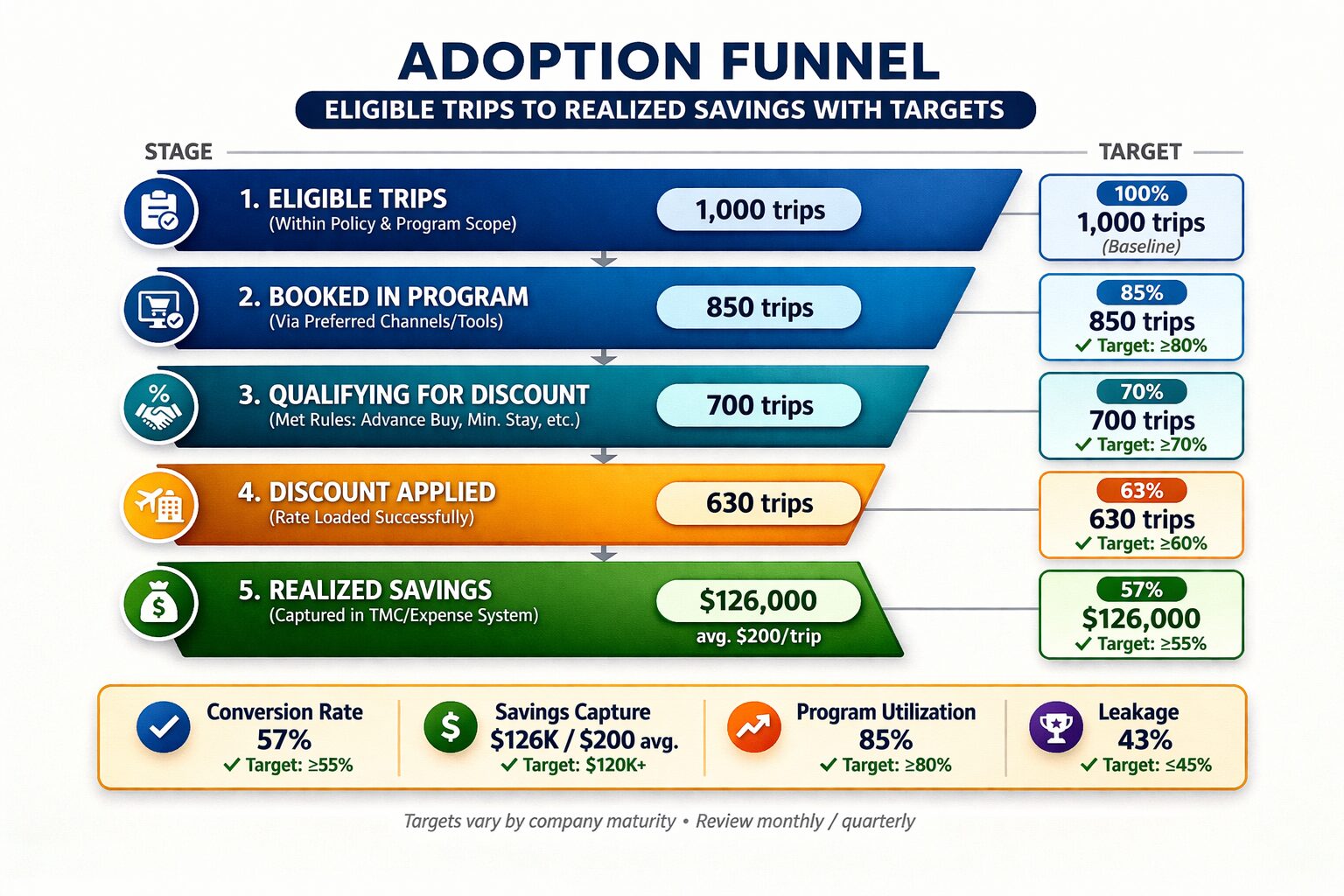
Rollout playbook and internal change management
30–90 day rollout checklist
1. Stakeholder alignment: present deal, KPIs, and enforcement plan to finance, procurement, HR, and executive sponsors.
2. Policy updates: revise travel policy to reflect negotiated channels, preferred properties, and approval thresholds.
3. Booking tool configuration: block unauthorized channels for top markets or require pre-trip approval for non-compliant bookings.
4. Training and comms: short webinars, quick-reference guides, and incentive plan for travel arrangers and frequent travellers.
5. Pilot & iterate: start with top city or business unit, collect feedback, and then scale.
Internal link: For tips on internal rollout and compliance, consult these implementation and compliance tips.
Enforcement best practices and tech stack recommendations (Best practices / key takeaways)
Best practices
1. Automate parity monitoring and get weekly reports — humans can’t crawl every OTA.
2. Require booking-level feeds from suppliers to reconcile rebates and detect leakage.
3. Use supplier scorecards (quarterly) to discuss SLA performance and reset expectations.
4. Incentivize compliance — small monthly perks for high adopters or travel arranger recognition.
5. Lock critical markets in the CBT and require exceptions to be logged and justified.
6. Hold quarterly business reviews with suppliers showing performance and negotiating incremental amendments.
7. Never accept ambiguous blackout language — require specific dates and notice.
Tools recommended
– Corporate Booking Tools (e.g., Concur, Egencia) integrated with TMC reporting.
– Parity monitoring SaaS (several vendors provide OTA crawlers and alerting).
– BI tool or simple spreadsheet for dashboards.
Key takeaways
– Align incentives: procurement wants savings, travel managers want service, travelers want convenience — a negotiated program must bridge all three.
– Build measurable targets: adoption, negotiated delta, and net savings.
– Keep contracts simple, specific, and auditable.
For a vendor-side relationship approach, see vendor relationship management best practices.
Pros and cons of centralized vs decentralized booking models (multiple viewpoints)
Advantages
- Centralized
- Higher adoption and easier enforcement
- Easier reporting and single point of accountability
- Stronger ability to drive volume for discounts
- Decentralized
- Faster local responsiveness and flexibility
- Potential for local rate-shopping that captures lower-cost options in fringe markets
Disadvantages
- Centralized
- Can be slower for last-minute/local booking needs
- Risk of user frustration if system is clunky
- Decentralized
- Higher leakage to OTAs, lower adoption of corporate rates
- Harder to produce consistent reporting and rebates
Practical guidance: hybrid models often work best—centralize policy and top-market bookings while allowing local teams to manage specific exceptions with guardrails and pre-approved vendor lists.
Best Practices (Actionable list)
- Never accept vague blackout language — require a defined list and 90-day notice for changes.
- Require booking-level data feeds and quarterly reconciliations as part of contract deliverables.
- Set realistic tier thresholds from historical data and make thresholds rolling 12-month lookbacks.
- Model airline deals both as upfront discounts and rebate realization scenarios.
- Automate parity monitoring and triage violations weekly.
- Start adoption targets at 30–50% for new programs and aim for 60–80% within 12–18 months.
- Use concession tradeoffs (service + availability) when suppliers resist headline discounts.
- Keep legal clauses simple, measurable, and enforceable — prefer credits to vague remedies.
Frequently Asked Questions
### Q: How much can I realistically save by negotiating hotel and airline rates?
A: Typical hotel savings range from roughly 7–20% depending on market, baseline rates, and adoption. Airline savings are more variable—some programs see moderate upfront discounts plus rebates that increase realized savings. Industry case studies and TMC whitepapers document these ranges; actual results depend on adoption and enforcement.
### Q: What are the most important contract clauses to insist on?
A: Rate guarantees/parity, audit rights, clear attrition/cancellation terms, SLAs with remedies, termination/exit language, and a reasonable force majeure clause. Include explicit timelines and remedies for violations (e.g., credits per parity breach) to make clauses enforceable.
### Q: How do I calculate negotiated rate ROI?
A: Use formulas like Negotiated delta (%) = (Published avg – Negotiated avg) / Published avg, gross savings = delta × volume, and Net savings = Gross savings + Rebates – Program costs. Track monthly and quarterly to account for rebate lag.
### Q: Should I pursue city-level or global hotel rates?
A: City-level is best when spend concentrates heavily in a few markets (you can negotiate deeper local discounts). Global deals are simpler for distributed programs. Choose based on your top 12–20 markets analysis and volume thresholds.
### Q: How do I enforce rate parity and stop leakage to OTAs?
A: Combine contractual parity clauses, automated parity monitoring tools, booking-tool controls, and internal incentives. Use audit rights and a clear escalation path with suppliers to fix violations.
### Q: When negotiating with airlines, what unique levers exist versus hotels?
A: Airlines offer fare-class controls, rebate programs, minimum annual spend, preferred inventory access, and fee waivers. Airline deals often require separate measurement for rebates and may include longer realization timelines.
### Q: What’s a realistic adoption target for a newly negotiated program?
A: Aim for 30–50% adoption at launch and 60–80% in mature centralized programs, per industry benchmarks. Adoption depends on booking controls, communications, and incentives.
Conclusion
Effective negotiated-rate programs combine clean data, smart timing, concrete concession trades, unambiguous contract language, and rigorous measurement. When those pieces are in place, negotiated rates deliver measurable net savings and predictable travel experiences.
Actionable next step: run a 30-day prep sprint — extract your top 12 hotels/routes by spend, calculate current negotiated delta using the formulas above, and schedule outreach to top suppliers in your highest-spend city. Use these negotiation and outreach scripts to structure the first call.
Sources & Further Reading
- GBTA (Global Business Travel Association) — corporate travel spend reports and market trends (https://www.gbta.org/)
- Amadeus and Phocuswright — distribution and booking-channel studies on corporate booking mix (https://amadeus.com/) (https://www.phocuswright.com/)
- BCD Travel / TravelPerk / SAP Concur — negotiated program adoption and savings whitepapers (vendor websites)
- Procurement benchmark reports — contract clause prevalence and audit rights surveys (industry procurement publications)
- Industry news and chain policy pages — post-COVID flexibility updates from major hotel chains and airlines
- Internal papublishing resources:
- Negotiation and outreach scripts: https://www.papublishing.com/cold-calls-i-went-from-nothing-to-120k-year-solo-using-this-process-script-included/
- Vendor relationship management best practices: https://www.papublishing.com/reliable-advertising-and-marketing-guidance-for-social-media-marketing/
- Cost-control and ROI mindset: https://www.papublishing.com/smart-advice-for-your-home-business-success/
- Implementation and compliance tips: https://www.papublishing.com/these-tips-will-help-you-run-your-home-business/