Effective Remote Team Management Tips for Modern Organizations
As distributed work becomes a defining feature of modern organizations, leaders are increasingly expected to coordinate high-performing teams across time zones, cultures, and digital environments. Success in this setting depends on more than providing tools; it requires intentional management practices that sustain clarity, accountability, and engagement at a distance.
The guidance below consolidates remote team management tips that help organizations translate strategy into daily execution. When communication rhythms align with measurable outcomes and psychological safety, managers can reduce friction and improve consistency in remote collaboration. Approaches grounded in organizational behavior and socio-technical systems thinking emphasize that productivity is shaped by both human dynamics and workflow design.
Because informal cues are limited in remote work, structure becomes a substitute for proximity. Clear expectations, reliable feedback loops, and a thoughtful mix of synchronous and asynchronous work protect focus while supporting inclusion. The sections that follow focus on practical actions that strengthen coordination, build trust, and enable teams to deliver results without sacrificing well-being.
Communication Systems and Cadence for Distributed Teams
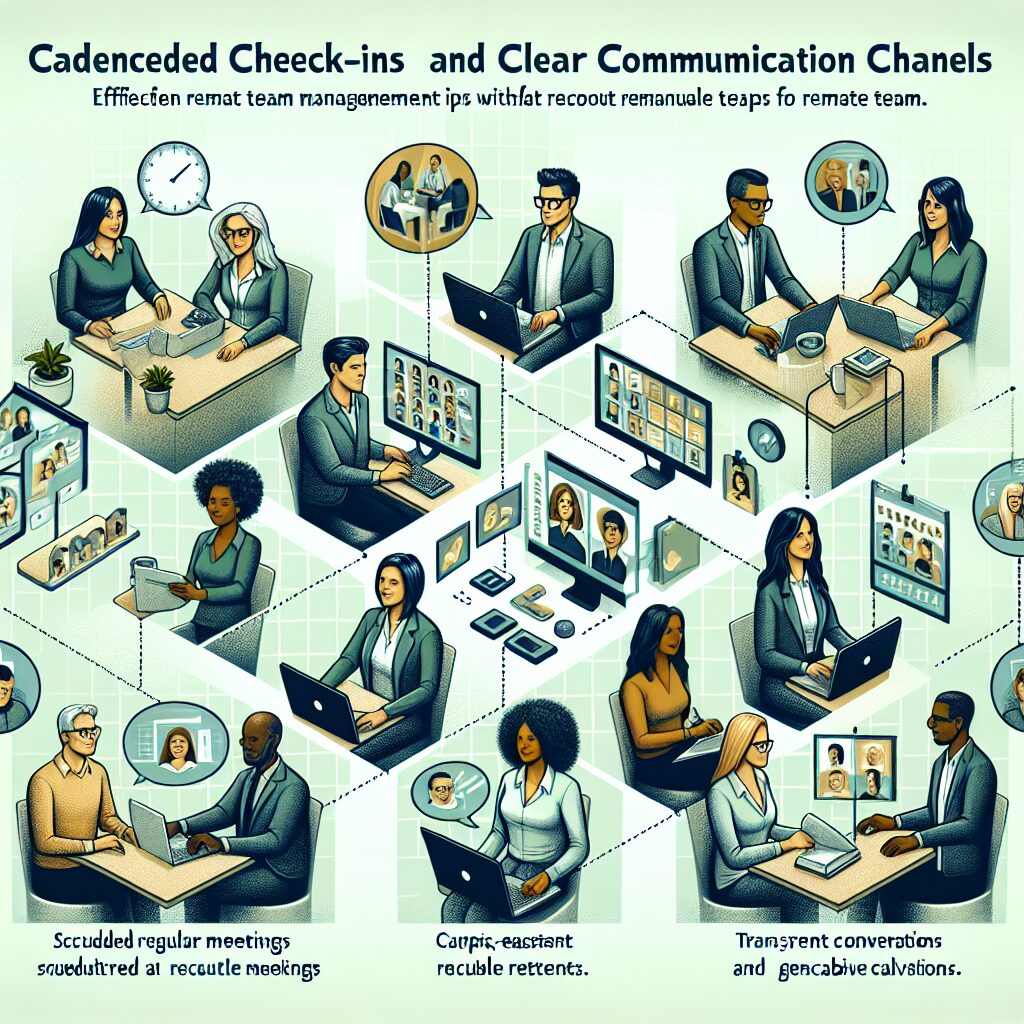
Distributed teams rarely fail due to lack of talent; they struggle when communication lacks an agreed “operating system.” Without hallway context, ambiguity spreads quickly and small gaps become rework. A deliberate cadence—paired with clear channel rules—turns scattered messages into predictable coordination.
Establishing Clear Communication Channels and Response Expectations
Clarity improves when teams define what each channel is for before adding more tools. Assigning channels to intent (urgent, collaborative, archival) and setting response norms helps protect focus without slowing execution.
Create a simple “channel map” to reduce cross-posting and anxiety-driven checking. Separating real-time escalation from decision-making and knowledge storage keeps work from disappearing into chat history. The Microsoft Work Trend Index notes increased meeting and message volume for many knowledge workers, which makes boundaries and norms a productivity issue—not a preference.
- Chat: quick clarifications, lightweight coordination, and time-sensitive issues (define what counts as “urgent”).
- Email: external communication, formal approvals, or sensitive threads requiring a durable trail.
- Project tool (Jira/Asana/Linear): tasks, owners, due dates, and status updates—your single source of truth for execution.
- Docs/Wiki: decisions, specs, playbooks, and onboarding materials (not “FYI” chat links alone).
Make response-time norms explicit and role-aware. Defining expected response windows (e.g., 2 hours for time-critical incidents, 24 hours for non-urgent questions) while protecting “focus blocks” reduces the pressure to stay perpetually available. When leaders model these behaviors—through scheduled sends and clear status messages—teams gain permission to work deeply without sacrificing reliability.
Running Effective Virtual Meetings and Asynchronous Updates
Even with strong channel discipline, some work still benefits from real-time alignment. Meetings become more effective when they are treated as a scarce resource, while asynchronous updates carry routine coordination without forcing overlapping hours.
Design virtual meetings around outcomes, not airtime. Use decision questions (e.g., “Which option do we ship?”) instead of open-ended agendas, and assign roles—facilitator, timekeeper, and note-taker—so the session produces a clear artifact. Sharing a short pre-read 24 hours in advance shifts cognitive load out of the call and improves participation across time zones.
To reduce recurring status calls, standardize asynchronous updates in a project tool or a dedicated update channel. An “O3” format (Objectives, Obstacles, Outcomes) keeps progress measurable and comparable across functions.
- Objectives: top priorities for the next 5 working days.
- Obstacles: what is blocked, by whom, and the requested action.
- Outcomes: what shipped/closed, tied to metrics or customer impact.
“The most important thing in communication is hearing what isn’t said.” — Peter F. Drucker
To cover what “isn’t said” in async work, embed short feedback loops: emoji reactions for acknowledgment, threaded questions for clarity, and a standing “decision review” slot for unresolved trade-offs. Used consistently, these practices reduce rework without adding meetings back in.
Documentation Standards to Reduce Misalignment
In distributed environments, memory becomes a fragile dependency and context can vanish between time zones. Lightweight documentation standards make decisions durable, clarify ownership, and prevent the same debates from repeating—especially when people join midstream.
As a rule of thumb, decisions that affect timeline, scope, cost, or customer experience deserve a written record. Keep documentation structured but minimal. Many organizations use Decision Records (often called ADRs in engineering) to capture context, options considered, and the chosen path in a consistent format.
- Document owner and last updated date (so accountability is visible).
- Purpose and non-goals (what the work will not address).
- Decision plus rationale and trade-offs.
- Dependencies, risks, and rollback/contingency notes.
Discoverability matters as much as content. Naming conventions, agreed locations, and a default expectation that links live in the project system—not only in chat—make knowledge easier to retrieve. Strong documentation hygiene supports transactive memory (knowing who knows what) and reduces “single points of knowledge,” a common hidden bottleneck in distributed teams.
Remote Team Management Tips for Goal Setting and Performance Alignment
Once communication is reliable, misalignment usually shows up in priorities and follow-through. Remote teams can stay busy while outcomes drift if goals are not measurable and ownership is unclear. This section focuses on turning plans into visible commitments so progress is trackable and performance conversations feel fair rather than subjective.
Defining Objectives, Key Results, and Role Accountability
Goals only become useful when they translate into day-to-day ownership. Aligning objectives to measurable outcomes—while clarifying roles and decision rights—supports execution across time zones without sliding into micromanagement.
Well-formed objectives describe direction; key results define evidence. Pair each objective with 2–4 measurable key results that are time-bound and auditable (numbers, dates, or customer-impact signals). The Google re:Work guidance on OKRs emphasizes outcomes rather than tasks—especially important when leaders cannot “see” effort in a shared office.
- Objective: Improve trial-to-paid conversion for Product X this quarter.
- Key result: Increase conversion from 7.5% to 9.0% by end of Q2.
- Key result: Reduce onboarding drop-off at step 3 from 28% to 18%.
- Key result: Ship two onboarding experiments with documented learnings.
To reduce parallel work and hidden bottlenecks, clarify accountability with a lightweight RACI (Responsible, Accountable, Consulted, Informed) or a “DRI” (Directly Responsible Individual) convention. Reinforce it with explicit decision boundaries—what can be approved independently versus what requires review—so execution does not stall when managers are offline.
Performance Reviews, Feedback Loops, and Coaching at a Distance
When performance signals are mostly digital, evaluation can drift toward visibility bias, where the most vocal person appears most productive. Building evidence-based reviews and short feedback loops reduces subjectivity and improves coaching outcomes in asynchronous environments.
Separate “impact” from “activity” in review inputs. Use artifacts remote teams already produce: shipped deliverables, metrics movement, incident notes, decision records, customer feedback, and documented cross-functional contributions. A consistent rubric lowers perceptions of favoritism and supports procedural justice, which is closely tied to employee acceptance of decisions.
More frequent check-ins usually outperform annual formality. Monthly or biweekly conversations focused on one growth theme tighten behavior-to-feedback loops and reduce surprise at review time. Coaching also improves when managers ask for self-assessment first (“What would you repeat? What would you change?”) and then add specific observations connected to outcomes.
- Use “SBI” feedback: Situation–Behavior–Impact, anchored to observable facts.
- Balance recognition with calibration: name the contribution, then clarify the bar.
- Document agreements: a short recap note prevents misremembered expectations.
“Feedback is the breakfast of champions.” — Ken Blanchard
Managing Workload, Prioritization, and Cross-Functional Dependencies
Alignment can still fail when capacity is overcommitted or dependencies remain invisible. Sustainable delivery requires realistic planning, transparent trade-offs, and coordination that does not rely on hallway reminders.
Plan with capacity as a constraint rather than a guess. Setting explicit WIP limits (work in progress) and reserving a buffer for interrupts—incidents, stakeholder changes, or review cycles—reduces chronic overload. Teams that track cycle time and throughput can forecast more reliably than teams that rely on optimism; Little’s Law offers a simple lens: as WIP rises, cycle time tends to rise as well.
Trade-offs become easier when prioritization is explicit. Use a shared framework (e.g., impact vs. effort, or risk-reduction value) and require a short rationale for “top 3” items. For cross-functional work, capture dependencies directly in the project system—who delivers what, by when, and what happens if it slips—so progress does not depend on synchronous reminders.
- Dependency handshake: request, owner, due date, acceptance criteria, and escalation path.
- Milestone-based checkpoints: align on intermediate outputs, not just final deadlines.
- Service-level expectations: clarify response windows between functions (e.g., design reviews in 3 business days).
With communication and goals in place, these practices keep performance alignment grounded in shared evidence and realistic capacity—so distributed teams move faster with fewer surprises.
Building Culture, Trust, and Engagement Across Time Zones
Operational structure alone does not guarantee cohesion when people rarely share the same “now.” As distance grows, assumptions can harden, misunderstandings can linger, and motivation can quietly erode. This section focuses on the human system behind execution: trust, engagement, and repairing tension without relying on proximity.
Psychological Safety, Inclusion Practices, and Team Norms
High performance across time zones depends on whether teammates feel safe to surface problems early and disagree respectfully. Inclusive participation and explicit norms prevent “whoever is online” from dominating decisions.
Build psychological safety by making expectations about voice and risk explicit. Research by Amy Edmondson (Harvard Business School) links psychological safety to learning behaviors such as asking for help and reporting errors—signals that matter more when issues cannot be spotted in person. Managers can normalize candor by sharing their own small mistakes and rewarding early escalation rather than last-minute heroics.
- “No blame” incident reviews: focus on contributing factors and safeguards, not personal fault.
- Red-team moments: assign one person to stress-test a plan so dissent is a role, not a risk.
- Two-way agendas: invite questions in advance to reduce the advantage of fast speakers.
Inclusion also requires structural choices. Rotating meeting times across regions, defaulting to written pre-reads, and using “silent start” discussions (5 minutes of reading before debate) broadens participation for non-native speakers and reflective thinkers. Treat team norms like product requirements: document them, test them, and revise them when they stop working.
“The greatest danger in times of turbulence is not the turbulence—it is to act with yesterday’s logic.” — Peter F. Drucker
Recognition, Motivation, and Retention in Remote Environments
Remote engagement rarely drops because people do not care; it declines when effort feels unseen. Recognition systems that are fair and specific help sustain motivation and reduce avoidable attrition, especially for employees far from headquarters.
Effective recognition is specific, timely, and tied to impact. Public praise in a team channel works best when it names the behavior (“unblocked a dependency in 24 hours”) and the outcome (“reduced cycle time”). To reduce proximity bias, systematize recognition through a rotating “wins roundup” in weekly updates and a lightweight peer-nomination form that prompts for evidence.
- Impact receipts: short write-ups linking work to metrics, customer quotes, or risk reduced.
- Credit mapping: explicitly acknowledge behind-the-scenes roles (QA, ops, enablement).
- Career visibility: publish promotion criteria and examples of “good” at each level.
Retention improves when teams manage energy as carefully as tasks. Gallup research on engagement connects engagement to performance and reduced turnover; in remote settings, the levers often include autonomy and growth. Protect “maker time” blocks, support internal mobility, and ensure each employee has a development plan with one measurable skill target per quarter.
Watch for early signals of drift—fewer comments in docs, delayed replies, or missed check-ins. Responding with curiosity (“What’s changed?”) before performance narratives form remains one of the most effective remote team management tips for sustaining engagement.
Conflict Resolution and Difficult Conversations in Virtual Settings
Distance can turn small friction into lasting resentment because tone is easier to misread and repair attempts are delayed. Addressing tension early—and choosing the right medium—protects both relationships and decisions.
Match channel to complexity: sensitive topics should move from text to voice or video, while factual alignment can stay in writing. The rule of thumb is “interpretation needs conversation”—if you notice yourself assigning intent (“they’re blocking me”), schedule a short call. During discussion, separate content (the issue) from process (how you work together) so both are addressed.
- Use a shared frame: “What problem are we solving, and what constraints are real?”
- State observations: facts first, then impact, then request (avoid mind-reading).
- Agree on a next step: owner, deadline, and how you’ll confirm resolution.
Time-zone gaps can amplify heat when responses lag. A predictable escalation path helps: a 1:1 attempt, then a mediated triad with a manager, followed by a written decision record if needed. If writing is necessary, keep messages short, avoid sarcasm, and invite correction directly: “If I’m missing context, please point it out.”
“Seek first to understand, then to be understood.” — Stephen R. Covey
Handled early, conflict becomes a source of clarity rather than churn; handled late, it becomes attrition risk.
Remote Team Management Tips for Tools, Security, and Operational Excellence
Even cohesive teams can miss deadlines when the system creates friction. As norms and feedback mature, performance increasingly depends on the toolchain and the operational guardrails behind it. This section focuses on standardizing workflows, protecting data, and building improvement loops that hold up through growth and turnover.
Selecting Collaboration Tools and Standardizing Workflows
Tools are not neutral; they shape how fast work moves, how easily context is found, and how consistently teams execute. Choosing a cohesive ecosystem—and then standardizing workflows—keeps execution from depending on tribal knowledge.
Instead of adopting “best-in-class” for every niche, many organizations benefit from a cohesive tool ecosystem that reduces context switching. Evaluate platforms with a simple scorecard: integration depth (SSO, APIs), auditability, offline access, and time-zone friendliness (async comments, notifications). Limiting “systems of record” to one per category—one for tasks, one for docs, one for chat—also reduces debates about where truth lives.
Standardization should feel like a productivity gain, not bureaucracy. Templates and workflow defaults help new hires contribute faster and reduce variation across functions. A shared “launch checklist” in the project tool, paired with a lightweight “definition of done,” prevents recurring misses (QA skipped, enablement forgotten, analytics not instrumented).
- Workflow conventions: statuses, WIP limits, and required fields (owner, due date, risk).
- Templates: PRD/spec, meeting notes, incident report, and decision record.
- Automation: routing approvals, nudging stale tasks, and posting release notes to a changelog.
To keep conventions current, appoint a rotating tool steward each quarter to collect pain points, retire redundant apps, and adjust standards after reorganizations.
Data Protection, Access Controls, and Compliance Requirements
Security breakdowns in distributed work often start as convenience choices: shared passwords, personal devices, or “anyone with the link” documents. Practical controls around identity, access, and data handling protect the organization without grinding collaboration to a halt.
Start by treating identity as the perimeter. Enforce single sign-on and multi-factor authentication across core tools, and centralize joiner/mover/leaver workflows so access is removed quickly when roles change. The Verizon Data Breach Investigations Report highlights credential misuse as a persistent breach pattern, making strong authentication and rapid deprovisioning especially high leverage.
From there, apply least-privilege access through role-based groups and periodic reviews, particularly for finance, HR, and production systems. Where compliance applies (e.g., GDPR, HIPAA, SOC 2), translate policy into concrete behaviors: where customer data may be stored, how long artifacts are retained, and which channels are prohibited for sensitive information.
- Classification labels: public, internal, confidential, regulated—mapped to storage rules.
- Device standards: disk encryption, patching SLAs, and remote wipe for lost endpoints.
- Secure sharing defaults: expiring links, domain restrictions, and watermarking for exports.
“You can’t protect what you don’t know you have.” — Ann Cavoukian
Risk reduction is easier to sustain when secure alternatives are readily available: approved password managers, sanctioned file transfer, and pre-built “secure workspace” folders with correct permissions.
Continuous Improvement Through Metrics, Retrospectives, and Process Audits
Operational excellence is not a one-time rollout; it is a repeatable learning habit. A small set of metrics, consistent retrospectives, and occasional audits help teams spot bottlenecks early without turning improvement into blame.
Choose signals that reflect flow and quality. In product and engineering teams, DORA metrics (deployment frequency, lead time for changes, change failure rate, time to restore) are widely used; the DORA research program links these measures to organizational performance. For non-technical teams, parallel indicators include request turnaround time, rework rate, stakeholder satisfaction, and backlog aging.
- Flow: cycle time, blocked-time percentage, and WIP by person/team.
- Quality: defect escape rate, incident recurrence, and review rejection reasons.
- Reliability: on-time delivery rate and dependency SLA adherence.
Retrospectives create value when observations become commitments. Use a consistent format (what helped, what hurt, what to try), then track actions as real tasks with owners and dates. Limiting each retro to one process change and one tooling tweak keeps improvements small enough to complete before the next cycle and clear enough to evaluate.
When process drift appears, lightweight audits restore clarity. Quarterly checks of permissions, documentation freshness (last-updated dates), and workflow adherence can reveal systemic gaps, especially after hiring bursts. The objective is operational hygiene, not policing, so distributed execution remains resilient as the organization scales.
Leading Distributed Teams with Clarity, Trust, and Operational Discipline
Effective remote management comes down to designing conditions where good work is the default. With clear communication routes, measurable commitments, and inclusive norms, teams spend less energy interpreting uncertainty and more energy executing. Supported by secure, standardized workflows and steady improvement loops, distributed organizations can deliver results with consistency and resilience.
Bibliography
Amy C. Edmondson. “Amy Edmondson.” Harvard Business School Faculty & Research. Accessed March 10, 2026. https://www.hbs.edu/faculty/Pages/profile.aspx?facId=6451.
DORA. “DORA Research: The State of DevOps.” Accessed March 10, 2026. https://dora.dev/research/.
Gallup. “State of the Global Workplace: Employee Engagement Drives Growth.” Accessed March 10, 2026. https://www.gallup.com/workplace/236441/employee-engagement-drives-growth.aspx.
Google re:Work. “Set Goals with OKRs.” Accessed March 10, 2026. https://rework.withgoogle.com/guides/set-goals-with-okrs/.
Microsoft. “Work Trend Index.” Accessed March 10, 2026. https://www.microsoft.com/en-us/worklab/work-trend-index.
Verizon. “2024 Data Breach Investigations Report (DBIR).” Accessed March 10, 2026. https://www.verizon.com/business/resources/reports/dbir/.