20+ Proven Small Business Marketing Strategy for Beginners
Small Business Marketing Strategy: A Practical Guide for Beginners
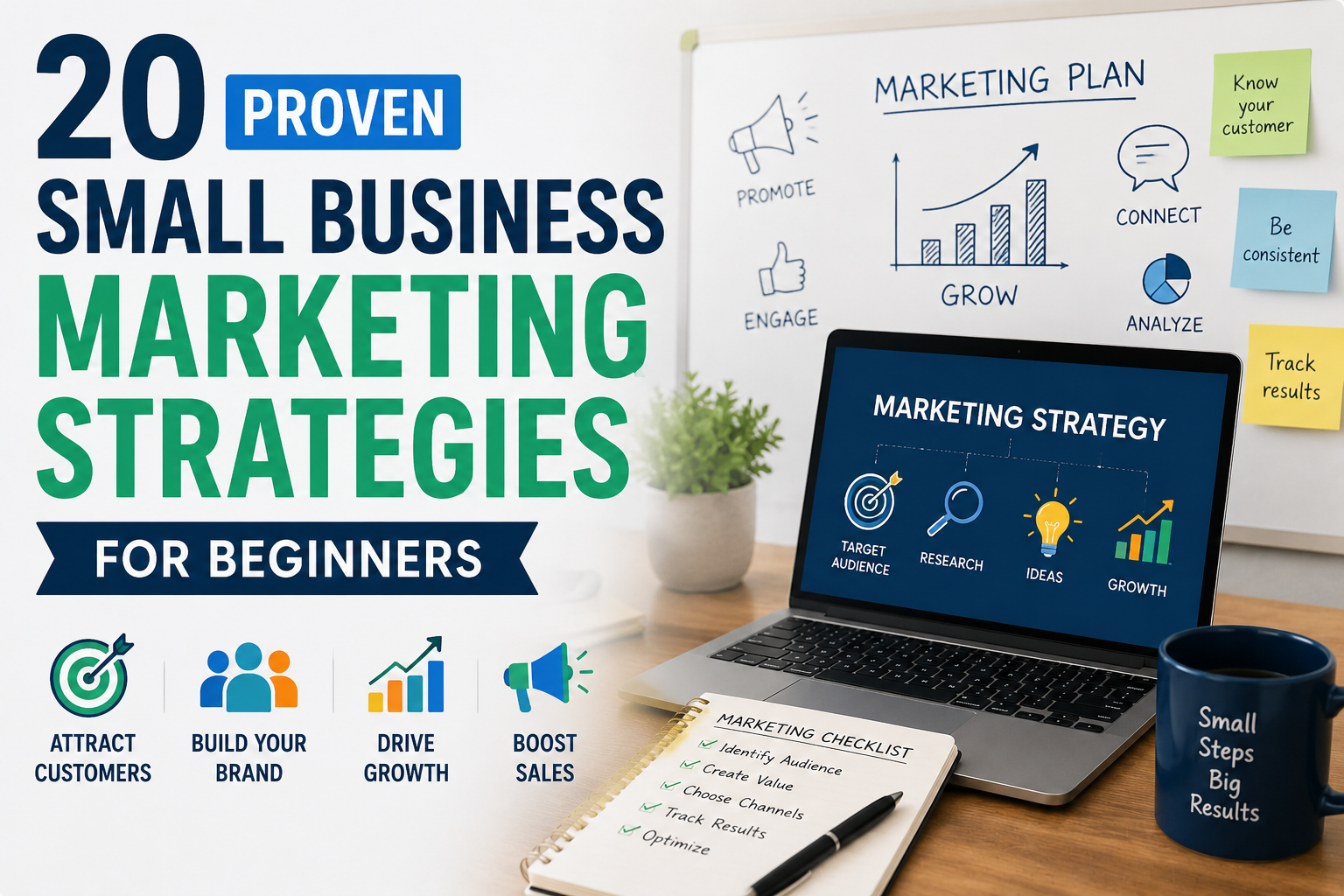
Starting a small business and then turning it into a brand is no easy feat. You have a limited budget, growing competition, and countless responsibilities. That’s why you should have a small business marketing strategy to stand out. Statistics show that 75% of U.S. small businesses use at least two marketing channels to promote their products and services. But how do you build a marketing strategy that actually works for your business? Let’s find out!
Local SEO Checklist for Small Business Owners

As a local small business, your most valuable, high-converting customers are people searching near you right now. Even 86% of people look up local businesses on Google Maps before deciding to visit. So, whether you run a salon, plumbing service, or a dental clinic, you should focus on the following local SEO checklist:
Set Up Google Business Profile
One local small business marketing strategy is to set up your Google Business Profile. It’s a free tool or service that offers businesses an amazing opportunity to list their business in Local Search results and Google Maps. With a GBP, you see increased traffic and overall credibility. Statistics show customers are 70% more likely to visit a business with a business profile.
Implement Local Business Schema Markup
Local schema business markup is a structured data or code that’s added to a website to help search engines understand and rank your small business. It includes your name, address, phone number, hours, and what customers say about your services.
So if you have a low star rating but genuine reviews, you’ll be ahead of business with a perfect score but barely any reviews.
Optimize Your Web Page Content
To rank in Google’s “map pack” and attract nearby customers, another small-business marketing strategy is to optimize web content. For instance, you need to incorporate geo-specific terms in your blog posts, titles, and other headers. Create unique landing pages for each city, as well as write content about local events and sponsorships.
Build Local Backlinks
Well, local SEO isn’t just about your website; it’s also about who’s discussing your services. Yes, it’s true! When a local business mentions you, it not only reinforces your credibility but also signals to search engines that you are a trustworthy part of that local area.
So, list your business on Yelp and the Chamber of Commerce, sponsor local events, and do guest blogging for local news outlets.
How to Set Up and Optimize a Google Business Profile?
To set up and optimize your Google Business Profile, you have to claim your listing at Google.com/business and fill out the necessary information. Here’s an overview of the step-by-step process:
- Go to Google Business Profile, click Create Account > To Manage My Business.
- Often, your business already has a profile on Google. Simply go to business.google.com/create, enter the business name into the search bar to see if an existing profile appears. Select it from the drop-down.
- Add or update your business name and select your business category.
- Next, add your location to make it easy for customers to find you.
- Put in your Service Area and Contact Information.
- Follow on-screen prompts to complete setting up your Google My Business Profile.
- Now that you’ve added all the necessary details, choose whether to verify it now or later. Select the verification method from available options, including phone, email, video recording, live video call, and mail.
How to Optimize Google My Business Profile?
Once you’ve completed the Google My Business Profile, you should follow the given tips to optimize it:
- Make sure to choose a primary category and up to 9 subcategories. Don’t overstuff and only add categories that match your business. For example, the main category is Employment Agency, with subs including Temporary Employment Agency, Recruitment Agency, Payroll Service, and other relevant ones.
- Fill the services section carefully, as it’s an important part of SEO. Add all your services and use real, user-intent-based keywords throughout the copy.
- Make the most out of your description option. You get 750 characters; use them well to tell about your business, what you do, and where you do it.
- Encourage your clients to leave reviews of your service and the location.
- Post your team and facility photos, and post regularly on Google My Business Profile to stay relevant.
Email Marketing Basics: Building Your First List

Email marketing is a digital small business marketing strategy where you send emails to connect with customers. It’s quite common, as 63% of marketers globally use email marketing. Let’s discuss the basics of email marketing and how you can build your first list:
Create a Dedicated Landing Page
Make a visually appealing landing page that allows visitors to subscribe to your email list. Put a pop-up prompt that appears as soon as someone opens your page and is hard to ignore.
Offer Incentives
Offer customers unique discounts and exclusive content when they sign up for your newsletter. A 10% off on your next purchase or access to the premium collection can get you the desired emails.
Create an Online Competition
Another exciting way to get email addresses is to create an online competition on social media using platforms like Wazoku or ShortStack. To participate, customers will have to share their email addresses, building your first-ever email list.
Segment Your Customers
Know that not all of your customers are the same, and they shouldn’t get the same messages either. Segment them by spending, interests, and demographics, then send tailored emails. Segmented email campaigns have an open rate that is around 14.32% higher than non-segmented campaigns.
How to Write Blog Posts That Actually Rank on Google?
To write blog posts that actually rank on Google, you need to prioritize user intent and optimize for SEO. The following are the tips that help you in writing a high-quality blog post:
Do Research
Start by searching relevant topics for your small business niche. You can use tools like AnswerThePublic or put yourself in the customer’s shoes to generate good suggestions. After that, find keywords related to that topic to see if people are actively searching for it or if it has the potential to rank.
Have a Clear Structure
Search engines love well-structured content as it’s easy to scan and crawl. Therefore, you must maintain a clear structure in your blog, such as:
- Use H1 for your title.
- Divide sections into H2s and supporting points in H3s.
- Keep paragraphs short and easily skimmable.
- Use bullet points wherever necessary to maximize engagement.
Create Catchy Titles
The title of the blog is the first thing your readers will see. So, another small-business marketing strategy is to create catchy titles that immediately make people click. It should be short, have your main keyword, and address user intent.
Use SEO-Friendly URLs
Don’t rely on clunky, auto-generated URLs; rather, aim for something simple and direct, like yourdomain.com/top-5-video-games-in-2026. Keep the blog URL lowercase and use hyphens to improve overall readability.
Place Internal and External Links
Also, place internal and external links in your blog. Internal links keep your audience engaged for as long as they sift through your various pages. While credible external links signal to search engines that your content is high-quality, maximizing your ranking chances.
Social Media Marketing on a Small Business Budget
Social media marketing refers to the use of Instagram, Facebook, LinkedIn, and TikTok to build your brand and increase sales. 92% of businesses utilize social media for marketing, and 78% of marketers say it has increased brand recognition. However, if you have a small budget for this small business marketing strategy, here are the suggestions that can save your day:
Use Free Social Media Tools
You might think all social media marketing tools are expensive, but some are actually free. For instance, you can use Hootsuite and Buffer to schedule and manage social media posts and access detailed analytics. You can access free tutorials and engage with the user community to learn how to use them efficiently.
Focus More on Organic Reach
While you can run ads to get customers, it’s suggested to focus more on organic reach. Regularly post engaging, high-quality content and respond to customer comments instantly. Participate in conversations and update accordingly based on feedback to show that you truly care about your prospects.
Rely on User-Generated Content
If you are a small business on a budget, you can also leverage user-generated content. It’s way more inexpensive compared to hiring a professional and builds trust.
All you have to do is ask your customers to share their experiences with your products via pictures or videos using a unique hashtag. A recent study found that 84% of people are more likely to trust a brand that uses user-generated content (UGC) in its marketing.
Partner with Influencers
Another small business marketing strategy to excel on social media platforms is to collaborate with micro-influencers. Find influencers whose voices resonate with your brand and have them share your products in exchange for an authentic product review.
How to Create a Marketing Plan for a Small Business?
Your small business strategy isn’t just a one-step solution; it involves defining your audience and goals, selecting the right channels, and measuring and maximizing success. Let’s discuss how you can create a marketing plan for a startup in detail:
Analyze Your Current Strategy
Before you establish a new startup strategy, analyze all your existing marketing strengths and weaknesses. Make a list of the channels you are already using and what results they are offering.
Find Your Target Audience
Who is your ideal target audience? Carefully evaluate the problems your products are solving and who can benefit from them. Understand their age, interests, salary, and location to create marketing campaigns accordingly.
Have a Clear Budget
A small business marketing strategy shouldn’t take up your whole budget and funds, as it can push your business into losses. Rather, allocate a particular monthly budget for it and divide it wisely among social media, paid ads, and email marketing.
Identify Key Touch Points
You should identify the customer’s key touchpoints, where they are most likely to interact with your business, social media, or website. Then, create dedicated, SEO-friendly content that drives brand awareness and enhances revenue.
Best Low-Cost Marketing Ideas for Small Businesses
Having a top-notch small business marketing strategy often requires extensive budget and resources. Nonetheless, the following low-cost marketing ideas can help promote your business effectively without spending a fortune:
Create Short Form Video Content
Do you know the average attention span of a human adult is only 8.25 seconds? Hence, a budget-friendly small business marketing strategy is to make short-form video content. Post reels of your products and behind-the-scenes content on Instagram, YouTube, or TikTok to gain quick visibility.
Start an Email Newsletter
Email marketing is another affordable small business marketing strategy. You can share blogs, discounts, and business updates with your customers to encourage repeat business.
Get Positive Reviews
Request that your satisfied customers leave positive reviews of your products or services on your website and other platforms. This improves your credibility and ranking, urging people to invest in your offerings.
Use Referral Marketing
Word-of-mouth marketing is inexpensive yet very effective. You can offer rewards and freebies to your existing customers for becoming your referrals and asking others to try your products.
Print Business Cards
Digital marketing indeed has all the buzz, but that doesn’t mean traditional methods don’t work anymore. Get your business cards printed and distribute them in areas where your services are in demand to increase traffic.
Host a Giveaway
If you struggle to get engagement, all you have to do is host a giveaway on your social media channels and see the magic. Encourage people to participate by asking their friends to follow or sign up, and give away free products in return.
How to Easily Track and Measure Your Marketing Results?
Having a small business marketing strategy is great, but you shouldn’t overlook the results it offers. Here are a few tips and metrics that help you track your marketing progress:
Monitor Website Traffic
Carefully monitor your website traffic by tracking visitor behavior, user engagement, and traffic sources. Tools like Google Analytics and Google Search Console are quite helpful in this regard.
Track Conversion Rate
To track your conversion rate, divide the number of visitors who took a desired action by the total number of visitors, then multiply by 100. Hotjar, Amplitude, and Mixpanel are platforms that provide insights into your conversion rate.
Measure Social Media Engagement
Measuring social media engagement involves tracking content likes, comments, saves, shares, and clicks across different channels.
The formula for this is (Total engagement ÷ Impressions) × 100. Use Sprout Social, Hootsuite, or Btandwatch to get detailed analytics.
Benefits of a Small Business Marketing Strategy
Now that you are aware of how to create a small business marketing strategy and measure its success, let’s get into the details of the benefits marketing offers to your business:
Improves Brand Recognition
You start a business, and without proper marketing, it cannot become a brand. So one of the benefits of a marketing strategy is that it improves brand recognition. Consistent messaging, targeted campaigns, and engaging content enhance visibility and build trust in your business.
Increase Lead Generation and Conversions
With a small business marketing strategy, you can attract prospects and guide them through the sales funnel. You rely on data-driven content and messaging that aligns better with the target audience, boosting the chances of viewers turning into loyal customers.
Promote Data-Driven Decision Making
Marketing strategies also have set key performance indicators (KPIs) to track and evaluate your campaign’s effectiveness. The data-based insights enable you to tweak your marketing efforts and eliminate ineffective tactics for better results.
FAQs
What are the key elements of a small business marketing strategy?
The key elements of a small business marketing strategy include identifying the target audience, having clear goals, choosing suitable channels, and managing your budget.
How can a small business create a marketing budget?
Small businesses can easily create a marketing budget by allocating a percentage of projected revenue to marketing activities and focusing on high-performing channels like social media and email marketing.
How often should a small business post on social media?
Small businesses should post 3 to 5 times a week to see faster growth and stronger audience interaction. However, it can change depending on your target customers and business type.
How long does it take to see marketing results?
To see marketing results, you have to wait 3 to 6 months based on the amount of work the brand needs.
What are some common small business marketing mistakes?
Common small business marketing mistakes include failing to define a clear target audience, not having a clear, mobile-friendly website, and ignoring SEO. In addition, it includes inconsistent branding, ignoring customer feedback, and overspending.
Conclusion
It’s a must to have a small business marketing strategy if you want to stand out from competitors. However, don’t spend aggressively at the start; rather, wait to see results and scale the marketing budget with increasing business revenue.