
Practical Guide to Cloud License Audits: Prepare, Negotiate, and Reduce Risk
Vendor audits are no longer occasional — industry surveys put the annual chance of receiving a licensing notice in the same order of magnitude as one-in-four to one-in-three organizations, and cloud complexity multiplies exposure. In short: if your estate runs SaaS, multitenant platforms, or cloud VMs, assume an audit is possible and prepare for it.
What you’ll learn
– Immediate actions to take on receipt of an audit letter (72‑hour checklist).
– A step‑by‑step, cloud‑specific preparation checklist and evidence package format.
– A response timeline template and negotiation levers you can use to limit scope and cost.
– How to collect, validate, and present cloud entitlement evidence.
– Post‑audit controls (automation, contract language, governance) to reduce future exposure.
Cloud license audit preparation, responding to a licensing audit letter, audit risk reduction checklist.
72-Hour Audit Response
Immediate Response First 72 Hours
The first three days decide whether you manage the audit or the audit manages you. Triage fast, assign clear owners, and preserve source‑of‑truth evidence before accidental changes or automated processes alter usage.
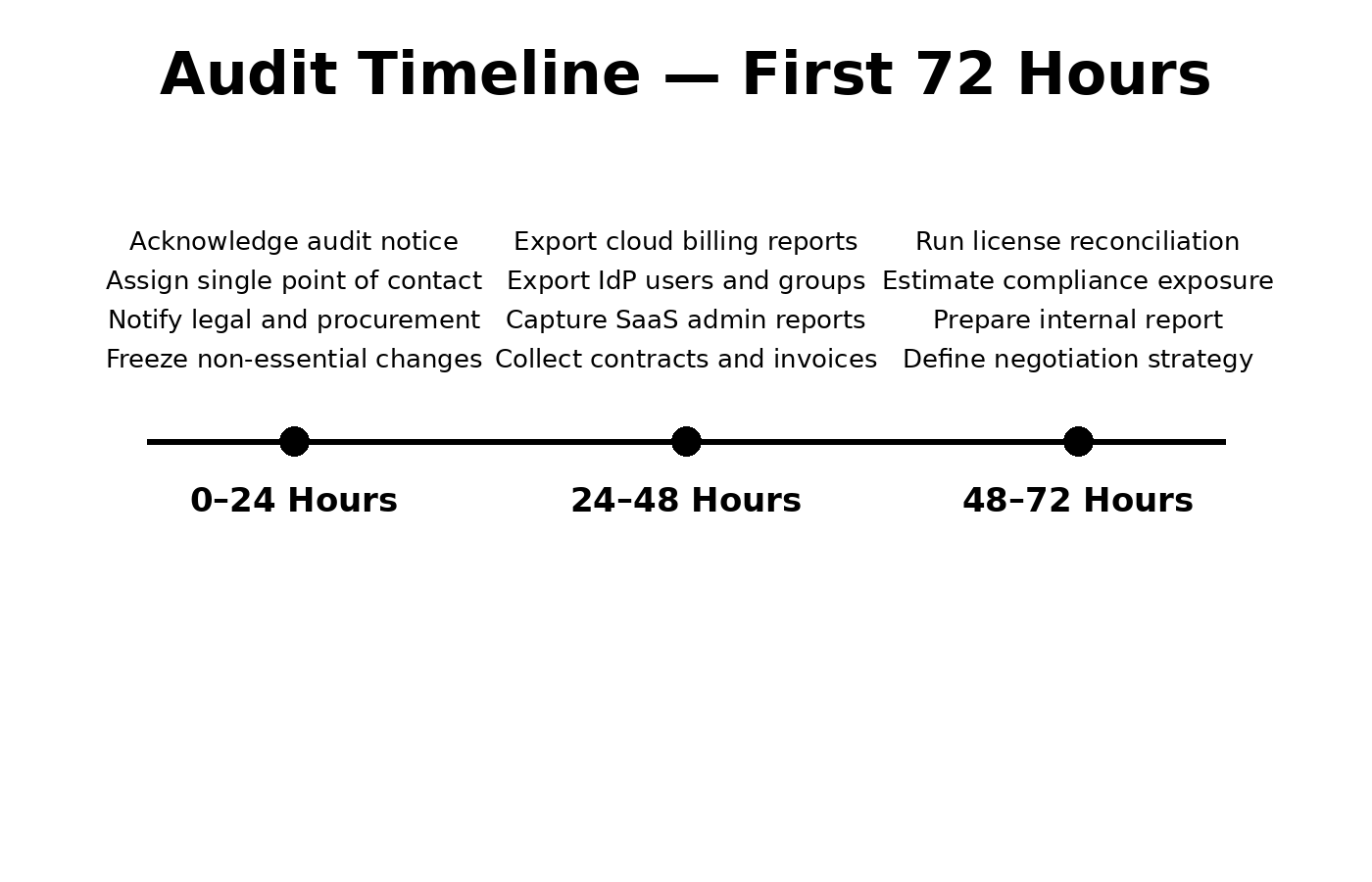
Triage checklist — actions to take within 24 hours
- Log receipt and acknowledge. Send a short, non‑committal acknowledgment (Day 0) confirming receipt and the name of a single point of contact (SPOC).
- Assign owners: SAM lead, cloud engineer, finance (PO/invoice retrieval), and in‑house counsel.
- Notify legal and procurement—don’t let business units handle vendor communications independently.
- Freeze non‑essential changes to cloud subscriptions, role assignments, and automated scaling rules where possible.
- Capture an immediate snapshot of billing exports and IdP/IAM states (see below for exports to collect).
Why this matters: many vendors’ audit notices expect an initial acknowledgement within days; common practice is to request scope clarification and an initial response within 7–30 days. According to vendor guidance and industry practice, asking for short timeline extensions up front buys time to collect evidence (see vendor pages linked in Sources & Further Reading).
For communication best practices, see papublishing.com/communication-strategy-turnaround for a template and escalation flow.
Technical Evidence Collection
Evidence preservation — technical steps (48–72 hours)
Collect immutable or time‑stamped exports from the source systems. Prioritize machine‑readable outputs (CSV, JSON) and preserve metadata (export time, API request IDs).
Minimum technical exports to capture:
– Cloud billing CSV/usage reports (AWS Cost and Usage Report, Azure Cost Management exports, Google Cloud billing export).
– SaaS admin exports (seat assignments, license counts, audit logs).
– IdP logs and group memberships (Okta, Azure AD sign‑in and group export).
– IAM user/group/role exports and privileged role assignments.
– Purchase orders, invoices, entitlement certificates, and contract versions.
– Time‑stamped screenshots where API exports aren’t available (include URL and browser console timestamp).
– VM/container inventory snapshots (image IDs, tags) if BYOL applies in IaaS.
According to Microsoft, Oracle, and cloud marketplace guidance, vendors commonly accept billing reports, entitlement certificates, and IAM logs as proof of legitimate usage—collect them early to avoid gaps.
Relevant internal resource: papublishing.com/new-microsoft-negotiation-get-it-done-early for Microsoft‑specific negotiation tips you may need once the technical package is ready.
Quick risk triage estimate potential exposure
Run a lightweight reconciliation immediately:
– Tally purchased entitlements vs. current active seats/users from IdP exports.
– Compare subscription counts on vendor invoices to live seat usage on SaaS admin consoles.
– Flag obvious over‑consumption (e.g., more active users than purchased seats, unexpected BYOL usage on cloud VMs).
– Produce a worst‑case remediation estimate (assume full true‑up + vendor penalty) to decide whether to involve external counsel/consultants.
Industry reports indicate reactive remediation costs materially exceed the cost of an ongoing SAM program. Use this quick estimate to prioritize whether you need consultant or legal help early (see Section C).
Download a cloud-license-audit-triage-pack
Technical Preparation and Evidence Collection
Cloud environments map licensing models to many different telemetry sources. Your job during the preparation phase is to produce a reproducible, auditable evidence package vendors accept.
Diagram mapping license models to cloud data sources
| License Model | Cloud Data Source |
|---|---|
| Per-User / Named Seat | IdP logs, SaaS user exports, HR sync |
| Subscription Seat Pools | Tenant admin exports, billing meters |
| Consumption / Metered | Cloud billing APIs, usage meter IDs |
| BYOL (IaaS) | VM metadata, images, activation logs |
| Concurrent / Floating | Application session logs, broker records |
Map licensing models to cloud sources
- Per‑user/per‑named‑seat licenses → Identity Provider (IdP) logs, SaaS admin console user exports, HR system syncs.
- Subscription seat pools (metered seats) → SaaS tenant admin exports, billing meter details.
- Consumption/utility pricing (metering) → Cloud billing APIs (AWS CUR, Azure consumption APIs), usage meter IDs.
- Bring‑Your‑Own‑License (BYOL) in IaaS → VM metadata tags, images, license keys, and vendor activation logs.
- Concurrent licensing / floating pools → Application logs showing concurrent sessions and load‑balancer or broker records.
Cite cloud adoption context: major analyst firms report a majority of enterprise workloads are now in cloud or hybrid environments, increasing the number of telemetry sources auditors can use (see Gartner/IDC in Sources).
For who collects/validates these artifacts, see the hiring guidance in papublishing.com/skills-a-professional-biostatistics-recruiter-wants which outlines technical hiring for compliance teams.
Standard evidence package templates and formats
Produce a predictable package that aligns with vendor guidance. Vendors want reconciled counts, source exports, and provenance.
Recommended deliverables (packaged in a single PDF + a data folder with raw exports):
– Executive summary (1 page): scope, SPOC contact, defined timeframe, and reconciliation methodology.
– Reconciliation report (PDF): entitlement rows reconciled to usage rows with delta column and explanation for each variance.
– Raw export folder: billing CSVs, IAM/user JSON or CSV, SaaS admin CSVs, POs/invoices (PDF), entitlement certificates (PDF).
– Chain‑of‑custody note: how and when each export was generated (API call IDs, user who exported, timestamp).
– Appendix: screenshots or API logs for items that cannot be fully exported.
Vendors like Microsoft and Oracle list acceptable evidence as invoices/POs, entitlement documents, and system exports; include all of those to shorten the back‑and‑forth.
Point of practice: prefer machine‑readable formats (CSV/JSON) for reconciliation; include a reconciler script or mapping table to show how counts were calculated.
For packaging and communication templates, reference papublishing.com/communication-strategy-turnaround.
Reconciliation methods sample approaches and tools
Approaches:
– Full inventory scan: Export all entitlements and compare to all usage. Pros: comprehensive. Cons: heavy, exposes more data, higher internal cost.
– Targeted sampling: Agree with vendor on a representative sampling method (by business unit, geography, or application). Pros: limits scope and exposure. Cons: can miss issues outside the sample.
– Hybrid: Full entitlement list with sampled usage validation for large or contested systems.
Tools and automation:
– Use cloud billing APIs (AWS CUR, Azure Cost Management) and automate daily exports.
– Correlate IdP group membership with HR system to remove stale users.
– Leverage a SAM platform or reconciliation scripts (CSV/JSON processing) to produce repeatable reports.
– Integrate outputs in a CMDB so license assignments map to owned assets.
SAM vendors and consultants document sampling vs. full‑scan tradeoffs in white papers—sampling typically lowers cost exposure but requires strict methodology to be acceptable to vendors.
See papublishing.com/navigating-blogging-and-digital-marketing for viewpoints on AI tools and automation you can apply to reconciliation pipelines.
Negotiation Strategy
Negotiation Strategy and Response Timeline
Good negotiation converts panic into process. The goal is to limit scope, push for sampling, and buy remediation time — not to win an ideological fight with your vendor.
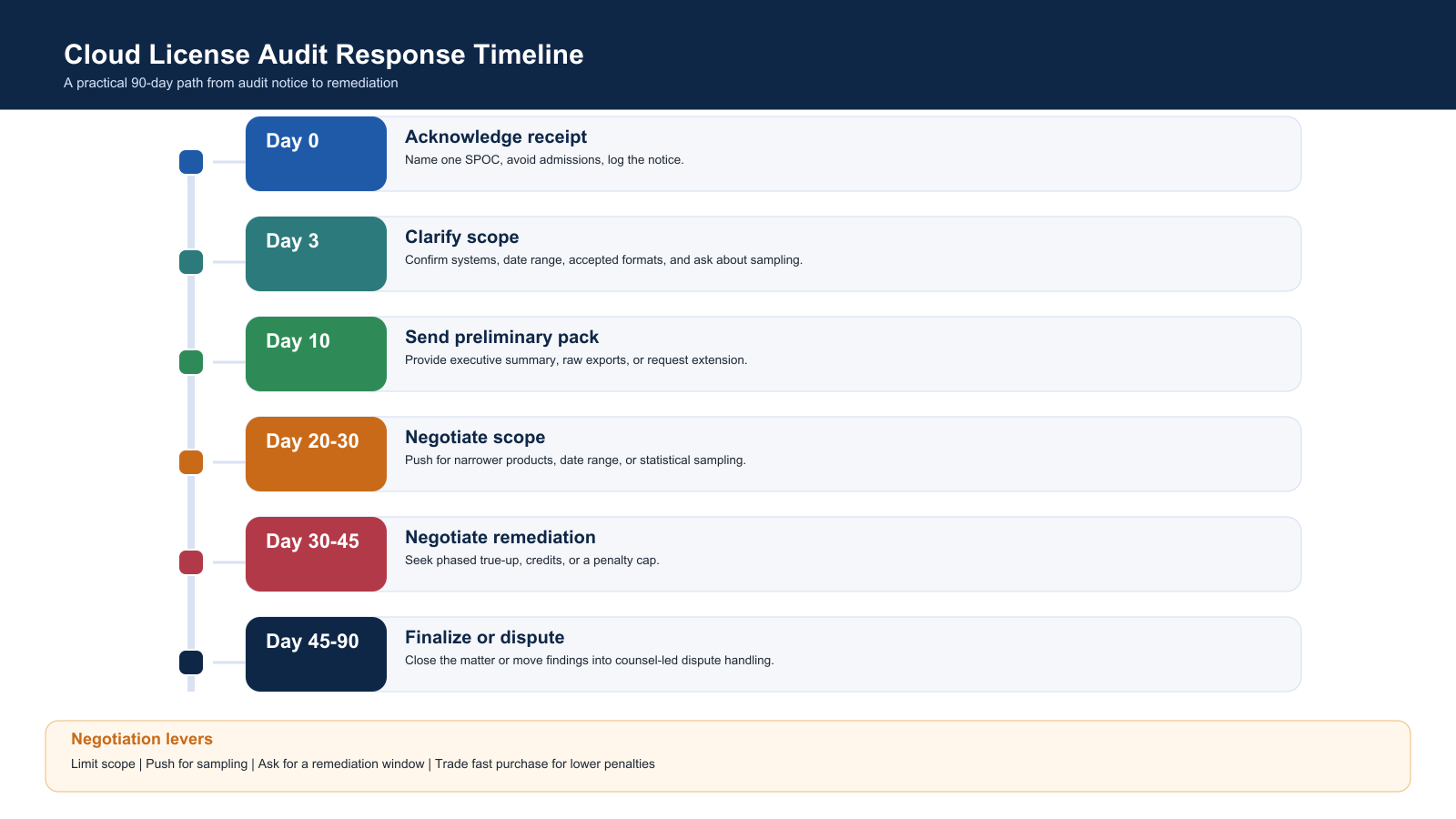
Sample response timeline calendar with negotiation callouts
| Timeline | Action |
|---|---|
| Day 0 | Acknowledge audit notice and assign SPOC |
| Day 3 | Request scope clarification and evidence format |
| Day 10 | Deliver preliminary evidence or request extension |
| Day 20–30 | Propose sampling and limit audit scope |
| Day 30–45 | Negotiate remediation or credits |
| Day 45–90 | Final remediation agreement or dispute |
Sample response timeline & communication script
Use a concise timeline and short scripts for consistent, low‑risk communication. Below is a ready‑to‑use timeline:
- Day 0: Acknowledge receipt. Script: “We acknowledge receipt of your audit notice dated [date]. Our SPOC is [name]; we are gathering information and will respond with a proposed timeline within 3 business days.”
- Day 3: Request clarification on scope and format. Script: “Please confirm the systems, date range, and evidence formats you will accept (CSV/JSON/PDF), and whether you request full‑scan or sampling.”
- Day 10: Deliver preliminary evidence pack (executive summary + raw exports noted above) or request an agreed extension if data needs more time.
- Day 20–30: Propose sampling or limited scope and request vendor to accept independent third‑party verification if needed.
- Day 30–45: Negotiate remediation terms (phased true‑up, credits, or remediation windows).
- Day 45–90: Final remediation agreement or disputed findings process.
Data context: vendors commonly expect an initial acknowledgment within 7–30 days and many grant extensions when customers request them in writing. Industry practice shows most disputes are resolved by negotiation rather than litigation (see Sources).
Short disclosure script bullets (what to disclose vs. withhold):
– Disclose: copy of reconciliation, raw export evidence, purchase history, and immediate remediation steps you plan.
– Reserve: argumentative legal positions and internal root‑cause analyses that admit systemic mismanagement until counsel is involved.
– Always document: every exchange in a ticketed system or email chain.
For communication playbooks, refer to papublishing.com/communication-strategy-turnaround.
Negotiation levers what to ask for and when
Common levers to reduce cost and exposure:
– Limited scope: ask to confine the audit to specific products, business units, or date ranges.
– Sampling: request statistically valid sampling methodology instead of full scans.
– Remediation window: propose a phased remediation over 60–120 days rather than immediate full true‑up.
– Credits or discounts: offer to purchase correct entitlements upfront in exchange for reduced penalties.
– Cap on penalties: negotiate a ceiling on retroactive charges.
– Third‑party verification: agree on an independent auditor to reduce bias.
– Escrow or SA renewal timing: align remediation to coincide with maintenance renewals for smoother financial planning.
Pros/cons snapshot:
– Quick settlement: avoids legal costs and reduces vendor relationship strain but may set precedent and cause unnecessary spending.
– Contest findings: can reduce unfounded claims but risks higher legal expense and longer timeline.
According to industry sources, the majority of licensing disputes are resolved via negotiation; litigation is a last resort and typically more costly.
Internal guidance: for Microsoft‑specific negotiation tactics (renewal timing, SA leverage), see papublishing.com/new-microsoft-negotiation-get-it-done-early/.
When to involve legal and external SAM consultants
Bring counsel or a SAM consultant early when:
– Estimated exposure exceeds your internal threshold (e.g., multiple months’ license spend).
– Vendor requests full‑scan access to sensitive environments.
– The vendor’s audit team is escalating toward contractual default claims.
What consultants deliver: independent reconciliations, validated sampling plans, negotiation support, and expert witness capability if needed. Expect retainer ranges to vary widely by scope; ask for fixed‑price discovery phases to control spend.
Post-Audit Risk Reduction
Post‑Audit Reduce Future Risk
Turn the audit pain into process improvement. Use automation, contract language, and governance to make future audits routine and low‑cost.
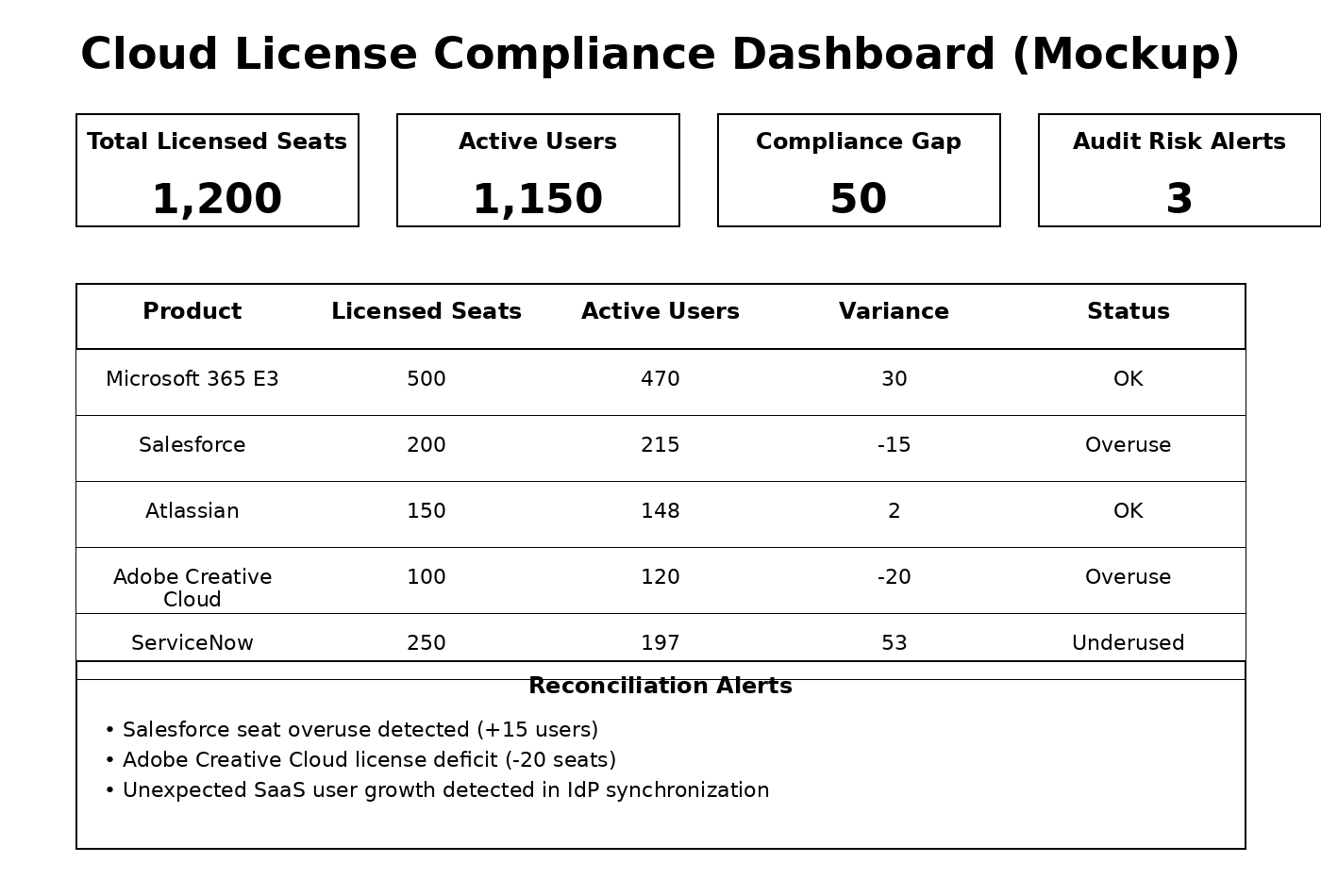
Continuous reconciliation playbook
Actionable steps:
1. Daily/weekly exports: automate billing and IdP exports to a secure evidence repository (retention policy 12–24 months).
2. Automated seat reconciliation: compare SaaS seat counts to HR/IdP groups nightly; flag anomalies.
3. IAM—CMDB integration: map licenses to owners and business units for faster evidence retrieval.
4. Alerts and SLAs: set thresholds (e.g., >5% unexpected growth) to trigger procurement and security review.
5. Monthly true‑ups: perform a business unit reconciliation and submit planned true‑ups within contract timelines.
Case studies from SAM vendors show continuous automation often reduces repeat audit findings significantly (vendor case studies report substantial reductions—see Sources).
For automation tools and AI approaches, see papublishing.com/navigating-blogging-and-digital-marketing.
Contract and procurement clauses to limit future audit exposure
Negotiate these clauses into future agreements:
– Narrowed audit scope (product/term specific).
– Defined evidence list (acceptable formats).
– Sampling limits and agreed methodology.
– Remediation caps and phased true‑up windows.
– Confidentiality and data minimization (avoid handing over full inventory with PII).
– Dispute resolution path (mediation/arbitration before litigation).
Vendor contracts frequently default to broad audit rights; push for customer‑friendly language at renewal or during new purchases. For Microsoft renewal leverage and clause examples, see papublishing.com/new-microsoft-negotiation-get-it-done-early/.
Roles, skills, and tooling – who should you hire or train
Recommended team composition:
– SAM analyst: ownership of entitlement reconciliation and reporting.
– Cloud billing engineer: automates exports and maps cloud meter IDs.
– IAM specialist: ensures identity lifecycle and group hygiene.
– Procurement/legal liaison: manages vendor contracts and negotiation.
– Security/DevOps liaison: ensures changes that affect licensing are visible.
Training priorities:
– IdP audit log analysis.
– Cloud billing APIs (AWS CUR, Azure consumption).
– Reconciliation scripting (CSV/JSON processing).
– SAM tool operation if you purchase a platform.
Internal hiring guidance: papublishing.com/skills-a-professional-biostatistics-recruiter-wants provides a compact checklist for technical hiring for compliance teams.
Best Practices / Key Takeaways
- Keep a single, versioned evidence repository with machine‑readable exports.
- Automate reconciliation as close to source as possible (IdP, billing API).
- Negotiate remediation windows and sampling to reduce immediate exposure.
- Avoid “snapshot‑only” defenses; produce reconciliations that show intent and controls.
- Document every communication and maintain an audit log of your own actions.
Multiple Viewpoints / Pros & Cons
Every choice has trade‑offs. Below are practical pros and cons to help you decide based on risk appetite and budget.
Contest the findings vs. settle quickly
Advantages of contesting
– Potentially lower final cost if vendor overreached.
– Maintains leverage for future negotiations.
Disadvantages
– Higher legal and internal resource cost.
– Longer timeline with potential vendor relationship damage.
Statutory reality: most disputes settle; litigation is expensive and slow. Use negotiation to narrow scope before deciding to litigate.
Full‑scan audits vs. targeted sampling
Full‑scan pros
– Comprehensive — reduces risk of missed findings.
– Creates a clean baseline.
Full‑scan cons
– High internal burden and data‑privacy exposure.
– Potential for higher immediate remediation.
Sampling pros
– Limits exposure and cost; faster to resolve.
– Less sensitive data shared.
Sampling cons
– May miss outlying issues; effectiveness depends on agreed methodology.
SAM white papers explain sampling strategies and statistical validity requirements—push for documented methodology if you accept sampling.
Hiring external SAM consultants vs. internal build
External consultants pros
– Fast ramp, specialist expertise, better negotiation leverage.
– Useful for complex estates and contested findings.
External consultants cons
– Higher short‑term cost; knowledge leaves with the consultant unless transferred.
Internal build pros
– Long‑term capability and lower recurring costs.
– Better integration with business processes.
Internal build cons
– Slower ramp, training overhead, and initial tooling spend.
Choose consultants for immediate remediation and negotiation support; invest in internal capability for long‑term risk reduction.
Common Cloud License Audit Triggers
Audits are often triggered by operational events rather than random selection.
Typical triggers include:
- Rapid cloud subscription growth
- Mergers or acquisitions
- Major vendor contract renewals
- Large SaaS tenant expansions
- Support contract expirations
- Vendor revenue-recovery initiatives
Recognizing these triggers allows organizations to prepare reconciliation evidence before vendors initiate formal audits.
Frequently Asked Questions
### Q: What should I do immediately after receiving a licensing audit letter?
A: Acknowledge receipt, assign a single point of contact, notify legal, preserve evidence (export billing and IAM snapshots), and request scope clarification. Start a lightweight reconciliation to estimate exposure. (Keywords: responding to a licensing audit letter, cloud license audit preparation)
### Q: What types of evidence do vendors typically accept for cloud subscriptions?
A: Vendors commonly accept purchase orders, invoices, entitlement certificates, cloud billing reports (e.g., AWS CUR, Azure billing CSV), IAM/user logs, SaaS admin exports, and time‑stamped API exports or screenshots. Microsoft, Oracle, and cloud marketplace guidance all cite these as acceptable evidence types.
### Q: How long do I have to respond and negotiate with vendors?
A: Windows vary; common practice is 7–30 days for an initial acknowledgment and 30–90 days to produce evidence. Vendors often grant extensions if requested early in writing—ask for scope clarity and reasonable deadlines immediately.
### Q: Should we accept a full‑scan audit or push for sampling?
A: If data sensitivity or cost is a concern, push for statistically valid sampling and independent verification. Full scans can be comprehensive but expose more data and may increase short‑term costs. Negotiate the methodology and limits.
### Q: How much does noncompliance typically cost compared to running a SAM program?
A: Research and vendor reports indicate reactive remediation and penalties can be multiple times the annual cost of a proactive SAM program. While exact amounts vary, proactive investment typically yields lower total cost of ownership over time.
### Q: Can automation eliminate audit risk?
A: No. Automation reduces findings, speeds response, and lowers human error, but governance, contracts, and legal controls are still required. Automation makes evidence repeatable and auditable but doesn’t replace policy.
### Q: When should we hire external SAM consultants or legal counsel?
A: Bring them in early if exposure is high, the vendor is pushing full scans, or your team lacks cloud SAM experience. Consultants can deliver reconciliations and negotiation leverage quickly; counsel can manage legal risk and contract exposures.
Best Practices (Actionable Checklist)
- Acknowledge any audit within 48 hours and name a SPOC.
- Preserve evidence immediately: export billing, IdP logs, SaaS admin reports.
- Produce a reconciled executive summary and raw export folder within 10–30 days.
- Push for sampling, defined scope, and remediation windows to limit cost.
- Automate daily/weekly exports into a secure, versioned evidence repository.
- Integrate IdP, CMDB, and procurement systems to reduce manual reconciliation.
- Negotiate contract clauses at renewal to narrow audit rights and define evidence lists.
- Maintain an internal playbook (72‑hour checklist and 90‑day response timeline).
Download Timeline and Triage Packet
Conclusion
Act fast, collect source‑of‑truth evidence, use negotiation levers to limit scope and cost, and invest in continuous reconciliation so future audits are operationally routine rather than crises. Run the immediate 72‑hour checklist now, perform a lightweight reconciliation within 7 days, and engage legal or SAM consultants if your exposure estimate crosses your risk threshold.
If you want a ready‑made one‑page response timeline and evidence checklist to use the next time you get a licensing letter, consider downloading the triage pack at papublishing.com (recommended asset to create).
Cloud license audit preparation, responding to a licensing audit letter, audit risk reduction checklist
Sources & Further Reading
- According to Flexera’s State of ITAM report (2023), software audits and vendor compliance activity remain a significant operational risk for IT teams.
- Gartner coverage on cloud adoption and enterprise workloads shows the majority of workloads are now cloud or hybrid, increasing audit surface. https://www.gartner.com
- Microsoft Licensing and Audit FAQ — guidance on acceptable evidence and audit process.
- Oracle License Management guidance — what entitlement evidence Oracle expects. https://www.oracle.com/corporate/contracts/
- AWS billing and marketplace documentation for billing exports and evidence. https://docs.aws.amazon.com/cur/latest/userguide/what-is-cur.html
- SAM vendor white papers (e.g., 1E, Snow Software) discussing sampling methodologies and benefits of continuous reconciliation. https://www.1e.com/resources/; https://www.snowsoftware.com/resources
- Industry commentary on negotiation outcomes and dispute resolution from in‑house counsel surveys (various ACC/industry reports).
Internal PAPublishing resources referenced:
– Microsoft licensing negotiation tips: https://papublishing.com/new-microsoft-negotiation-get-it-done-early/
– Audit response communications strategy: https://papublishing.com/communication-strategy-turnaround/
– AI tools and automation for reconciliation: https://papublishing.com/navigating-blogging-and-digital-marketing/
– Technical hiring for compliance teams: https://papublishing.com/skills-a-professional-biostatistics-recruiter-wants/
– Small business governance and compliance tips: https://papublishing.com/category/work-from-home/
(For vendor policies and exact timelines, consult the vendor audit guidance in your contract and the vendor pages above; timelines and acceptable evidence formats are frequently updated.)