
Common Loyalty Program Mistakes and How to Fix Them
Checklist — what I will do in this article:
– Identify the most frequent loyalty program common mistakes and explain their business impact
– Provide clear, actionable fixes to improve customer retention tactics loyalty
– Show how to measure success with a concise measure loyalty program roi formula and relevant KPIs
– Recommend design principles to avoid loyalty program overdiscounting and design loyalty tiers customers value
– Explain technical integration best practices to integrate loyalty with crm system for better personalization and measurement
Introduction
Why loyalty programs matter
Loyalty programs are a direct lever on Customer Lifetime Value (CLV) and retention. Improving retention even slightly can have outsized profit effects: for many businesses, a 5% increase in retention can drive a 25%–95% increase in profits (Bain & Company). Loyalty programs, when well-designed, reduce churn, increase purchase frequency, and lower acquisition costs—turning occasional buyers into long-term revenue generators.
“It’s cheaper to keep a customer than to get a new one.” — this old marketing adage is true, and loyalty programs are a primary tool to capture that value.
Sources:
– Bain & Company research on retention and profitability: https://www.bain.com/insights/stop-trying-to-delight-your-customers/
– McKinsey on personalization impact: https://www.mckinsey.com/business-functions/growth-marketing-and-sales/our-insights/the-value-of-getting-personalization-right
Purpose of this article
This guide identifies common pitfalls—loyalty program common mistakes—shows how they hurt business, and gives practical fixes you can prioritize and implement. It’s designed for marketing leaders, product owners, CRM managers, and loyalty program managers in English-speaking markets.
How to use this guide
Prioritize fixes by expected impact and implementation effort:
– Quick wins: changes that require minimal engineering (communications, UX, benefit tweaks)
– Medium effort: CRM integration, cohort analysis, A/B testing
– Long-term: full architecture and program redesign
Use the checklist at the end as an action roadmap.
1. Mistake: Poorly defined program goals
Symptoms and consequences
- Vague program language like “increase engagement” without numeric targets
- Marketing spend feels “spray-and-pray” with limited measurable lift
- Low or no alignment between loyalty initiatives and revenue/retention KPIs
- Siloed teams (marketing, product, finance) interpreting program results differently
Consequences include wasted budget, muddled messaging, and weak customer retention tactics loyalty. Without clear goals you can’t measure success or compute a credible measure loyalty program roi formula.
Common root causes
- Leadership wants a program because competitors have one, not because of a strategic objective
- KPIs focus on surface metrics (members signed up) rather than business outcomes (retention, CLV)
- No agreed-upon baseline or control group for measuring lift
Fixes and checklist
- Define 2–3 primary objectives (e.g., reduce 12-month churn by X%, increase repeat purchase rate by Y%)
- Tie objectives to revenue and retention metrics (CLV, repeat purchase rate, retention rate)
- Establish a baseline and control groups for measurement (A/B or holdout segments)
- Adopt a simple measure loyalty program roi formula (see Section 6)
- Assign cross-functional owners (marketing, CRM, finance) and weekly KPI reviews
Checklist:
– [ ] Set numeric retention and revenue targets
– [ ] Agree on measurement approach (cohort, A/B)
– [ ] Map KPIs to business outcomes and reporting cadence
2. Mistake: Low points redemption and engagement
Why low redemption happens
Low redemption rates usually result from:
– Overcomplex earning/redeeming rules (multiple conversion tables, confusing thresholds)
– Rewards that are distant in time or require excessive points accumulation
– Poor communication and discovery—members don’t know what they’ve earned or how to use it
– Weak UX on mobile and web for finding rewards and redeeming points
This leads to disengaged members and lower perceived program value.
Fixes to boost redemption
- Simplify earning and redemption. One point = one cent (or straightforward equivalent) is easier to understand than multi-tier conversion math.
- Introduce micro-rewards. Small, frequent rewards (e.g., $1–$5 discounts, free shipping passes) encourage habitual redemption.
- Shorten the path to reward. Lower thresholds for first redemptions to create a positive reinforcement loop.
- Improve UX and transparency. Show current balance, next reward milestone, and “how to redeem” prominently in account and cart experiences.
- Use targeted prompts and reminders. Trigger emails/SMS when a member is close to a reward or when points are expiring.
- Gamify progress. Visual progress bars and milestone notifications increase motivation.
Tracking improvements
Key metrics to monitor:
– Redemption rate (%) = (Value redeemed / Value issued) * 100
– Active members (30/90-day active)
– Time-to-first-redemption (median days)
– Repeat purchase frequency among redeemers vs non-redeemers
Example benchmark:
– If your current redemption rate is 12% and peer benchmarks are 25%–40% for similar industries, aim to raise redemption by 10 percentage points in 12 months.
3. Mistake: Overdiscounting and margin erosion
How overdiscounting happens
- Reward inflation: allowed redemptions grow over time without cost controls
- Poor economics: no per-member profitability model or caps on reward usage
- “Discount-first” mentality to drive short-term sales without considering long-term margins
Business risks
- Eroded margins and profitability
- Reduced perceived value of brand (customers expect discounts)
- Competitive spiral—each brand escalates discounts to match peers, lowering industry profitability
Smart alternatives
Avoid loyalty program overdiscounting by blending monetary and non-monetary value:
– Non-monetary rewards: early access to products, exclusive content, recognition (badges), or community perks
– Experiential perks: VIP events, behind-the-scenes access, priority customer support
– Partner offers: cross-brand partnerships that deliver perceived value at lower cost
– Behavioral rewards: reward actions that increase customer value (referrals, reviews, social shares)
– Dynamic reward pricing: variable reward cost based on customer segment or lifetime value
Tactics to control cost:
– Use breakage models (expected non-redemption) but be conservative and transparent
– Set caps for maximum redemptions per period or per customer
– Introduce tiered costs or minimum spend for high-value rewards
Example: Instead of a blanket 10% off coupon, offer early access to a limited product for top-tier members—lower direct cost, higher brand value.
4. Mistake: Poorly designed tier structure
Problems with arbitrary tiers
- Tiers that don’t motivate customers to move up or reflect true value
- Benefits that are either trivial or too generous (both fail)
- Too many tiers or confusing qualification rules that stall progression
This means members don’t see clear benefits for increased spend or loyalty.
Principles for tier design
When you design loyalty tiers customers value:
– Clear progression and attainable milestones. Each tier should be achievable with reasonable effort.
– Meaningful benefits at each level. Offer perks members truly care about—free shipping, faster support, exclusive products.
– Behavioral economics: create loss aversion (mid-tier members defend their status), time-limited tier trials, and status signaling (badges, labels).
– Balance between recognition and rewards. Some customers value status more than discounts.
– Differentiated perks for segments. B2B customers may value account management and flexible billing; B2C may value experiences and convenience.
Example tier models
- B2C example:
- Bronze (0–$250/year): free shipping over $50, 1x points
- Silver ($250–$999/year): free shipping, 1.25x points, birthday reward
- Gold ($1,000+/year): priority support, 1.5x points, exclusive launches, early access
- B2B example:
- Standard: base discounts, online support
- Preferred (volume-based): negotiated pricing, onboarding credit, quarterly business review
- Partner: dedicated account manager, co-marketing budget, priority feature requests
Design tips:
– Keep tiers to 2–4 meaningful levels
– Use both financial incentives (points multiplier) and non-financial (status, service)
– Test tier thresholds and benefits with customer segments
5. Mistake: Siloed systems and weak personalization
The cost of disconnected data
When loyalty systems are disconnected from your CRM and customer data:
– Offers are generic and untargeted
– You can’t deliver lifecycle-appropriate rewards (e.g., win-back offers)
– Measurement is fractured—hard to attribute lift to the loyalty program
Disconnected systems undermine personalization and reduce the effectiveness of customer retention tactics loyalty.
How to integrate loyalty with crm system
Best practices for technical integration:
– Define the canonical identity. Map loyalty IDs to CRM Contact IDs or Customer IDs, and resolve duplicates via identity resolution.
– Real-time event flows. Use webhooks, event streaming (Kafka/PubSub), or APIs to push earning/redemption events into CRM and CDP (Customer Data Platform).
– Bi-directional sync. CRM and loyalty platforms should both consume and write data—CRM uses loyalty data for segmentation; loyalty platform uses CRM attributes for targeting.
– Use a CDP or middleware. A CDP reduces point-to-point integrations and acts as the single customer view.
– Security and privacy. Encrypt PII, respect opt-outs, and ensure GDPR/CCPA compliance.
– Batch fallbacks. Use daily SFTP/CSV transfers for slow-changing data and APIs for real-time actions.
– Instrument web/app checkouts. Show available points and reward options at point-of-sale.
Sample architecture (high-level):
– E-commerce platform → Event stream → CDP → Loyalty engine → CRM / Marketing automation → Channel delivery (email/SMS/app)
– Provide an API gateway and use OAuth for secure integrations.
Personalization best practices
- Use CRM data to create lifecycle-based rewards (welcome, nurture, at-risk, win-back)
- Combine behavioral triggers with loyalty status for targeted offers (e.g., “As a Silver member, enjoy 48-hour early access”)
- Implement server-side recommendation engines for reward suggestions based on purchase history
- A/B test personalized offers vs generic offers and measure lift
6. Mistake: Not measuring ROI or learning from data
Missing or misleading metrics
Common pitfalls:
– Counting total members rather than active members
– Focusing on short-term sales lift only and ignoring long-term CLV effects
– Not using holdout/control groups to isolate program impact
– Ignoring incremental costs (operational, technology, partner commissions)
Why measure loyalty program roi formula matters: without a clear ROI you cannot scale or justify investment.
Measure loyalty program roi formula and KPIs
A concise and practical ROI formula for loyalty programs:
Loyalty Program ROI = (Incremental Gross Profit from Program - Program Cost) / Program Cost
Where:
– Incremental Gross Profit from Program = (Incremental Revenue * Gross Margin) – Cost of goods sold directly tied to redemption
– Program Cost includes technology, marketing, reward costs, partner commissions, operational expense, and taxes
Suggested KPIs to monitor:
– Retention lift (%) = (Retention_rate_post – Retention_rate_pre)
– Incremental revenue attributable to members ($)
– CLV (Customer Lifetime Value) delta for members vs matched non-members
– CAC (Customer Acquisition Cost) saved via referrals and repeat purchases
– Redemption rate and breakage rate
– Net Promoter Score (NPS) change among members
– ROI as above (monthly and annually)
Practical example:
– Baseline: Average CLV = $200
– After program: CLV among members = $260 → CLV lift = $60
– If average cost to serve a member and reward costs = $20, incremental gross profit = $40 per member
– If tech/marketing/program costs per member = $10 → ROI = ($40 – $10)/$10 = 3.0x
Using data to iterate
- Use cohort analysis to see retention patterns over time (e.g., 1, 3, 6, 12 months)
- Run randomized control trials or geographic holdouts before major program changes
- Close the loop: feed performance data into product and marketing decisions
- Set a regular cadence for learning reviews (monthly dashboards, quarterly strategy)
Conclusion
Quick recap of key mistakes and fixes
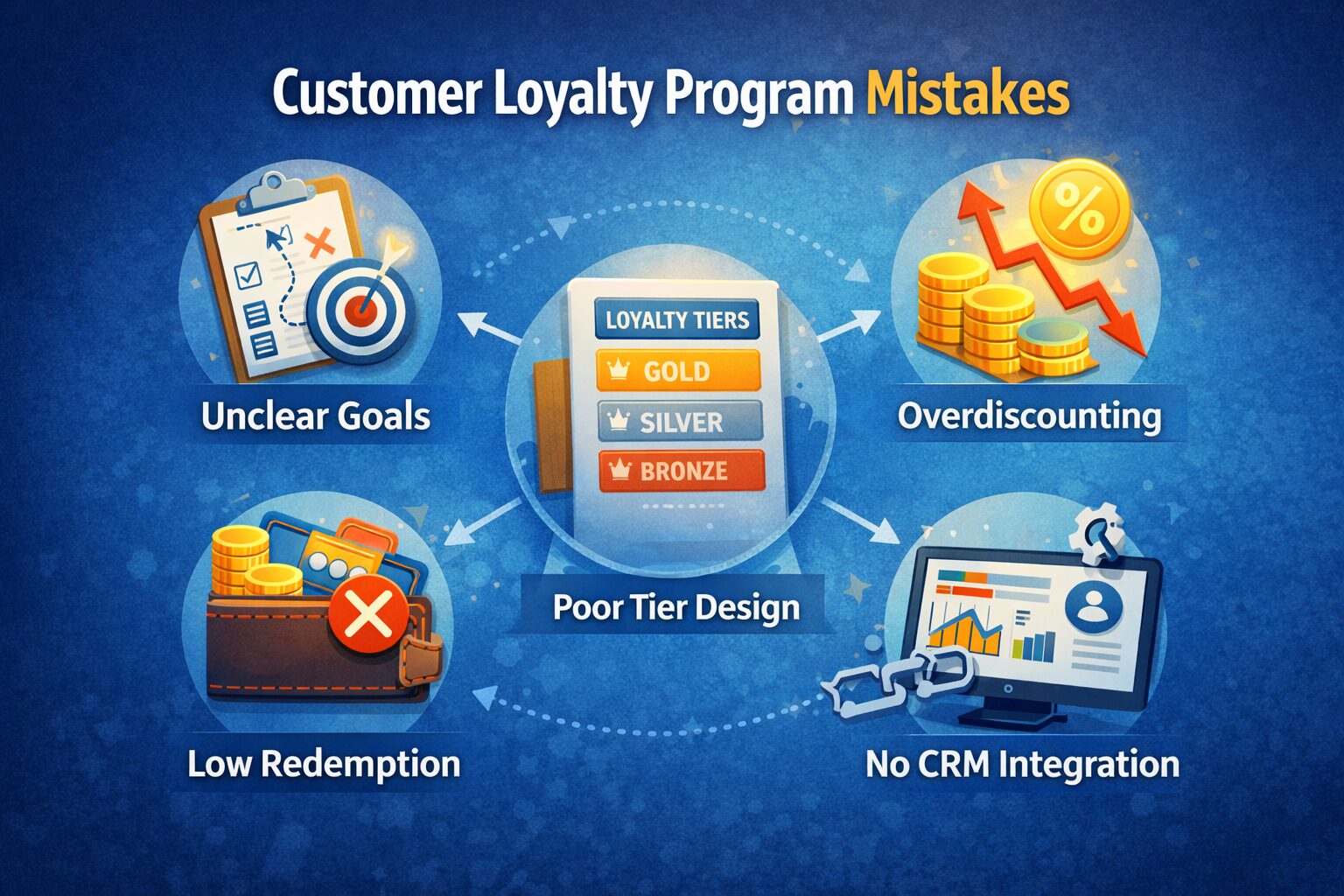
- Poorly defined program goals → define objectives, baseline, and a clear measure loyalty program roi formula
- Low points redemption and engagement → simplify, add micro-rewards, improve UX
- Overdiscounting and margin erosion → favor non-monetary benefits, caps, and partner rewards to avoid loyalty program overdiscounting
- Poorly designed tiers → design loyalty tiers customers value with clear progression and meaningful perks
- Siloed systems and weak personalization → integrate loyalty with crm system for real-time personalization and measurement
- Not measuring ROI or learning from data → adopt ROI formula, KPIs, and cohort/holdout testing
Loyalty Program Insights & Research — Bain & Company — A deep resource on loyalty and customer retention trends from Bain & Company, including research on loyalty’s impact on growth and profits.
Prioritized next steps
- Audit current program against the checklist (goals, UX, economics, tech, measurement)
- Fix highest-impact quick wins (clarify goals, simplify redemption, low-friction rewards)
- Integrate loyalty with CRM and CDP for real-time personalization
- Run A/B tests and holdouts for proposed changes and measure with the measure loyalty program roi formula
- Iterate quarterly based on cohort and financial results
Final note on strategy
Loyalty is a long-term discipline: combine customer retention tactics loyalty with sound economics and integrated systems. A well-measured, personalized, and tiered program creates sustainable value—both for customers and the business.
Call to action:
– Start with a 2-week audit: map your KPIs, measure current redemption and retention, and run a small experiment (e.g., micro-rewards for a targeted cohort). If you’d like, I can draft a tailored 4-step audit plan based on your business model.