
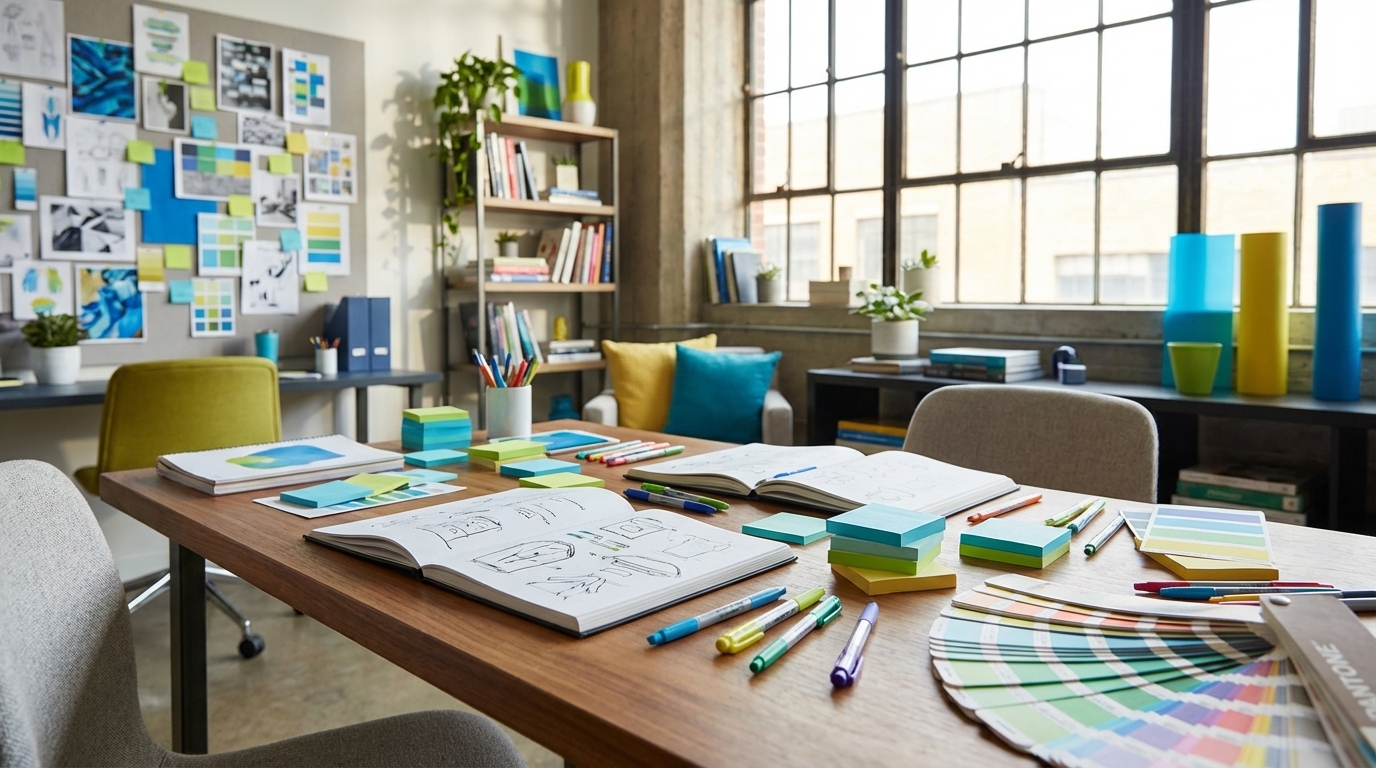
Creative Mess: I still remember that one time my cluttered desk sparked my best project idea yet. Despite advice to tidy up for clarity, my messy workspace somehow seemed to fuel my imagination in ways a neat desk never did. That made me wonder — could creative messes actually be the secret sauce for better ideas? Throw in colors and their psychological effects, and suddenly, a chaotic table becomes a playground for the mind.
The Unlikely Ally: How Messy Desks Foster Creative Thinking
If you were to peek at my desk right now, you’d probably see a whirlwind of color and chaos—sketches piled on top of notebooks, sticky notes with half-formed ideas, and pens scattered like confetti. For years, I tried to tame this creative mess, believing a tidy workspace was the secret to workplace productivity. But over time, I discovered that my cluttered desk was more than just a sign of busyness—it was an unlikely ally in my creative journey.
Personal Chaos, Unexpected Inspiration
I remember one afternoon when a looming deadline had me feeling stuck. My desk was a patchwork of coffee mugs, color charts, and scribbled notes. As I reached for a pen, my hand brushed against an old doodle I’d forgotten about. That accidental discovery sparked a new idea, completely changing the direction of my project. It was a reminder that creative messes aren’t just distractions—they’re fertile ground for spontaneous inspiration.
This isn’t just my experience. Many creative thinkers share stories of their best ideas emerging from the colorful chaos of their workspaces. Messy tables mean busy imaginations, and sometimes, the most unexpected connections are born from the jumble of our everyday tools.
Messiness Signals an Active Imagination
There’s something powerful about a desk that’s alive with activity. When I see scattered sketches and open books, I don’t see disorder—I see evidence of a mind in motion. Messiness signals an active imagination, one that isn’t afraid to break from conventional thinking patterns. In fact, creative thinking often thrives in environments that embrace unpredictability.
When everything is perfectly organized, it’s easy to fall into routines and predictable solutions. But a little chaos invites curiosity. It encourages us to make connections between unrelated ideas, to experiment, and to take risks. As Scott Adams once said:
Creativity is allowing yourself to make mistakes. Art is knowing which ones to keep.
A messy desk is a visual reminder that mistakes and experiments are not only allowed—they’re essential to the creative process.
Science Behind the Mess: Creative Thinking and Workplace Productivity
Research backs up what many of us have felt intuitively: moderate chaos can actually boost creative thinking and workplace productivity. Studies suggest that a cluttered environment encourages divergent thinking—the ability to generate many different ideas in response to a single problem. This kind of thinking is at the heart of innovation.
- Messy tables correlate with busy imaginations: When our surroundings are a little unpredictable, our minds become more open to new possibilities.
- Freedom from strict order: Creativity thrives when we aren’t boxed in by rigid rules about how things should look or be arranged.
- Spontaneous idea generation: The random juxtapositions of objects, notes, and sketches can lead to surprising insights and solutions.
One study even found that people working in slightly messy rooms were more likely to come up with creative uses for everyday objects than those in tidy spaces. The unpredictability of a creative mess seems to nudge our brains into thinking differently, breaking free from the usual patterns.
Embracing the Colorful Chaos of Innovation
When I let go of the pressure to keep everything perfectly in order, I found more freedom to explore, experiment, and innovate. My desk became a canvas, not just for my work, but for my imagination. The colorful chaos that once seemed like a flaw turned out to be a feature—a sign that my mind was busy, my ideas were flowing, and my creativity was alive.
So the next time you find yourself surrounded by a creative mess, remember: that clutter might just be the unlikely ally you need to spark your next big idea.
Color Psychology: The Invisible Force Shaping Our Workspaces
Colors, like features, follow the changes of the emotions. – Pablo Picasso
When I walk into a workspace, the first thing I notice isn’t the furniture or the gadgets—it’s the colors. The walls, the chairs, even the sticky notes scattered across a messy table, all quietly influence how I feel and how I think. This is the invisible force of color psychology at work, shaping our moods, our focus, and even our capacity for innovation.
How Color Psychology Influences Mood and Focus
We often underestimate just how much our surroundings impact us. Yet, research shows that the colors in our environment have a direct effect on our mood influence, focus enhancement, and even employee well-being. Whether I’m brainstorming wild ideas or buckling down for deep work, the colors around me can either energize or drain my creativity.
Blue: The Calm Catalyst for Focus
Blue is my go-to color when I need to clear my mind and get things done. Science backs this up—blue hues are proven to reduce heart rate and eye strain, making them ideal for concentration-heavy tasks. I’ve noticed that a splash of blue in my workspace helps me feel calm and centered, especially during stressful deadlines. It’s no wonder that so many offices use blue to create a sense of mental clarity and reduce stress.
- Blue reduces heart rate and eye strain, improving concentration.
- Perfect for meeting rooms or quiet zones where focus is key.
- Encourages a sense of trust and dependability among teams.
Green: The Innovator’s Oasis
Whenever I’m seeking balance or a fresh perspective, I gravitate toward green. There’s something about this color that feels both grounding and invigorating. Green not only minimizes eye strain—making it easy on the eyes during long work sessions—but also fosters mental clarity and innovative thinking. I find that a touch of green, whether from a plant or a painted wall, helps ideas flow more freely and supports creative problem-solving.
- Green fosters mental clarity and innovative thinking.
- Supports eye comfort, reducing fatigue during creative work.
- Encourages a balanced, harmonious atmosphere for collaboration.
Yellow: The Spark of Optimism and Creativity
Yellow is the color I turn to when I need a burst of energy or a shot of optimism. It’s the color of sticky notes, highlighters, and the first rays of morning sun streaming onto my desk. Yellow stimulates energy and creativity, making it perfect for brainstorming sessions or spaces where big ideas are born. But I’ve learned that too much yellow can be overwhelming, even anxiety-inducing, so I use it sparingly—just enough to inspire without distracting.
- Yellow stimulates energy and optimism but excessive use may cause anxiety.
- Best for accent walls, creative corners, or collaborative zones.
- Encourages enthusiasm and a positive outlook.
Color Chart: The Science Behind the Shades
| Color | Effect | Best Use |
|---|---|---|
| Blue | Reduces heart rate and eye strain, improves concentration | Focus zones, meeting rooms, individual workspaces |
| Green | Fosters mental clarity, supports innovation, minimizes eye strain | Creative spaces, collaborative areas, spaces with natural light |
| Yellow | Stimulates energy and optimism; excessive use may cause anxiety | Accent areas, brainstorming rooms, creative corners |
Warm Tones: Energizing Colors for Enthusiasm
I’ve also found that warm tones like orange can inject enthusiasm and warmth into a workspace, especially during group brainstorming. These energizing colors are perfect for sparking lively discussions and encouraging participation, but like yellow, they’re most effective in moderation.
Every color tells a story and sets the stage for how we work, think, and feel. By understanding and intentionally applying the principles of color psychology, we can create workspaces that not only look vibrant but also nurture our employee well-being, boost our focus, and unleash our creative potential.
Designing Creative Spaces: More Than Just Aesthetics
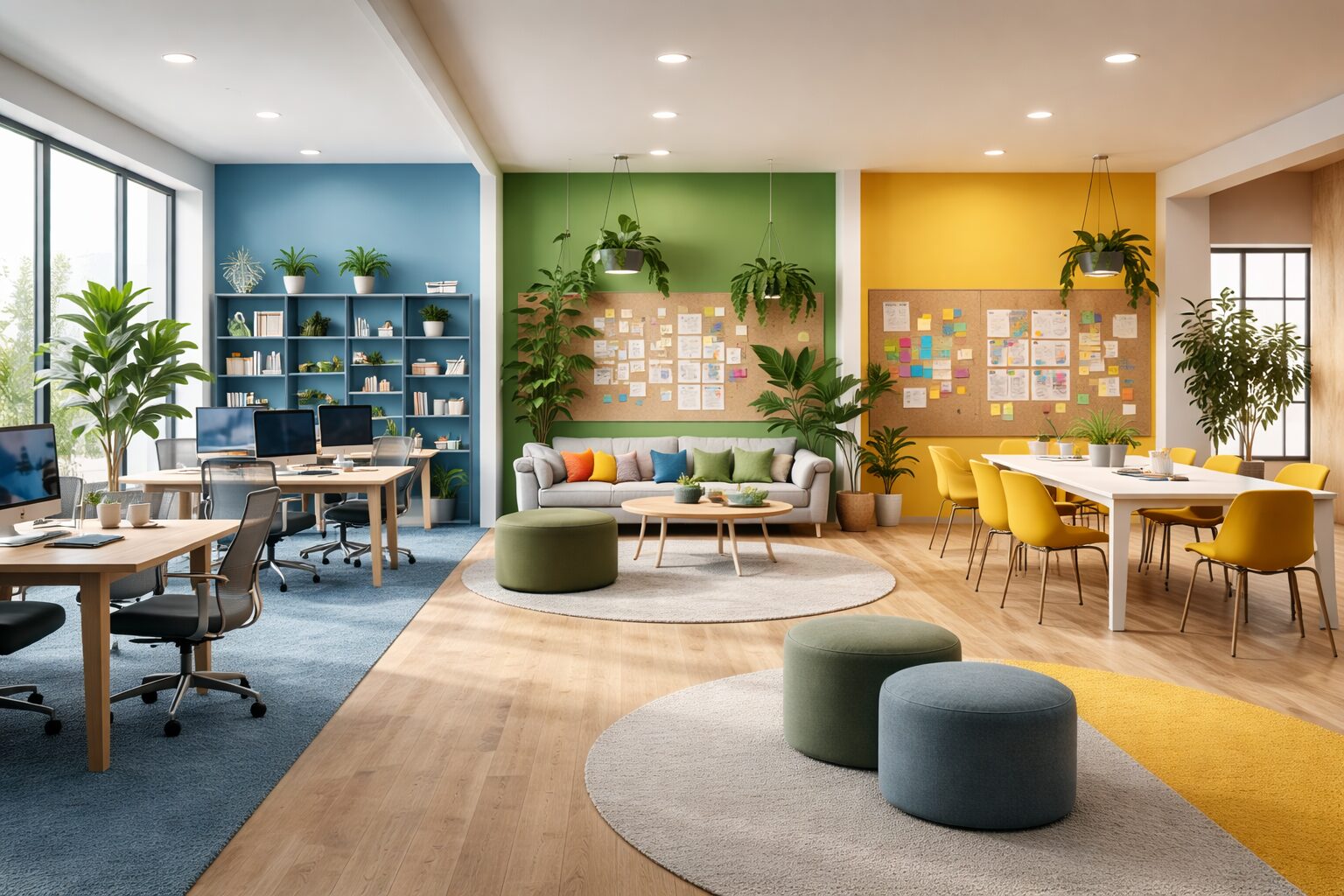
When I think about the most inspiring offices I’ve worked in, they’re never the ones with spotless desks and bland, white walls. Instead, it’s the creative spaces filled with bursts of color, scattered sketches, and the hum of collaboration that truly spark my imagination. It’s become clear to me that office design is about so much more than just looking good—it’s about creating an environment where ideas can flourish, where people feel energized, and where workplace productivity and employee well-being are woven into the very fabric of the space.
There’s a certain magic that happens when creative messes and color come together. I’ve seen firsthand how a messy table can mean busy imaginations at work. When we allow for a bit of chaos—papers spread out, color swatches everywhere, whiteboards filled with half-formed ideas—we’re actually giving ourselves permission to think freely and take risks. This colorful chaos isn’t just a sign of disorder; it’s a sign of innovation in action.
Modern office design trends are finally catching up to this idea. We’re moving away from the sterile, all-white environments of the past and embracing warmer, muted hues that reflect the unique identity of each company. These colors aren’t just for show—they have a real impact on how we feel and work. For example, warm tones like oranges and yellows can boost positivity and enthusiasm, especially during group brainstorming sessions. I’ve noticed that when our collaborative spaces are filled with vibrant tones, people are more likely to speak up, share ideas, and connect with their teammates. It’s as if the colors themselves are encouraging us to be bolder and more creative.
But it’s not all about bright colors and energy. There’s also a place for neutral, earthy tones in the office. These shades, inspired by nature, are a key part of biophilic design—a trend that brings the calming influence of the outdoors inside. In my experience, these spaces help reduce stress and support deeper concentration, making them perfect for focused work zones or quiet corners where employees can recharge. It’s a beautiful balance: vibrant, collaborative spaces for teamwork and muted, natural areas for solo work and relaxation.
Another thoughtful touch I’ve seen is the use of color coding in office layouts. By assigning different colors to different departments or zones, we make navigation easier and help teams feel a sense of identity and belonging. It’s a simple strategy, but it can transform the way people interact with their workspace—and with each other.
All of these design choices—embracing creative messes, using color intentionally, and creating collaborative spaces—have a direct impact on workplace productivity and employee well-being. When people feel comfortable and inspired by their surroundings, they’re more likely to do their best work. They’re also more likely to feel connected to their company’s culture and to each other. As Steve Jobs once said,
Design is not just what it looks like and feels like. Design is how it works.
In the end, designing creative spaces is about more than just aesthetics. It’s about understanding how our environment shapes our mood, our interactions, and our ability to innovate. By embracing a little bit of mess, infusing our offices with color, and creating spaces that invite collaboration and focus, we’re not just making our workplaces look better—we’re making them work better for everyone. The next time you see a messy table or a splash of unexpected color in your office, remember: this is where the magic of innovation begins.
TL;DR: Messy creative spaces combined with thoughtful use of color in office design can boost focus, creativity, and mood, enhancing overall workplace productivity and employee well-being.