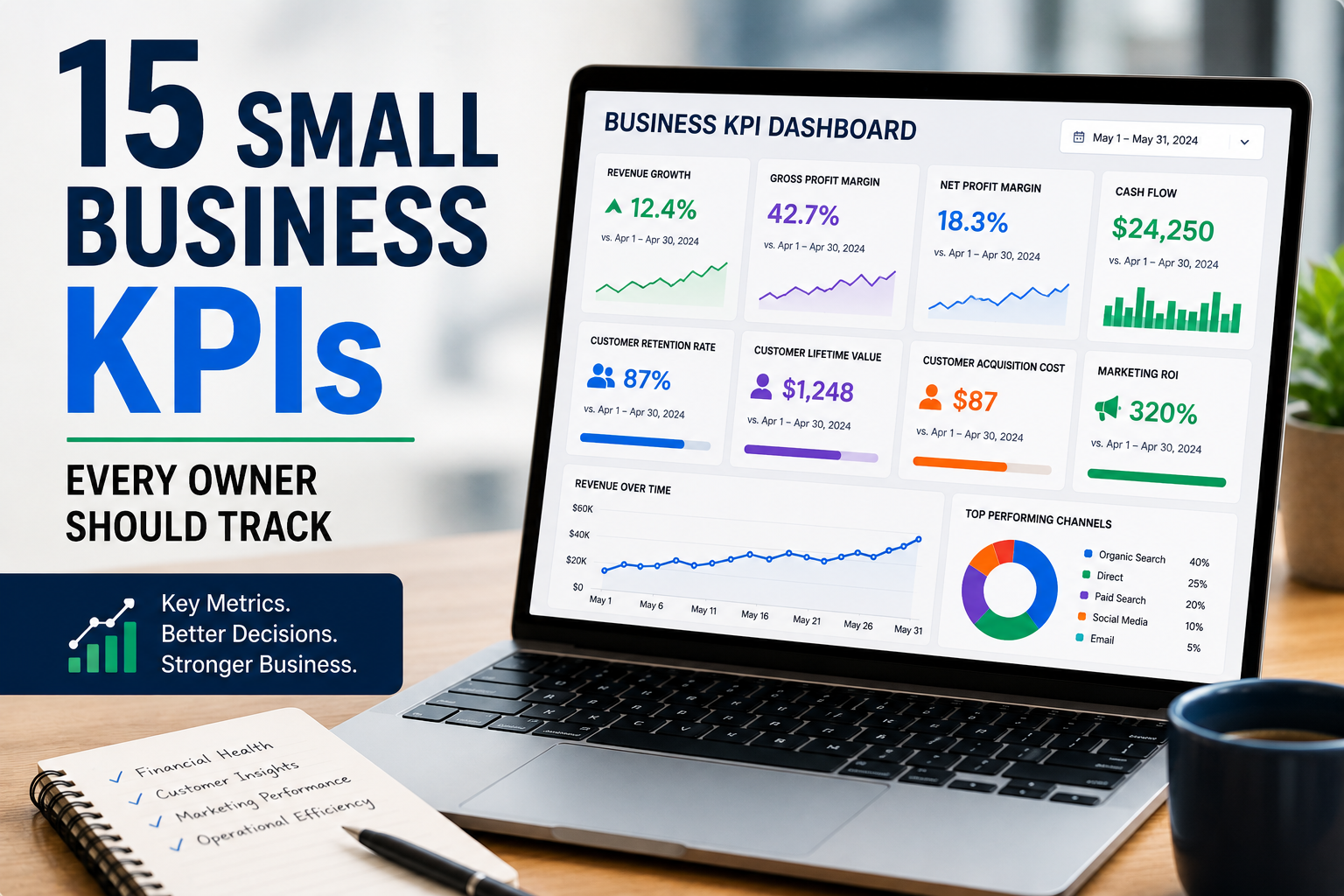
15 Small Business KPIs Every Owner Should Track
Small Business KPIs: 15 Metrics Every Owner Should Track
Running a successful small business requires more than hard work and good instincts. To make informed decisions, business owners need measurable data that shows what is working and where improvements are needed. This is where key performance indicators, or KPIs, become valuable.
Small business KPIs help owners track financial health, customer satisfaction, marketing performance, and operational efficiency. Understanding these metrics becomes much easier when you have a solid foundation in small business finance. Rather than relying on guesswork, KPIs provide clear indicators that support data-driven decisions and long-term business growth.
In this guide, we’ll explore the most important KPIs for small businesses, explain why they matter, and show you how to use them to improve profitability and overall performance.
| KPI Category | Example KPI |
|---|---|
| Financial | Cash Flow |
| Customer | Retention Rate |
| Marketing | Customer Acquisition Cost |
| Operations | Employee Productivity |
Small Business KPIs | What Are KPIs and Why Do They Matter?
Key performance indicators are measurable values that show how effectively a business is achieving its objectives. While businesses may collect hundreds of metrics, KPIs focus attention on the numbers that directly impact success.
For example, website traffic is a metric. Revenue growth rate is a KPI because it directly relates to business growth and profitability. The U.S. Small Business Administration recommends tracking financial performance and business goals regularly to support long-term growth.
The right KPIs help small business owners:
Measure progress toward business goals
Identify problems before they become serious
Improve financial health
Increase customer retention
Optimize marketing efforts
Improve operational performance
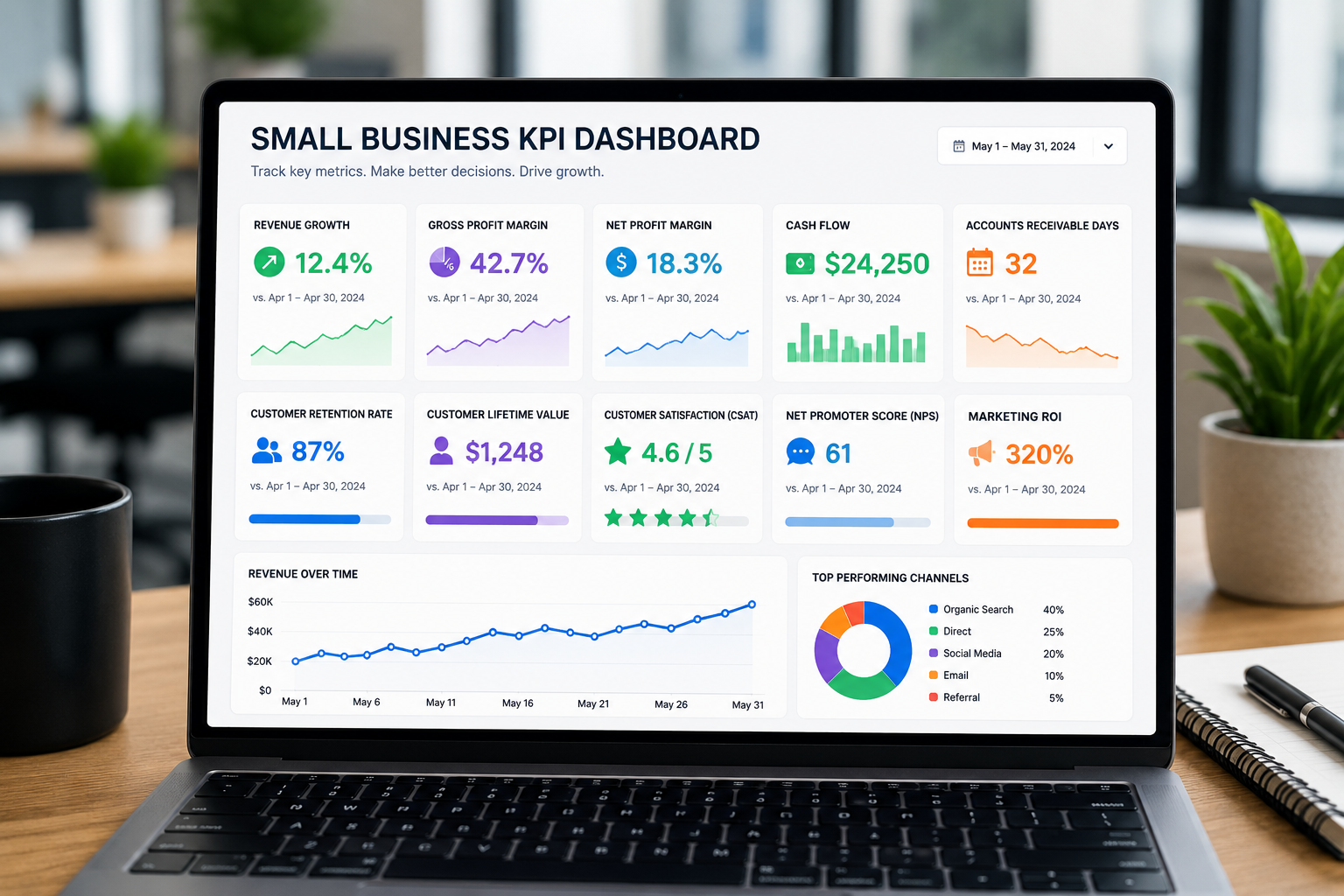
The 15 Small Business KPIs Every Owner Should Track
Financial KPIs
Financial KPIs provide insight into the overall financial health of your business.
1. Revenue Growth Rate
Revenue growth rate measures how quickly your business income is increasing over time.
Tracking revenue growth helps business owners understand whether sales and marketing efforts are producing results. Consistent growth is often a sign that demand for your product or service is increasing.
2. Gross Profit Margin
Gross profit margin shows how much money remains after deducting the direct costs of delivering a product or service.
A healthy gross profit margin allows businesses to cover operating expenses while maintaining profitability.
3. Net Profit Margin
Net profit margin measures the percentage of revenue that remains after all expenses have been paid. Taxes can have a significant impact on net profitability, making small business tax planning an important part of financial management.
This KPI provides one of the clearest indicators of overall business success and operational efficiency. Reviewing your profit and loss statement regularly can help identify opportunities to improve profitability.
4. Cash Flow
Cash flow tracks the movement of money into and out of the business.
Even profitable businesses can fail if cash flow becomes negative. Many owners use a financial dashboard to monitor cash flow and other critical business metrics in one place. Monitoring cash flow helps ensure you have enough funds to pay suppliers, employees, and other obligations.
5. Accounts Receivable Days
This KPI measures how long it takes customers to pay invoices.
Reducing accounts receivable days improves liquidity and strengthens financial health.
Customer KPIs
Customer-related KPIs help businesses measure loyalty, satisfaction, and long-term growth potential.
6. Customer Retention Rate
Customer retention rate measures the percentage of customers who continue doing business with you over time.
Retaining existing customers is often more cost-effective than acquiring new ones.
7. Customer Lifetime Value (CLV)
Customer lifetime value estimates the total revenue a customer generates during their relationship with your business.
Understanding CLV helps determine how much you can reasonably spend on customer acquisition.
8. Customer Satisfaction Score (CSAT)
Customer satisfaction surveys provide direct feedback about customer experiences.
Higher satisfaction scores often lead to stronger loyalty and more referrals.
9. Net Promoter Score (NPS)
Net Promoter Score measures how likely customers are to recommend your business to others.
A high NPS is often associated with strong customer relationships and long-term business growth.
Marketing and Sales KPIs
Marketing KPIs help measure the effectiveness of customer acquisition and sales efforts.
10. Customer Acquisition Cost (CAC)
Customer acquisition cost measures the amount spent to acquire a new customer.
Keeping acquisition costs under control is essential for maintaining profitability.
11. Lead Conversion Rate
Lead conversion rate measures the percentage of prospects who become paying customers.
Improving conversion rates often produces faster results than increasing marketing spending.
12. Marketing Return on Investment (ROI)
Marketing ROI measures how much revenue is generated from marketing activities compared to the cost of those activities.
Tracking ROI helps business owners invest in the channels that deliver the best results.
Operational KPIs
Operational KPIs measure how efficiently a business delivers products and services.
13. Order Fulfillment Time
Order fulfillment time measures how long it takes to complete and deliver customer orders.
Faster fulfillment often leads to better customer experiences and increased satisfaction.
14. First Response Time
For service-based businesses, first response time measures how quickly customer inquiries receive attention.
Fast response times can improve customer satisfaction and increase retention.
15. Employee Productivity
Employee productivity evaluates the output generated by employees relative to time and resources invested.
Monitoring productivity helps identify opportunities for process improvements and automation.
Small Business KPIs | How to Choose the Right KPIs for Your Business
Not every KPI is relevant to every business.
Start by identifying your primary business objectives. Businesses that already have a formal budgeting process often find it easier to identify meaningful KPIs. If your goal is growth, focus on revenue growth, lead conversion rates, and customer acquisition costs. If profitability is the priority, emphasize gross profit margin, net profit margin, and cash flow.
A good rule is to track between five and fifteen KPIs that directly support your business goals.
Avoid measuring everything simply because data is available. Focus on the metrics that influence decision-making.
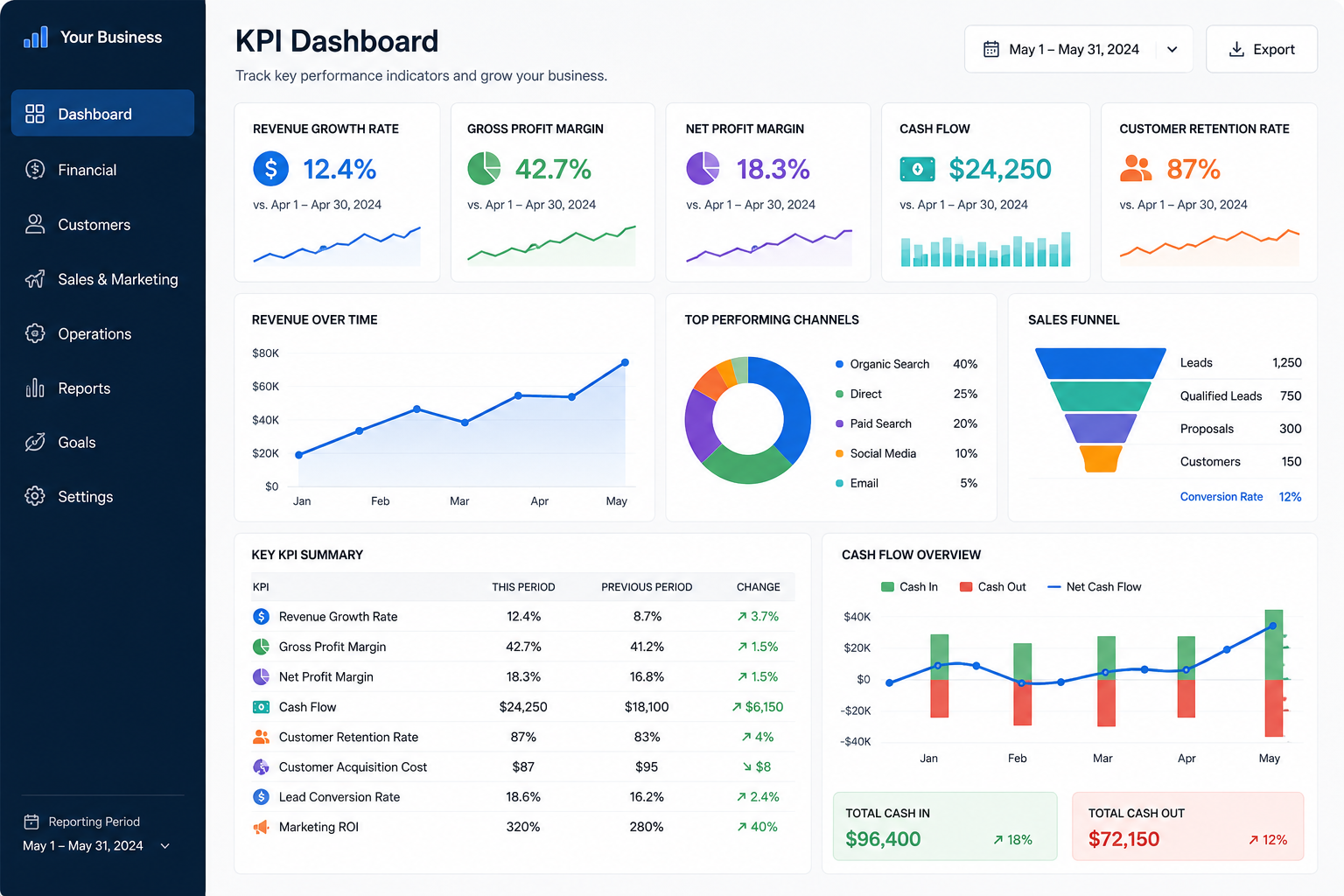
Small Business KPIs | Example KPI Dashboard for a Small Business
A simple KPI dashboard can help business owners monitor performance at a glance. Many businesses use tools such as Google Analytics to monitor website traffic, conversions, and customer behavior.
Key dashboard metrics may include:
Revenue Growth Rate
Gross Profit Margin
Net Profit Margin
Cash Flow
Customer Retention Rate
Customer Lifetime Value
Customer Acquisition Cost
Lead Conversion Rate
Marketing ROI
Order Fulfillment Time
Reviewing these metrics regularly helps identify trends and supports better business decisions.
Common KPI Mistakes Small Businesses Should Avoid
Tracking Too Many Metrics
Too many metrics create confusion and dilute focus. It’s also important to watch for hidden costs that can quietly reduce profitability and distort performance measurements. Concentrate on the KPIs that matter most.
Focusing on Vanity Metrics
Website visits, social media likes, and impressions may look impressive, but they do not always translate into revenue.
Ignoring Customer Retention
Many businesses focus heavily on acquiring new customers while neglecting existing relationships.
Inconsistent Data Sources
Using multiple reporting systems can create conflicting information. Establish a single source of truth whenever possible.
Failing to Review KPIs Regularly
KPIs are only useful when they are reviewed and acted upon consistently.
How to Build a Data-Driven Business
The most successful small businesses use KPIs to guide daily operations and long-term strategy.
Financial KPIs help protect profitability and cash flow. Customer KPIs reveal loyalty and satisfaction. Marketing KPIs measure growth opportunities. Operational KPIs uncover efficiencies that improve service quality.
By combining these indicators into a simple dashboard, business owners gain a clearer picture of overall business performance and can make more confident decisions.
Small Business KPIs | Frequently Asked Questions
What are KPIs in a small business?
KPIs are measurable indicators used to evaluate business performance and progress toward specific goals.
How many KPIs should a small business track?
Most small businesses should track between five and fifteen KPIs that align with their primary objectives.
What is the difference between a KPI and a metric?
A metric measures activity, while a KPI measures progress toward an important business objective.
What are the most important financial KPIs?
Revenue growth, gross profit margin, net profit margin, cash flow, and accounts receivable days are among the most important financial KPIs.
What is a KPI dashboard?
A KPI dashboard is a reporting tool that displays key business metrics in one location, making it easier to monitor performance and identify trends.
Small Business KPIs | Final Thoughts
Tracking the right small business KPIs can transform the way you manage and grow your company. By focusing on the metrics that directly impact profitability, customer satisfaction, marketing effectiveness, and operational performance, you can make smarter decisions and achieve sustainable growth.
Start with a small group of meaningful KPIs, review them consistently, and use the insights they provide to strengthen your business over time. For a deeper understanding of budgeting, cash flow, and profitability, explore our guide to small business finance.