Case Studies in Business: Real-World Examples of Successful Businesses and Their Strategies
Turning an idea into a sustainable enterprise often depends on more than ambition; it requires learning from real-world patterns of execution. This introduction to case studies in business uses Examples of Successful Businesses to show how distinct strategic choices can translate into durable growth, even in crowded or volatile markets.
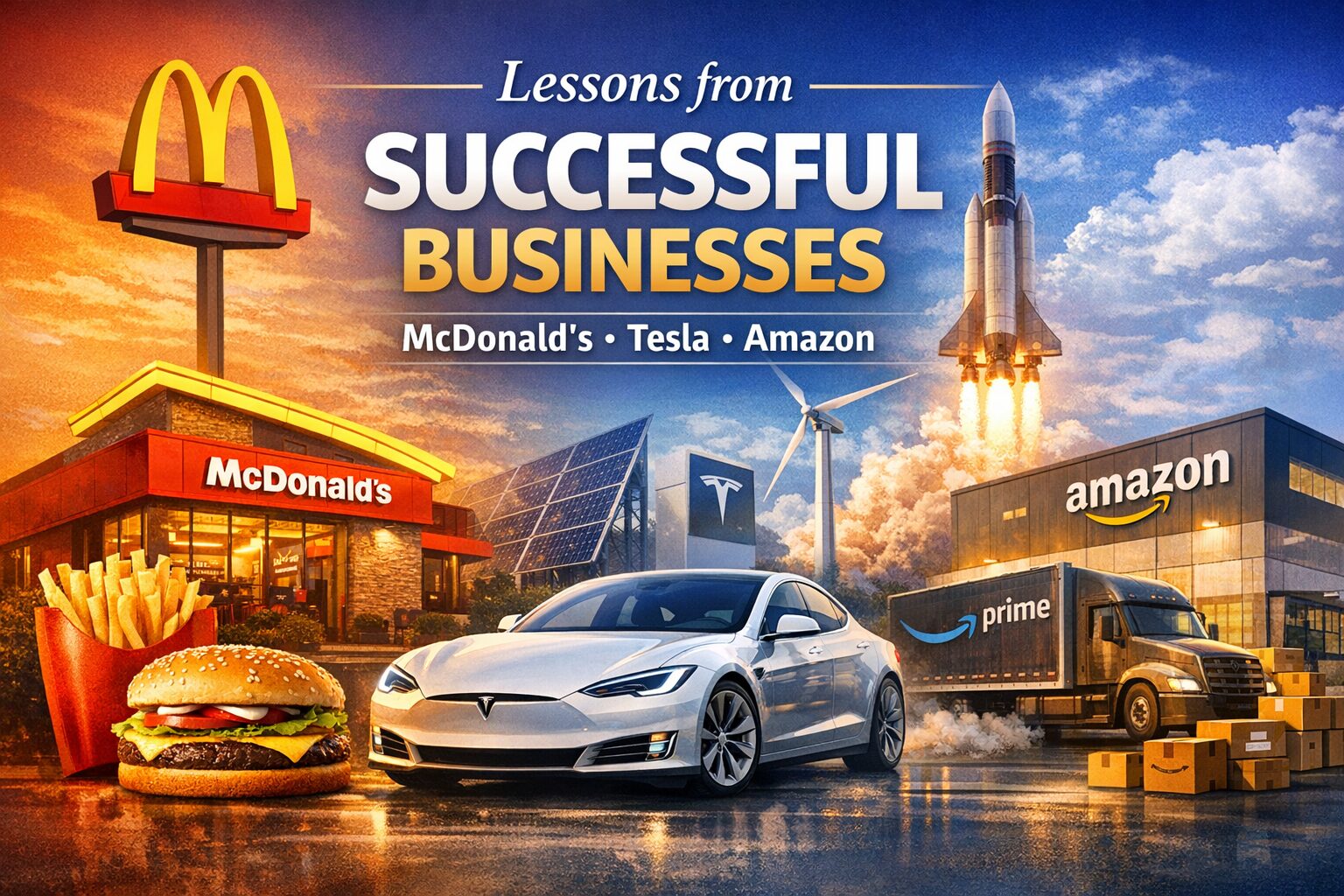
Instead of relying on abstract theory, this article examines three recognizable models of success: McDonald’s, Tesla, and Amazon. Each represents a different route to competitive advantage—operational consistency that reinforces brand trust, innovation-driven differentiation that reshapes customer expectations, and customer obsession that elevates service experience into a core asset.
Viewed side by side, these approaches highlight transferable principles: how standardization builds reliability at scale, how innovation can redefine an industry’s value proposition, and how relentless focus on customer outcomes strengthens loyalty. The aim is practical insight—strategies you can adapt, not simply stories you can admire.
McDonald’s Case Study in Business: Building a Global Brand Through Consistency
A meal can feel “familiar” even in a city you’ve never visited—when the experience is designed to be predictable. McDonald’s built its advantage by engineering repeatable choices that reduce uncertainty for customers and operators alike. This case study shows how McDonald’s turned predictability into a scalable competitive edge.
Standardized Menu, Service, and Store Experience
Customers notice consistency first in the menu, service speed, and store environment. McDonald’s protects its brand promise through standardization while still allowing limited, strategic variation. That balance helps the experience feel both reliable and relevant.
Rather than treating each restaurant as a unique outlet, McDonald’s designs the customer journey to be highly repeatable: order, pay, receive, and leave with minimal friction. A core set of products anchors expectations—familiar items remain dependable even while traveling—while operational routines keep taste and presentation consistent across locations.
Detailed specifications support that sameness: portioning, cook times, holding procedures, and presentation rules. Store layout and kitchen flow are also optimized to reduce errors and simplify execution. The result resembles “service manufacturing,” where the output is an experience as much as a product.
- Menu architecture that emphasizes repeatable bestsellers while testing limited-time offers.
- Process discipline (timers, station roles, quality checks) designed to reduce variation.
- Store design standards that support fast throughput and familiar navigation.
Localization is typically deliberate and controlled—regional items can reflect local tastes without undermining operational simplicity. Adaptation is permitted when it can be implemented without weakening the underlying system.
“Our system is built on uniform standards and shared values, so customers can count on us wherever they are.” —Chris Kempczinski
Operational Systems and Franchise Model as Growth Engines
Scaling a recognizable experience requires a structure that makes replication both controllable and economically attractive. McDonald’s relies on the franchise model and operational infrastructure—training, supply chain, and real estate—to turn a restaurant concept into a global network. Those mechanisms make expansion possible without sacrificing standardization.
Franchising distributes execution to local operators while maintaining strict system controls. This setup enables rapid expansion with shared investment and creates owner-operators who have strong incentives to manage labor, service speed, and local marketing effectively.
Supporting the front line is an “engine room” of measurable, coachable systems. Training programs, standardized equipment packages, and detailed operating procedures reduce the skill barrier for consistent delivery. As noted by McDonald’s Corporate, the company operates predominantly through franchisees globally, underscoring how central franchising is to the model.
- Scalable training that turns roles into repeatable tasks with clear benchmarks.
- Supply chain coordination that supports consistent inputs and predictable costs.
- Franchise governance (standards, audits, and performance targets) that protects brand integrity.
Real estate strategy reinforces the system as well: many locations are selected for traffic patterns and visibility, strengthening unit economics and encouraging reinvestment. Together, franchising and disciplined operations create a reinforcing loop—better unit performance supports growth while sustaining compliance.
Brand Recognition and Customer Trust at Scale
Once consistency is achieved, it becomes more than operational strength—it becomes trust. McDonald’s converts predictable delivery into brand recognition that holds up as the footprint expands. Repeated reliability turns everyday transactions into long-term brand equity.
Trust forms when expectations are met repeatedly under varying conditions—different staff, different cities, different times of day. Reduced risk creates psychological comfort: customers know what they’ll get, what it will cost, and how long it will take. That reliability becomes a strong advantage for travelers and families looking for quick, low-surprise choices.
Recognition is amplified through visual and sensory consistency: logos, packaging, store cues, and signature products function as mental shortcuts. Investor materials have referenced tens of thousands of restaurants worldwide, and that everyday exposure strengthens recall (see McDonald’s Investor Relations).
- Trust through repetition: the experience feels dependable, not experimental.
- Global visibility: ubiquitous locations reinforce mental availability.
- Systemwide standards: quality signals are protected across operators and regions.
Because the promise is operational rather than aspirational, the brand can credibly market “you’ll get what you expect”—and then deliver it. This is how McDonald’s turns uniform execution into a durable advantage that is difficult to match at comparable scale.
Tesla Case Studies in Business: Winning Market Share by Prioritizing Innovation
When a car is treated less like a purely mechanical product and more like a fast-improving technology platform, competition changes. Tesla’s rise contrasts sharply with models built on repeatability, emphasizing breakthrough performance, rapid iteration, and a reframed definition of “premium.” This section explores how innovation translates into demand through product engineering, brand identity, and ecosystem design.
Product Differentiation Through High-Performance EV Engineering
In categories where buyers expect trade-offs, performance can overturn skepticism quickly. Tesla used engineering-led differentiation—range, acceleration, efficiency, and manufacturing choices—to attract customers who were not initially shopping for an electric vehicle. That technical edge helped position EVs as desirable rather than merely acceptable.
Instead of framing EVs as “good enough,” Tesla made them aspirational. Models such as the Model S popularized the idea that an EV could compete with—and in certain metrics outperform—internal combustion cars, particularly in acceleration and software-driven features. As a result, early adoption often reflected a search for a superior driving experience, not only sustainability.
Demand at scale is reflected in delivery volume: Tesla reported over 1.8 million vehicle deliveries in 2023 in its public results (Tesla Investor Relations). Battery design focus, powertrain efficiency, and a manufacturing philosophy aimed at simplifying assemblies support the company’s ability to iterate quickly.
- Range and efficiency improvements that address daily “range anxiety” barriers.
- High acceleration as a clear, easily communicated advantage versus traditional rivals.
- Rapid iteration enabled by software-heavy architecture and vertically integrated components.
Differentiation, importantly, is not a single feature—it is a stack. Hardware establishes the baseline, while software updates and ongoing improvements keep the vehicle feeling current in an industry that traditionally evolves on multi-year cycles.
Mission-Driven Branding and Environmental Positioning
Product advantage can attract attention, but identity helps sustain loyalty. Tesla strengthens demand through mission-based positioning, connecting individual purchases to a broader transition away from fossil fuels. That narrative turns customers into advocates and keeps the brand culturally visible.
Rather than presenting itself as incremental change, Tesla frames its role as accelerating a societal shift. This clarity encourages owners to share their enthusiasm publicly, functioning as a form of distributed marketing. In turn, the mission reduces dependence on traditional automotive advertising and supports ongoing relevance even as competitors expand EV offerings.
The brand anchors this identity in its stated aim “to accelerate the world’s transition to sustainable energy,” repeated across official materials (Tesla About). That positioning can influence tolerance for quirks or learning curves, since the purchase is often interpreted as participation in something larger than convenience alone.
- Values alignment: customers “buy into” a direction, not just a vehicle.
- Social proof: owner communities amplify visibility through word-of-mouth.
- Status reframing: sustainability is presented as modern and high-performance, not restrictive.
“Tesla’s mission is to accelerate the world’s transition to sustainable energy.” —Elon Musk
Ecosystem Strategy: Software, Charging Network, and Direct Sales
Innovation becomes harder to copy when it is embedded in an interconnected system. Tesla extends its advantage beyond the vehicle through software, charging infrastructure, and a direct-to-consumer model that shapes the ownership experience. These choices reinforce one another and raise the difficulty of imitation.
At the center is software and the lock-in created by continuous improvement. Over-the-air updates can add features, refine interfaces, and adjust vehicle behavior without a dealership visit, keeping ownership value evolving after purchase. This structure also strengthens Tesla’s learning loop, helping it iterate faster than peers tied to legacy service models.
Charging access forms the second pillar. The Supercharger network has supported adoption by making long-distance travel feel routine. Its strategic weight increased as other automakers announced plans to adopt Tesla’s charging standard and access Superchargers, reinforcing infrastructure as an advantage rather than a support function (Tesla Supercharger).
- Over-the-air updates that continuously improve ownership value and reduce service friction.
- Charging infrastructure that lowers switching costs and increases confidence in EV travel.
- Direct sales and service model that standardizes pricing, messaging, and customer feedback loops.
Together, the car, software, and infrastructure form a reinforcing system. Competitors may match individual features, but replicating the full ecosystem at scale requires coordinated investment and alignment across multiple domains.
Amazon Case Study in Business: Customer Obsession as a Competitive Advantage
Retailers can match prices, copy product lines, and build comparable apps—so lasting advantage often comes from what customers experience. Amazon competes on what shoppers feel: time saved, uncertainty removed, and problems resolved quickly, until the experience becomes hard to replace. This case study shows how “customer obsession” becomes a measurable operating system rather than a slogan.
McDonald’s builds trust through repeatable operations, and Tesla defends advantage through innovation ecosystems. In contrast, Amazon reinforces loyalty by tightening the full loop: easier discovery, faster delivery, and retention mechanics that compound over time. The strategy becomes clearer when broken into three connected choices.
Frictionless Buying Journey: UX, Search, and Personalization
Before delivery speed matters, a purchase decision has to happen. Amazon reduces cognitive load during browsing through interface design, search relevance, and personalization that helps shoppers find the right item quickly. Each improvement reduces friction that would otherwise stall conversion.
Instead of functioning as a static catalog, the site operates like a decision engine. Autocomplete, filters, comparison tools, and dense product pages compress what would otherwise require multiple store visits into a few clicks. Features such as saved addresses, default payments, and “Buy Now” further shorten checkout, lowering abandonment when shoppers are distracted or uncertain.
Personalization adds a second layer of advantage. Recommendation modules—“Customers also bought,” “Inspired by your browsing history,” and tailored homepages—use machine learning signals to raise conversion and increase basket size. Just as importantly, they reduce search costs, limiting the time customers spend hunting. This philosophy is emphasized in shareholder communications that frame customer experience as a long-term compounding asset (Amazon Annual Reports).
- Search relevance that prioritizes intent, availability, and delivery promise—not just keyword match.
- Trust cues (ratings, reviews, verified purchase signals) that reduce perceived risk.
- Personalized discovery that shortens time-to-decision across repeat visits.
“We’re not competitor obsessed, we’re customer obsessed. We start with what the customer needs and we work backwards.” —Jeff Bezos
Fulfillment Excellence: Speed, Reliability, and Easy Returns
A “Buy” button is only a promise unless the last mile delivers. Amazon’s operational backbone—warehousing, transportation, and returns—turns convenience into a dependable reality. Consistency here reinforces trust and encourages repeat behavior.
Designed to trade complexity for reliability, the fulfillment network positions inventory closer to demand centers and uses data to anticipate what will sell where. That approach increases the share of orders delivered quickly without relying solely on premium shipping options. Investments in regionalized logistics and automation have supported faster delivery expansion while reducing variability, a theme highlighted in Amazon Investor Relations updates.
Returns are also treated as part of the product. Low-friction returns—printless drop-offs in some locations, rapid refunds, and clear tracking—reduce the psychological barrier to purchasing categories where expectations can vary. Although this can appear costly, it works as risk insurance that helps customers buy with more confidence.
- Delivery speed that increases conversion, especially for urgent or replenishment purchases.
- Order accuracy and tracking that reduce customer service friction and uncertainty.
- Easy returns that convert hesitation into action, supporting categories with higher trial needs.
Loyalty and Retention: Prime, Subscriptions, and Cross-Selling
Convenience wins the first purchase; retention economics make the model durable. Amazon strengthens lifetime value through Prime and recurring programs that raise purchase frequency and deepen multi-category attachment. These mechanisms make the platform feel increasingly “default” over time.
Prime operates as a loyalty flywheel by changing customer math. After paying a membership fee, shoppers are motivated to “get their value back,” increasing repeat purchasing and reducing comparison shopping. Amazon has reported over 200 million Prime members globally in prior disclosures (widely cited after the company’s 2021 milestone announcement via About Amazon News), illustrating how membership scale can become structural advantage.
Subscriptions reinforce the habit. Programs such as Subscribe & Save reduce reordering friction, while add-on services and bundled perks increase the perceived cost of leaving. Cross-selling follows naturally: once delivery and service outcomes are trusted, trying adjacent categories—from groceries to devices—feels less risky.
- Prime membership that increases frequency and reduces churn through sunk-cost motivation.
- Recurring subscriptions that stabilize demand and improve forecasting.
- Cross-category expansion that turns a retail relationship into a broader platform habit.
Overall, Amazon’s advantage is not “low prices alone,” but a coordinated system that turns time savings and reliability into loyalty—then uses that loyalty to fund even stronger service levels. This compounding loop captures customer obsession as a competitive asset.
FAQs: Lessons from These Case Studies in Business for Entrepreneurs
Big brands can feel distant, but the strategic patterns behind them are often practical and adaptable. The question is not “Which company should you copy?” but “Which advantage should you build first?” This FAQ translates the lessons into decisions entrepreneurs can use immediately.
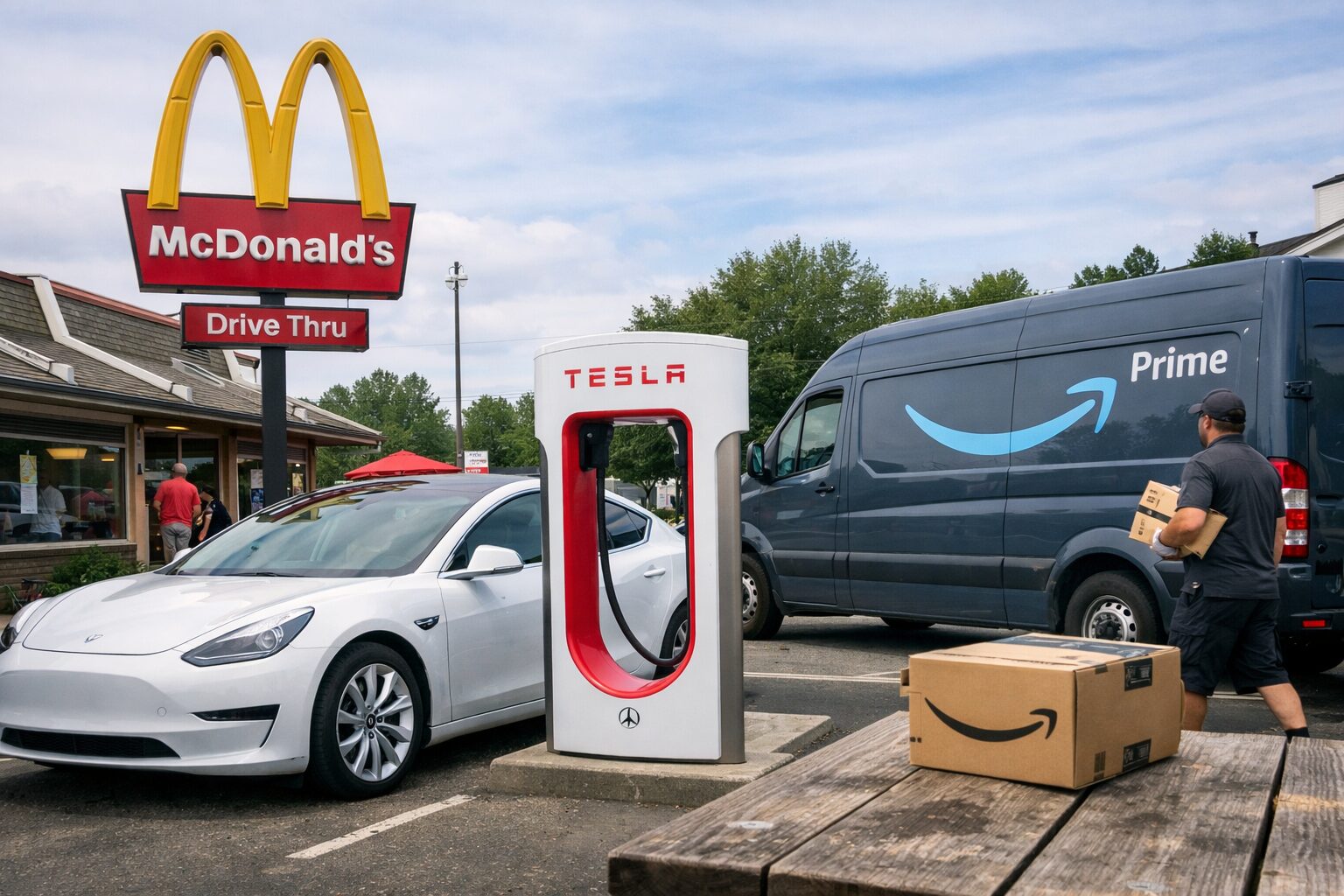
If you had to choose only one lever to pull—precision, breakthrough differentiation, or customer trust—which would most improve your business this quarter? Across all three cases, the shared theme is that each company turned a clear priority into a repeatable system.
What Can I Learn from These Examples of Successful Businesses?
These companies may be large, but their most useful lessons are not scale-dependent. What matters is the discipline of choosing a focus and building around it. When adapted thoughtfully, the same logic can apply to startups, local services, or growing online brands.
Strategic focus is the common thread: each company protects one advantage so well that it shapes every other decision. For entrepreneurs, that means defining a single “non-negotiable” and aligning operations, hiring, and metrics around it—rather than chasing multiple advantages at once.
- Pick a dominant advantage: reliability (McDonald’s), innovation velocity (Tesla), or customer experience (Amazon).
- Design systems, not slogans: checklists, feedback loops, and service standards beat motivation alone.
- Measure the promise: speed, defect rate, repeat purchase rate, and referral rate tell you if strategy is real.
- Earn the right to expand: add new locations, products, or categories only after unit-level performance is stable.
A practical way to operationalize this is to write your brand promise in one sentence, then list three processes that must work daily to keep it true. If those processes are unclear, the strategy is still abstract.
Why Is Consistency Central to McDonald’s Strategy?
In quick-service dining, customers don’t just buy food—they buy certainty. McDonald’s treats consistency as an economic asset, not a branding preference. That choice supports expansion while protecting trust.
Predictability reduces what economists call transaction costs: fewer surprises means less time evaluating alternatives and less fear of regret. In high-traffic settings such as travel corridors and dense urban areas, reduced decision friction can translate into higher frequency.
Operationally, consistency protects margins. Standard procedures reduce rework, waste, and training variability, which matters in an industry with structurally high turnover. The U.S. Bureau of Labor Statistics (JOLTS) tracks persistent churn patterns that make trainability and process discipline financially meaningful.
- Customer-side value: the same product and timing reduces perceived risk.
- Operator-side value: repeatable workflows decrease errors and improve throughput.
- Growth value: a standardized “playbook” makes new locations easier to launch and audit.
“Quality means doing it right when no one is looking.” —Henry Ford
Although the quote isn’t about restaurants, the principle applies: McDonald’s embeds “doing it right” into routines that hold up across staffing changes, busy hours, and geography.
How Has Tesla Differentiated Itself from Traditional Automakers?
In mature industries, beating incumbents often requires more than a better product—it requires a different rate of improvement. Tesla positioned itself like a technology company, using iteration speed and platform control to create separation. That orientation matters even as competitors increase EV investment.
A key differentiator is the software-centered vehicle architecture, which supports frequent over-the-air updates that improve features, efficiency, and interfaces after sale. This makes the car feel less like a fixed asset and more like an evolving device—unusual in an industry where upgrade cycles are typically measured in years.
Complementary infrastructure strengthens the ecosystem further. A strong charging experience reduces the “ownership penalty” of adopting an EV and increases willingness to switch. As other automakers moved toward Tesla’s charging connector standard—formalized as NACS—the ecosystem advantage became harder to overlook (see announcements aggregated by SAE International).
- Platform thinking: hardware + software + data loops reinforce one another.
- Faster iteration: frequent updates shift competition from model-year cycles to continuous improvement.
- Infrastructure as strategy: charging availability functions as adoption insurance, not a side benefit.
For entrepreneurs, the takeaway is not “build cars,” but bundle the complements: if your product requires setup, learning, maintenance, or supporting services, treat those frictions as part of what you sell—and remove them systematically.
What Makes Amazon’s Customer Satisfaction Strategy So Effective?
Convenience is easy to promise and hard to deliver consistently. Amazon’s approach works because it relies on compounding retention mechanics, where each improvement increases future purchasing and helps fund the next improvement. Satisfaction is treated as a system outcome rather than a vague goal.
Two major blockers in online commerce—uncertainty and delay—are reduced through reviews, clear delivery dates, and reliable order tracking, while fast shipping expands the number of situations where online ordering beats a store trip. Over time, that reliability becomes habit: customers stop “shopping Amazon” and start “shopping,” with Amazon as the default.
Prime amplifies the effect by reshaping behavior after the membership fee is paid. Once shipping feels “free” (even though it is prepaid), the threshold for ordering drops, raising frequency and lifetime value. This aligns with broader observations about subscription models and switching costs: bundled benefits make leaving feel like losing multiple conveniences at once.
- Trust infrastructure: reviews, refunds, and transparent tracking reduce uncertainty.
- Operational follow-through: delivery reliability turns marketing claims into lived experience.
- Retention design: memberships and subscriptions increase repeat behavior without constant re-acquisition spend.
“Your brand is what other people say about you when you’re not in the room.” —Jeff Bezos
Practically, the strategy endures because satisfaction is operationalized through metrics such as speed, resolution time, and repeat purchase—rather than treated as an aspiration alone.
Strategic Focus Wins: Systems That Turn Advantage into Scale
Enduring success rarely comes from doing everything well at once; it comes from choosing a primary advantage and building the organization to deliver it consistently. Across these case studies in business, the shared lesson is simple: strategy becomes durable when it is translated into repeatable systems and measured through execution. Define what you will be known for, then align daily decisions so that advantage compounds.
Bibliography
Amazon. “Annual Reports.” Accessed February 13, 2026. https://www.amazon.com/annualreports.
McDonald’s Corporation. “Our Stories.” Accessed February 13, 2026. https://corporate.mcdonalds.com/corpmcd/our-stories.html.
Tesla, Inc. “Investor Relations.” Accessed February 13, 2026. https://ir.tesla.com/.