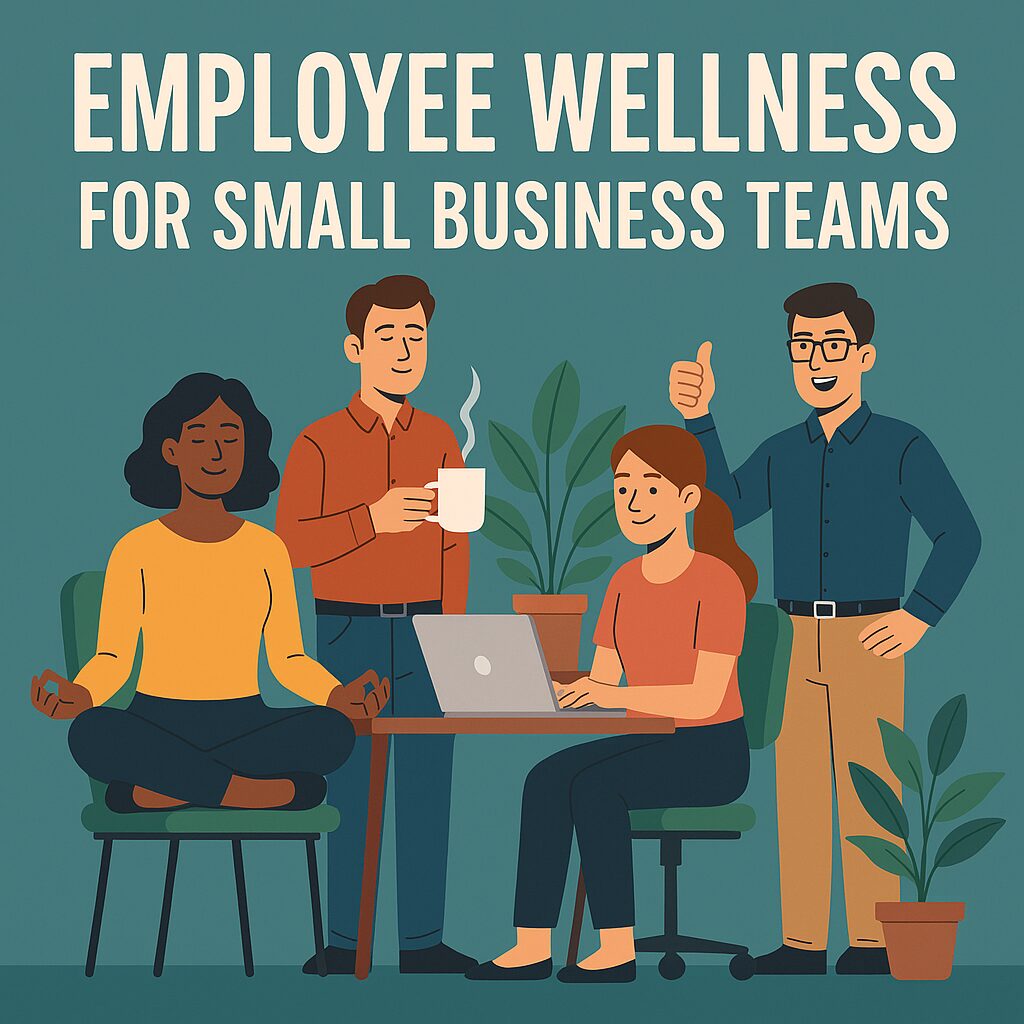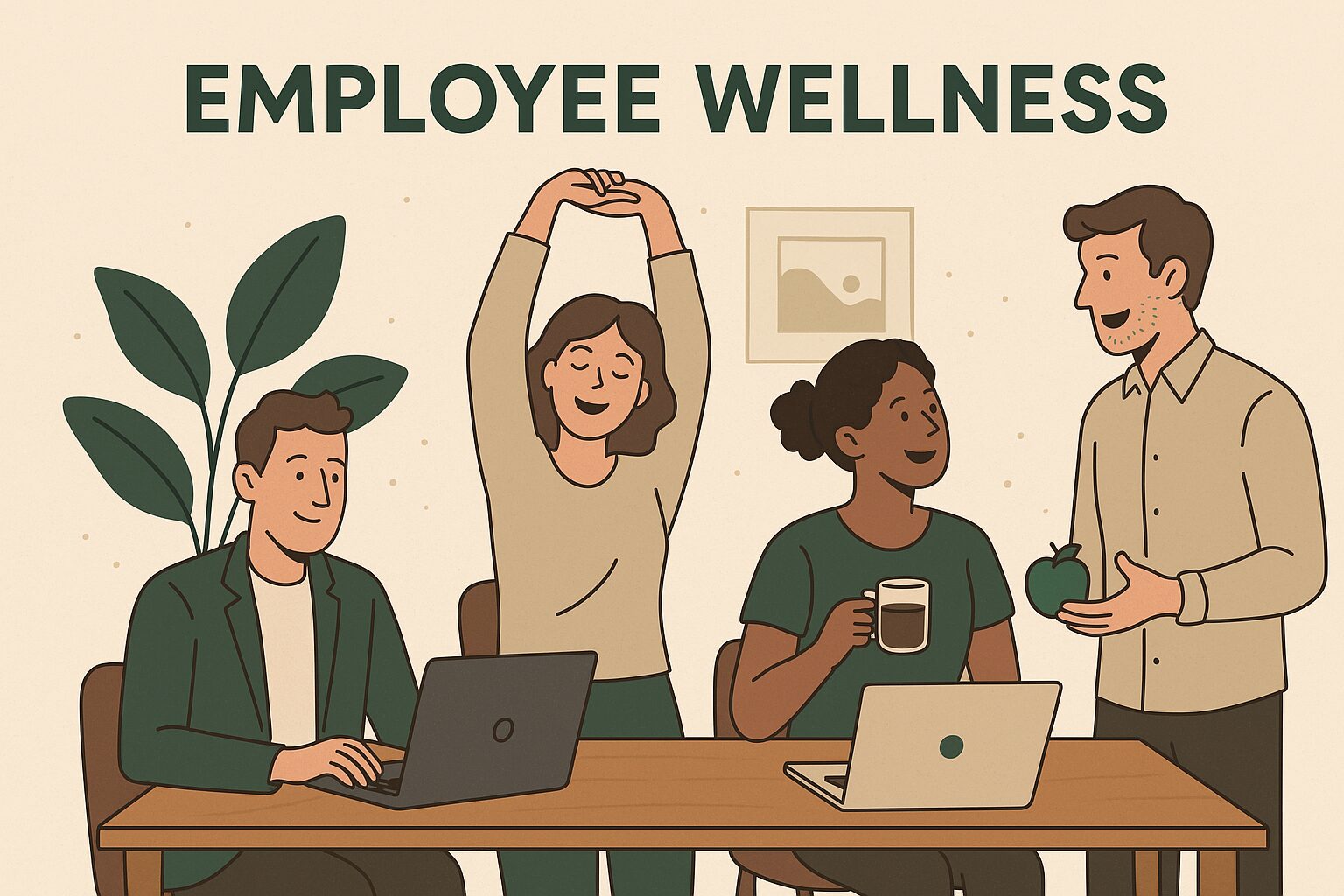
In a small business, people are the product, the brand, and the momentum. When energy dips, stress spikes, or burnout becomes “normal,” performance suffers quickly—and so do retention and culture. That is why employee wellness for small business is no longer a nice-to-have perk reserved for large companies; it is a practical way to protect productivity, strengthen small team culture, and keep great employees from quietly disengaging.
Workplace wellbeing goes far beyond gym discounts. It includes mental health, workload design, flexibility, physical comfort, and the daily signals that determine whether people feel safe to speak up. Research consistently links chronic workplace stress with reduced performance and higher turnover, and many surveys show burnout is a leading driver of quitting—a costly outcome for lean teams where every role is critical.
Below, you will see what wellness looks like in a small-team context and how to build it with affordable wellness programs, clearer boundaries, and stronger habits—not a big budget. You will also learn how to measure ROI, avoid common pitfalls, and turn wellbeing into a durable advantage through psychological safety, engagement, and sustainable growth.
Defining Employee Wellness for Small Business Teams: Scope, Priorities, and Practical Standards
Before launching any initiative, it helps to define what wellness actually means in a lean environment. Small teams feel disruption immediately, so the goal is a clear baseline—not a long list of perks. This section turns “wellbeing” into concrete, repeatable standards you can uphold.
When a team is eight people, everyone wears multiple hats, and a single sick day can derail a deadline, wellness has to stay practical. In small companies, that means focusing less on glossy benefits and more on the daily conditions that keep people steady, focused, and able to do good work without constantly running on fumes.
To make employee wellness for small business actionable, set a shared scope (what it includes and excludes), choose a few priorities, and define practical standards you can consistently uphold. The goal is not perfection; it’s building a baseline that prevents avoidable stressors from becoming “just how we operate.”
What “workplace wellbeing” looks like in a small team culture
Wellbeing becomes real when values translate into visible behaviors. This subsection highlights the day-to-day norms that signal whether your environment supports people or quietly drains them. Use it to clarify what “healthy work” looks like in practice.
In a lean team, workplace wellbeing often lives in the “micro-moments”: how requests are assigned, whether someone can ask for help without backlash, and how leaders respond when capacity is stretched. Because communication lines are short, culture is amplified—both the supportive parts and the unhealthy ones. In fact, one manager’s habits can influence the entire system faster than in a large enterprise.
Instead of chasing a long list of perks, many small businesses benefit from agreeing on minimum viable standards that protect energy and trust. These standards are especially useful during growth phases, when new hires need clarity and long-time employees need reassurance that the culture won’t degrade as pace increases.
- Predictable “how we work” rules (response-time expectations, meeting norms, and quiet hours).
- Fair workload signals (a consistent way to flag overload before it becomes burnout).
- Respectful boundaries (time off is real time off; urgent requests are clearly defined).
- Manager follow-through (commitments made in 1:1s are tracked and revisited).
A useful litmus test is simple: if a new team member asked, “What do you do here to prevent burnout?” could anyone answer in two sentences with examples? If not, wellbeing exists as intention, not infrastructure.
Key wellness domains: mental, physical, social, and financial wellbeing
Breaking wellness into domains makes it easier to assess and improve without getting overwhelmed. This subsection outlines four core areas and the signals that show where you are strong—or where friction is quietly accumulating. You do not need to treat each domain equally; you do need to know which ones are driving risk.
Why These Four Domains Matter for Small Teams
Mental wellbeing is often the highest-leverage domain for small teams because cognitive load is constant: context switching, customer escalations, and tight timelines. Support here looks like clear priorities, realistic deadlines, and psychological permission to surface problems early. Notably, the World Health Organization recognizes burnout as an occupational phenomenon, emphasizing the role workplace conditions play in chronic stress (World Health Organization).
Physical wellbeing matters even without a gym stipend. It includes basic ergonomic setups, movement breaks, and reasonable scheduling that prevents “work through lunch” from becoming routine. Small adjustments—monitor risers, better chairs purchased gradually, or a monthly ergonomic check-in—can reduce discomfort that quietly erodes attention and morale.
Social wellbeing reflects the health of relationships at work: trust, inclusion, and conflict handled early rather than avoided. In a small team culture, unresolved tension spreads quickly because people collaborate so closely. Simple rituals (structured retrospectives, rotating meeting facilitation, or a norm of documenting decisions) can reduce miscommunication and limit the interpersonal strain that often masquerades as “performance issues.”
Financial wellbeing is frequently overlooked, yet it shapes stress levels and retention. You may not be able to raise salaries overnight, but you can support stability with transparency and tools: clear pay bands where feasible, predictable schedules, and access to budgeting education. According to the American Psychological Association’s Stress in America reporting, money remains a common stressor for U.S. adults—an important reminder that “work stress” doesn’t stay neatly inside working hours.
- Mental: manageable workload, autonomy, support, access to help.
- Physical: ergonomic basics, movement, realistic pacing.
- Social: belonging, respectful conflict, psychological safety signals.
- Financial: predictability, clarity, resources that reduce uncertainty.
“The number one thing a leader can do is create clarity.” — Brené Brown
Clarity functions as a wellness intervention because it reduces the hidden tax of ambiguity—especially in teams where everyone is moving fast.
Aligning employee wellness for small business with business goals and capacity
Employee Wellness for Small Business: Wellness is easiest to sustain when it directly reduces operational pain. This subsection shows how to connect wellbeing efforts to outcomes leaders already track, so the work does not become another abandoned initiative. The focus stays on a few moves that fit your capacity and deliver visible impact.
Begin by identifying the “business cost” of low wellbeing in your context. In a service business, the cost may show up as missed response times and inconsistent quality. For a product team, it may appear as rework caused by rushed decisions. From there, choose one or two wellness priorities that directly address the bottleneck; that alignment is what keeps affordable wellness programs from feeling optional when revenue fluctuates.
Capacity-based standards are often the most reliable approach—rules that protect the team during peak periods rather than relying on willpower. Examples include a two-week “no new priorities without trade-offs” policy during launches, or a lightweight workload review in weekly planning. These operational policies also serve as burnout prevention.
- If retention is the pain: focus on manager 1:1 quality, growth pathways, and predictable time off.
- If productivity is uneven: reduce context switching, tighten prioritization, and redesign meetings.
- If customer issues spike: add recovery time after escalations and clarify on-call boundaries.
- If morale feels fragile: invest in conflict norms, recognition habits, and transparent decision-making.
Define success in terms the team can observe within 30–60 days: fewer after-hours messages, more accurate delivery estimates, lower “urgent” rework, or improved pulse-check scores. When employee wellness for small business becomes part of operating discipline—not a side project—it is easier to fund, easier to defend, and far more likely to last.
Why Wellness Drives Results: Productivity, Employee Retention Strategies, and Culture
Wellness can sound “soft” until you look at the operational cost of depleted teams. In lean environments, fatigue quickly becomes missed details, uneven quality, and slower customer response. This section connects wellbeing to outcomes small businesses track every week—so the case for wellness stays practical, not theoretical.
If wellness feels optional, ask a harder question: how much does it cost when a small team runs tired? In lean operations, fatigue shows up as missed details, slower customer response, uneven quality, and people quietly checking out. What starts as a morale issue often becomes a delivery issue—then a revenue issue.
To keep the link concrete, the focus below stays on measurable outcomes: output, error rates, retention, and team reliability. The point is not to justify perks; it’s to show why consistent wellness standards function like an operating system for performance.
The link between wellness, output, and error reduction (key stats to include)
Productivity improves when teams work within human limits—attention, recovery, and decision quality. This subsection explains how stress and burnout degrade output, and why modest process changes can reduce mistakes and rework. The aim is not “work less,” but work better with fewer preventable failures.
Burnout is more than feeling overwhelmed; it is a measurable risk factor for avoidable errors. A large meta-analysis in PLOS ONE found burnout was associated with approximately double the odds of patient safety incidents—evidence from healthcare, but the mechanism translates across roles: depleted attention increases mistakes, and mistakes create rework. In a small business, rework is expensive because it consumes your scarcest resource: focused time.
Chronic stress also interferes with cognitive function. The American Psychological Association notes that ongoing stress can impair concentration, memory, and decision-making. In practice, that shows up as “simple” oversights: shipping the wrong item, forgetting to follow up, missing a step in a process, or misreading a customer request.
- Lower error rates: fewer preventable mistakes when attention is not fragmented by overload.
- Faster cycle time: less rework and fewer last-minute escalations that disrupt the whole week.
- More consistent output: steadier delivery beats occasional hero sprints followed by drop-offs.
- Better prioritization: clearer minds make clearer trade-offs, reducing “busy but stuck” weeks.
Consider a simple example: a two-person customer support function that adds mandatory decompression time after escalations (even 10–15 minutes) often sees fewer tone mistakes and less back-and-forth. It is a wellness move that also functions as quality control.
Wellness as a driver of employee retention strategies and reduced hiring costs
Retention is one of the clearest financial arguments for wellness in small teams. This subsection explains how wellbeing reduces avoidable turnover and stabilizes execution, especially during growth. The emphasis stays on the practical reality: replacing people costs time, money, and momentum.
Replacing a team member is rarely “just recruiting.” It includes lost context, slowed delivery, manager time, and the ripple effect on customers. According to SHRM, replacement costs are commonly cited at 50%–60% of an employee’s annual salary, and can be higher for specialized roles. Even if your internal number differs, the direction is clear: churn is expensive, and small teams feel it immediately.
Wellness improves retention by addressing the conditions that trigger exit decisions: chronic overload, low control, unclear expectations, and lack of recovery. Compensation matters, but many departures start earlier with “I can’t keep doing this pace” rather than “I found a higher salary.” That is why employee retention strategies often work best when paired with burnout prevention policies that are visible and consistently enforced.
- Reduce regrettable turnover: protect top performers from becoming the “default catch-all.”
- Shorten vacancy disruption: fewer surprise resignations means more predictable planning.
- Lower hiring pressure: less urgent recruiting reduces bad-fit hires made in a panic.
- Preserve institutional knowledge: fewer resets of processes, customer history, and standards.
One low-cost intervention is a 30-day workload audit after major launches: identify what expanded permanently (support load, maintenance, meetings) and remove or delegate one recurring obligation. This directly reduces “new normal” creep that often pushes people out.
How employee wellness for small business strengthens trust, collaboration, and accountability
Wellness influences performance through how people coordinate, speak up, and follow through. This subsection shows how wellbeing practices strengthen small team culture by making work safer to discuss and easier to plan—without lowering standards. In short, wellness supports accountability by reducing fear and ambiguity.
When capacity is respected, people are more willing to be honest early—before problems become crises. That honesty is the foundation of psychological safety, a concept widely associated with effective teams. In Google’s research on team effectiveness (Project Aristotle), psychological safety emerged as the most important dynamic: teams performed better when members felt safe to take interpersonal risks, such as admitting a mistake or asking for help.
Collaboration also improves when wellness standards reduce hidden resentment. If one person is always “the hero” answering messages at night, others either follow (and burn out) or disengage (and conflict grows). By contrast, norms like defined escalation rules, documented decisions, and realistic deadlines create a fairer environment—one where accountability is based on clear commitments, not endurance.
- Trust increases when time off is honored and workload conversations are normal, not taboo.
- Collaboration improves when people can ask for support without being labeled “not resilient.”
- Accountability strengthens when priorities are explicit and trade-offs are visible to everyone.
- Conflict becomes more productive because issues are addressed earlier, with less emotional charge.
“Trust is built in very small moments.” — Brené Brown
Those “small moments” are often wellness moments: how a manager responds to an overload signal, whether a deadline shifts when scope expands, or whether a mistake is treated as data rather than blame. Over time, employee wellness for small business becomes a culture engine—supporting high standards without requiring people to sacrifice their health to meet them.
Affordable Wellness Programs and Burnout Prevention Without a Big Budget
Employee Wellness for Small Business: Not every wellness improvement requires spending money; many of the biggest gains come from changing how work moves through the team. In small organizations, the fastest wins usually come from reducing preventable friction and making capacity visible. This section focuses on practical, low-cost moves that reduce burnout risk while improving reliability.
What if the most effective “wellness benefit” in your company isn’t a stipend at all—but a few decisions about how work flows? In small organizations, the fastest wins often come from removing friction: unclear priorities, nonstop urgency, and invisible workload.
The goal here is to treat affordable wellness programs as operational upgrades. When designed well, they reduce burnout risk, protect focus, and make performance more consistent—without adding a heavy HR burden.
Low-cost mental health supports that improve engagement and performance
Mental health support does not require an in-house therapy program. This subsection outlines practical, low-cost ways to reduce cognitive strain, encourage early help-seeking, and improve engagement—especially in high-context, fast-moving roles. The focus stays on access, clarity, and leader follow-through.
Start with access and clarity. Many small businesses already offer an Employee Assistance Program through their benefits broker, yet utilization stays low because people don’t know it exists or doubt confidentiality. A simple fix is a quarterly “how to get help” reminder that lists anonymous options (EAP, community clinics, telehealth) and exactly how to access them.
Then build “manager-as-signal” skills. Training does not need to be expensive: a shared 60-minute session on how to respond when someone discloses stress (“thank you,” “what would help,” “let’s adjust load”) can prevent the common failure mode of good intentions followed by no change. The CDC emphasizes that workplace mental health is strongly shaped by job demands and organizational support—meaning leaders have leverage even without large budgets.
- Normalize micro check-ins: one question in 1:1s such as “What feels heavy right now?”
- Offer focus protection: meeting-free blocks or “deep work mornings” reduce mental overload.
- Provide curated resources: a one-page list of local/virtual counseling and crisis lines.
- Create decompression norms: after a difficult customer escalation, require a short reset.
“Rest is not idleness, and to lie sometimes on the grass under trees on a summer’s day… is by no means a waste of time.” — John Lubbock
Flexible work policies for burnout prevention and sustainable workloads
Flexibility works best when it is treated as a capacity tool, not a vague perk. This subsection offers small, explicit, enforceable policies that reduce “always on” pressure and protect sustainable workloads. The key is making expectations clear enough to apply during high-stress weeks.
Defining what truly counts as “urgent” is one of the highest-impact moves. Without that definition, everything becomes urgent—and burnout becomes predictable. Use a two-tier system: (1) true emergencies with a clear response window and escalation path, and (2) normal work with agreed response times. The result is less stress signaling and fewer interruptions.
Flexibility also requires fair boundaries. A remote employee receiving messages at midnight is not experiencing flexibility; they are absorbing organizational anxiety. Lightweight guardrails—such as core collaboration hours (e.g., 10 a.m.–3 p.m.) and an expectation that after-hours messages do not require replies unless explicitly tagged urgent—reduce pressure without slowing execution.
- Trade-off rule: “If a new priority enters, something else must move.”
- Capacity check: 10 minutes in weekly planning to flag overload and reassign work.
- Time-off protection: require a backup owner for critical tasks before PTO starts.
- Predictable scheduling: publish schedules earlier for shift teams to reduce stress.
Building psychological safety: norms, leadership behaviors, and communication rituals
Psychological safety is built through repeated interactions, not slogans. This subsection focuses on small rituals that make it safer to raise concerns, admit mistakes, and ask for help—while keeping standards high. The aim is to make truth-telling easier than image management.
Two norms often reduce fear quickly: “problems are shared early” and “bad news travels fast.” Leaders reinforce these by reacting with curiosity instead of blame. When a mistake happens, asking “What in the system made this likely?” before “Who did this?” turns errors into learning rather than silence.
Consistency comes from rituals. A short weekly retro using three prompts (Start/Stop/Continue) is often enough to surface tension before it calcifies. If conflict avoidance is common, a decision log—who decided, what was decided, and why—reduces second-guessing and the stress of ambiguous ownership.
- Meeting close-out: “What’s one risk we’re not saying out loud?”
- 1:1 commitment tracking: write down actions and revisit them next week.
- Blameless post-mortems: document contributing factors and prevention steps.
- Recognition with specificity: praise the behavior, not the personality (“You clarified scope early”).
“It is not enough to be busy; so are the ants. The question is: What are we busy about?” — Henry David Thoreau
Budget-friendly physical wellness options: movement, ergonomics, and healthy habits
Employee Wellness for Small Business: Physical wellness can be improved through better defaults rather than expensive perks. This subsection highlights low-cost ways to reduce everyday fatigue and discomfort that quietly undermine attention. The intent is to make the healthy choice the easy, normal choice.
Ergonomics is often a quiet ROI winner. Neck pain, wrist strain, and poor seating degrade attention over time—then show up as irritability and slower work. Instead of buying everything at once, offer a modest “ergonomics priority list” and improve one item per person over a few months (monitor riser, lumbar support, external keyboard). The Occupational Safety and Health Administration notes that ergonomic improvements can reduce the risk of musculoskeletal disorders—an issue that affects both office and light-industrial roles.
Movement can be supported without forcing “fitness culture.” A two-minute stretch at the start of a shift meeting, walking 1:1s, or a “stand-and-reset” rule between long calls helps people recover. Pair it with healthier defaults such as water access, planned breaks for shift teams, and realistic expectations around lunch.
- Micro-break norm: 5 minutes off-screen every 60–90 minutes when feasible.
- Ergonomic self-check: monthly prompt with a photo of the workstation for quick fixes.
- Healthy meeting design: cap recurring meetings at 25/50 minutes to add breathing room.
- Snack strategy: low-cost fruit/nuts instead of only high-sugar options.
Tailoring employee wellness for small business initiatives to shift work, remote, and hybrid teams
Wellness only works when it matches how work actually happens. This subsection shows how to adapt employee wellness for small business initiatives across shift, remote, and hybrid setups so support stays equitable. The goal is consistency in outcomes, even when schedules and environments differ.
For shift teams, the biggest levers are predictability and recovery. Publish schedules as early as possible, minimize last-minute changes, and ensure breaks are real rather than “when it slows down.” If overtime is frequent, treat it like an exception requiring leadership review—otherwise it quietly becomes the operating model.
Remote and hybrid teams need deliberate connection without meeting overload. Replace “presence” with outcomes by clarifying deliverables, reducing status pings, and relying on written updates. To prevent isolation, add small rituals that do not demand extra hours: a rotating buddy check-in, asynchronous kudos, and a clear pathway to raise concerns privately.
- Shift teams: protected breaks, fair rotations, and clear handoff checklists.
- Remote teams: written norms, fewer interruptions, and explicit “offline” expectations.
- Hybrid teams: meeting equity (no side conversations), shared notes, and consistent decision logs.
The through-line is fairness: people should not need to be the loudest voice—or work the latest hours—to access support. When wellness practices are tailored to how work really operates, they stop feeling like “extra” and start functioning as burnout prevention infrastructure.
Measuring ROI and Building Long-Term Advantage Through Employee Wellness for Small Business
Without measurement, wellness can feel like a set of good intentions competing with payroll and deadlines. Small teams have an advantage here: changes show up quickly when you track the right signals. This section focuses on lightweight measurement and feedback so improvements stay visible and durable.
When progress is hard to see, wellness can start to feel like “nice ideas” rather than operational discipline. The good news is that small teams often see results faster—if they track the right signals. This section explains what to measure, how to measure it without heavy tooling, and how to turn wellbeing into a durable advantage rather than a short-lived initiative.
Choosing metrics: absenteeism, turnover, engagement, and performance indicators
Metrics work best as a small set of leading and lagging indicators. Lagging indicators (like turnover) show what already happened; leading indicators (like workload strain and engagement) provide time to intervene. This subsection keeps measurement practical and tied to cost, capacity, and reliability.
Four categories typically map well to lean operations. Absenteeism and turnover are straightforward to quantify; engagement and performance indicators take slightly more structure, but they show where burnout prevention is working—or quietly failing.
- Absenteeism: track unplanned sick days per person per quarter and patterns around launches or peak seasons.
- Turnover: voluntary exits, regrettable turnover (top performers), and tenure at exit.
- Engagement: pulse scores (e.g., “I can sustain my workload” or “I know what success looks like this week”).
- Performance indicators: error/rework rates, cycle time, customer escalations, and on-time delivery.
A practical way to estimate ROI is to connect improvements to concrete costs. For example, if a retention-focused wellness change prevents one departure, you avoid replacement costs that are often substantial; SHRM commonly cites total replacement cost ranges around 50%–60% of salary (often higher for specialized roles). Even if your internal number is lower, preventing churn can fund several months of modest wellness investments.
Avoid “vanity metrics” like participation in a single activity. Someone can attend a mindfulness session and still be overloaded. When possible, treat wellness as an operating input and measure outputs that matter: fewer emergencies, more predictable delivery, and less after-hours spillover.
Employee Wellness for Small Business: Simple feedback systems and lightweight reporting for small teams
Feedback only works when it is consistent and leads to visible action. This subsection outlines lightweight loops that fit into existing meetings and help leaders catch strain early. The goal is a system that is simple enough to sustain and meaningful enough to trust.
A monthly pulse check that takes under two minutes is often enough. Use 3–5 questions on a 1–5 scale plus one optional open-text prompt, and keep questions stable for at least a quarter so trends mean something. Most importantly, share results back to the team—otherwise feedback trains people to disengage.
- Capacity: “My workload is manageable this week.”
- Clarity: “I understand the top priorities and trade-offs.”
- Recovery: “I can disconnect outside working hours.”
- Support: “If I raise a problem early, it will be handled constructively.”
- Open prompt: “What’s one thing we should stop to protect focus?”
For lightweight reporting, use a one-page “wellness ops” note each month: 2 trend lines (e.g., sick days and pulse capacity score), 1 insight, and 1 commitment. The commitment matters most. If the team flags meeting overload, commit to a specific experiment such as capping recurring meetings at 25/50 minutes or removing one standing sync.
Finally, consider a quarterly “stay interview” for key roles: a short conversation about what makes the job sustainable and what might cause someone to leave. It is a retention tool disguised as listening. As management scholar Peter Drucker is often quoted, “What gets measured gets managed.” For small teams, the practical extension is simple: what gets discussed gets improved.
Common mistakes small businesses make when launching wellness initiatives
Wellness can backfire when it feels disconnected from real workload and planning. This subsection highlights common pitfalls that create cynicism, so efforts build credibility rather than “initiative fatigue.” The emphasis stays on avoiding mismatches between messages and day-to-day reality.
A frequent misstep is treating wellness as an add-on rather than a constraint in planning. If deadlines remain unrealistic, a new meditation app becomes one more task. A related issue is performative wellness: announcing support while ignoring the operational drivers of stress (constant scope changes, unclear ownership, chronic understaffing).
- Perks without workload change: activities are offered, but capacity is never adjusted.
- One-size policies: remote, shift, and in-person realities are treated as identical.
- Privacy mistakes: asking for personal health details instead of focusing on work conditions.
- No manager enablement: leaders aren’t trained to respond when someone flags overload.
- Inconsistent enforcement: boundaries exist on paper but collapse during pressure.
Another subtle failure mode is relying on a single champion. When wellness depends on one person’s energy, it disappears the moment that person gets busy—or leaves. Instead, assign ownership like any other operational area: one person maintains the pulse survey, another tracks time-off coverage, and leaders commit to one behavior change per quarter.
“Culture is what happens when no one is watching.” — Henry Cloud
If after-hours messaging rules vanish the first time a client escalates, the “real” culture has been revealed. Small teams build trust by doing the hard part: keeping standards during stressful weeks, not only during calm ones.
Long-term competitive advantages of investing in people: brand, hiring, and resilience
Some benefits of wellness appear on a spreadsheet; others compound over time. This subsection connects employee wellness for small business to durable advantages such as recruiting strength and operational resilience. The through-line is stability: healthier systems hold up better under pressure.
ROI isn’t only a line item; it is also the compounding effect of stability. A healthy culture becomes a recruiting asset because candidates increasingly evaluate employers on sustainability, not just salary. Public review platforms and referral networks make your internal reality visible, and clear norms around workload, time off, and conflict create a credible employer brand that attracts people who prefer clarity over chaos.
Resilience is a less obvious dividend. Businesses with better recovery norms handle unexpected events—supply issues, customer escalations, short-staffed weeks—without defaulting to panic. That matters because repeated “emergency mode” erodes decision quality. According to the American Psychological Association, chronic stress can impair concentration and decision-making, which is exactly what you can’t afford when margins are thin and choices are frequent.
- Brand: customers experience steadier service when teams aren’t constantly depleted.
- Hiring: stronger referrals and lower “sell effort” when culture is consistently described.
- Retention: fewer surprise exits preserves continuity and institutional knowledge.
- Execution: predictable capacity enables better planning and more accurate promises.
Over time, wellness becomes a strategic moat: competitors can copy pricing and products faster than they can copy a high-trust, sustainable operating system. That is the long game—turning workplace wellbeing into a repeatable advantage that supports growth, not an expense revisited only after burnout forces your hand.
Wellness as a Small Business Growth System, Not a Luxury
Wellness is most effective when it is treated as part of how the business runs, not a side initiative. In small teams, small changes compound quickly—especially when standards remain intact during stressful periods. This closing section ties the message together without rehashing every tactic.
Employee wellness for small business works best as operating discipline: clear expectations, sustainable capacity, and everyday norms that protect attention and trust. When those standards are consistent—and paired with lightweight measurement—wellbeing becomes a practical advantage: steadier execution, stronger retention, and a culture built for endurance rather than emergency mode.
Bibliography
American Psychological Association. “Stress in America.” Accessed February 13, 2026. https://www.apa.org/pubs/reports/stress-in-america.
American Psychological Association. “Stress and the Body.” Accessed February 13, 2026. https://www.apa.org/topics/stress/body.
Centers for Disease Control and Prevention. “Mental Health in the Workplace.” Accessed February 13, 2026. https://www.cdc.gov/workplacehealthpromotion/health-strategies/mental-health/index.html.
Occupational Safety and Health Administration. “Ergonomics.” Accessed February 13, 2026. https://www.osha.gov/ergonomics.
Rework with Google. “Guide: Understand Team Effectiveness (Project Aristotle).” Accessed February 13, 2026. https://rework.withgoogle.com/print/guides/5721312655835136/.
SHRM. “Talent Acquisition.” Accessed February 13, 2026. https://www.shrm.org/topics-tools/tools/toolkits/talent-acquisition.
World Health Organization. Burn-out an “occupational phenomenon”: International Classification of Diseases. Geneva: World Health Organization, 2019. Accessed February 13, 2026. https://www.who.int/publications/i/item/9789240003927.
World Health Organization. International Classification of Diseases 11th Revision (ICD-11). Geneva: World Health Organization, 2019. Accessed February 13, 2026. https://icd.who.int/.
Hall, Louise H., Judith Johnson, Ian Watt, Sonia Tsipa, and Daryl B. O’Connor. “Healthcare Staff Wellbeing, Burnout, and Patient Safety: A Systematic Review.” PLOS ONE 11, no. 7 (2016): e0159015. https://pubmed.ncbi.nlm.nih.gov/26978401/.