A Comprehensive Guide to Small Business Funding Options
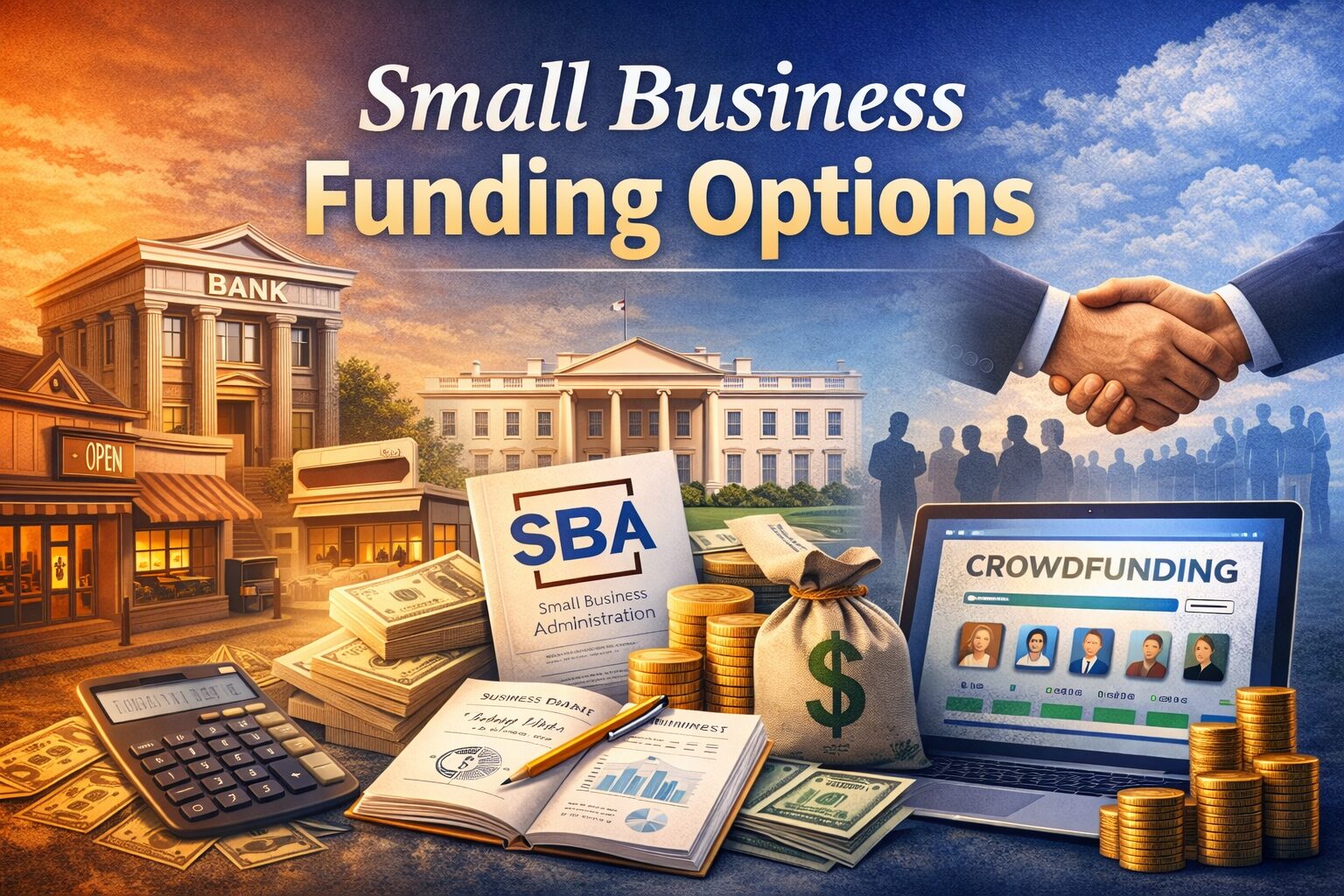
Launching and operating a small business requires substantial financial resources. Whether funds are needed for hiring staff, expanding operations, or purchasing inventory, funding is crucial for small businesses to grow and succeed. However, obtaining capital can be a difficult undertaking, especially for new entrepreneurs. This article examines the range of funding options available, from conventional financing options to non-traditional approaches such as equity financing and crowdsourcing.
Traditional Lending and Government Small Business Funding Options
Despite the explosion of digital fintech solutions, the vast majority of entrepreneurs still look to established institutions for capital. The stability and structure offered by conventional financial systems remain attractive to business owners aiming for long-term sustainability. This section explores the primary avenues of traditional finance, ranging from commercial banking products to federal assistance programs designed to mitigate risk for lenders and borrowers alike.
Before committing to a specific financial product, it is essential to understand the distinctions between standard bank loans and revolving credit. While both provide necessary capital, they serve different operational needs and come with unique qualification standards.
Bank-Based Small Business Funding Options and Credit Lines
Securing a commercial loan remains a cornerstone strategy for accessing capital. Banks typically offer term loans, providing a lump sum upfront, which simplifies long-term financial planning through fixed interest rates and predictable repayment schedules. This funding structure is often utilized for significant capital expenditures, such as purchasing real estate, acquiring other companies, or heavily investing in equipment. However, accessing these funds can be a rigorous process; banks generally require collateral—such as property or inventory—and a pristine credit history to mitigate their risk.
Conversely, a business line of credit offers a fluid solution for managing operational costs. Similar to a credit card, this option provides access to funds up to a limit, allowing borrowers to withdraw money only when necessary, making it ideal for controlling fluctuations in cash flow. Unlike term loans, interest is typically charged only on the amount actually drawn, not the total credit limit. Business owners should be aware, however, that lines of credit often carry variable interest rates, which can increase the cost of borrowing if market rates rise.
While private banks offer direct lending, many entrepreneurs find it difficult to meet the strict underwriting criteria required for conventional loans. To bridge this gap, the federal government has established programs that reduce the risk for lenders, thereby opening doors for small businesses that might otherwise be rejected.
Overview of Small Business Administration (SBA) Loan Programs
The Small Business Administration (SBA) operates differently than direct lenders; instead of lending money directly, it provides a guarantee to banks for a portion of the loan. This federal backing encourages lenders to approve financing for small businesses that may lack sufficient collateral or a long operating history. The most common vehicle is the 7(a) Loan Program, which can be used for working capital, expansion, and equipment. Another popular option is the 504 Loan Program, specifically designed for purchasing fixed assets like real estate or heavy machinery to promote business growth and job creation.
Utilizing SBA programs offers distinct advantages regarding affordability and terms. Because the government backs these financial instruments, they often feature lower down payments and longer repayment terms compared to non-guaranteed bank loans. This structure significantly lowers monthly payments, preserving vital cash flow for the borrower. According to data from the U.S. Small Business Administration, these programs have supported millions of jobs by providing capital that the private sector alone would not supply.
Prospective borrowers must be prepared for a thorough vetting process. The application timeline for SBA loans can be lengthy, often requiring:
- Extensive financial documentation, including tax returns and profit and loss statements.
- A detailed business plan demonstrating the ability to repay.
- Personal background checks and statements of personal history.
For entrepreneurs who may not need large-scale bank financing or who operate in niche sectors, other avenues exist. Specifically, grant funding and micro-lending institutions provide targeted support for specific demographics and economic development goals.
Government Grants and Non-Profit Microloan Opportunities
Government grants represent a unique form of funding that does not require repayment, making them highly sought after. However, they are rarely provided for general business startup costs or operational expenses. Instead, federal, state, and local governments allocate these funds to specific projects that align with public policy goals, such as scientific research and development, environmental conservation, or economic revitalization in rural areas. For example, the Small Business Innovation Research (SBIR) program specifically targets companies engaged in high-tech innovation. Because these funds are essentially “free,” the competition is intense, and eligibility requirements are strictly enforced.
When grants or traditional bank loans are out of reach, microloans offered by non-profit organizations and Community Development Financial Institutions (CDFIs) act as a vital alternative. These lenders often prioritize social impact over pure profit, targeting underserved entrepreneurs, including women, minorities, and those in low-income communities.
“CDFIs bridge the gap between Wall Street and Main Street, ensuring that capital reaches the businesses that need it most but are often overlooked by traditional finance.” — Opportunity Finance Network
While the loan amounts are generally smaller—typically under $50,000—micro-lenders often provide more than just money. They frequently offer mentorship, technical assistance, and flexible underwriting criteria that consider the entrepreneur’s character and business potential rather than just a credit score. This holistic approach helps fledgling business owners build the credit history necessary to eventually graduate to traditional banking products.
Equity Financing and Private Investment Channels
Is the prospect of monthly debt service preventing your startup from scaling at the necessary speed? While loans provide capital without sacrificing ownership, the obligation to make immediate and regular repayments can strangle the cash flow of a high-growth enterprise. For businesses with aggressive expansion targets, seeking partners who are willing to bet on future profitability in exchange for a stake in the company is often the superior strategy. This section analyzes the landscape of private investment, navigating the complexities of sharing ownership to fuel exponential growth.
Before approaching external partners, entrepreneurs must weigh the long-term implications of bringing on shareholders. Unlike a bank loan, which ends once the debt is settled, equity financing creates a permanent relationship that alters the decision-making structure of the organization.
Evaluating Equity Small Business Funding Options
Equity financing involves raising capital by selling shares of the business to investors, effectively trading a portion of ownership for immediate cash. This method is distinct from debt financing because there is no obligation to repay the funds if the business fails, nor are there monthly interest payments to manage. This financial freedom allows companies to reinvest every dollar of revenue back into product development, marketing, and talent acquisition, making it an ideal route for startups in the pre-revenue or rapid scaling phases. Common vehicles for this type of funding include initial public offerings (IPOs) for mature companies, private placements, and equity crowdfunding platforms.
Accepting this capital comes with a specific cost: dilution of control. When business owners issue common stock or preferred stock to investors, they are ceding a percentage of their future profits and, frequently, voting rights regarding corporate strategy. Investors may require a seat on the board of directors or veto power over significant operational changes. Furthermore, businesses may utilize instruments like convertible debt, a loan that automatically turns into equity upon a future financing round, to bridge the gap between seed funding and larger investment stages.
“Equity is the most expensive money you will ever take because you are giving away a piece of the future value of your company, which could be limitless.” — Harvard Business Review
Once a business owner decides that shedding equity is preferable to servicing debt, the next challenge is identifying the right type of investor. Not all capital sources operate with the same goals, timelines, or involvement levels.
Distinctions Between Angel Investors and Venture Capitalists
Although both groups provide capital in exchange for equity, angel investors and venture capitalists (VCs) serve different stages of a company’s lifecycle and operate under vastly different incentives. Angel investors are typically high-net-worth individuals who invest their own personal funds into early-stage startups or entrepreneurs with whom they feel a personal connection. Because they are investing their own money, they often make decisions faster and are willing to take risks on unproven ideas. Angels frequently provide mentorship and industry connections, acting as a bridge for companies that are too young for institutional funding but too large for friends and family financing.
Venture capitalists, conversely, are professional employees working for firms that invest pooled capital from limited partners, such as pension funds, endowments, and corporations. Consequently, VCs have a fiduciary duty to maximize returns, leading them to focus on companies with proven traction and the potential for massive scale—often seeking a 10x return on investment within a five to seven-year horizon. VCs typically inject significantly larger sums of money, often in the millions, but they also demand rigorous corporate governance, formalized reporting, and a clear exit strategy, such as an acquisition or an IPO.
Securing a meeting with these investors is merely the first step; converting interest into a signed check requires a meticulous approach to presentation and negotiation.
Procedures for Approaching and Negotiating with Investors
Accessing the world of private investment requires more than just a solid business idea; it demands a strategic networking approach and a compelling narrative. Cold emails rarely succeed in this arena. Instead, entrepreneurs should leverage industry conferences, online investment platforms like AngelList, and local incubator events to build warm introductions. Once a connection is made, the cornerstone of the fundraising process is the pitch deck—a concise presentation that must articulate the unique value proposition, the size of the total addressable market, and the team’s ability to execute.
When investors show interest, the conversation shifts to due diligence and negotiation. This phase involves a deep dive into the company’s financial records, legal standing, and intellectual property. The critical point of negotiation is usually the pre-money valuation of the company, which determines how much equity the founder must give up for the investment amount. Entrepreneurs must also navigate the term sheet, a non-binding agreement that outlines the specific conditions of the investment.
Key elements to scrutinize in a term sheet include:
- Liquidation preferences, which dictate who gets paid first if the company is sold.
- Anti-dilution provisions that protect investors if the company raises money later at a lower valuation.
- Vesting schedules for founder shares to ensure long-term commitment.
- Board seat composition and voting rights on key operational decisions.
Because these agreements define the long-term relationship between the founders and their backers, it is highly recommended to engage legal counsel specializing in venture finance to ensure the terms are equitable and do not stifle future fundraising efforts. According to data from the National Venture Capital Association, companies that engage experienced legal teams during seed rounds face fewer governance disputes as they scale toward exit.
Modern and Alternative Small Business Funding Options
Has the digital revolution rendered the traditional bank manager obsolete for certain types of entrepreneurs? While established financial institutions remain a cornerstone of the economy, the rise of financial technology, or fintech, has democratized access to capital in unprecedented ways. For business owners who do not fit the rigid criteria of commercial banks or the high-growth profile required by venture capitalists, these modern avenues offer flexibility and speed. This section explores the landscape of alternative finance, where algorithms, community support, and creative asset utilization replace standard underwriting procedures.
Before diving into specific platforms, it is crucial to recognize that ease of access often comes with a premium. Alternative financing typically emphasizes speed and convenience over low interest rates, requiring borrowers to carefully calculate the cost of capital against their immediate liquidity needs.
Crowdfunding Models for Capital Generation
Crowdfunding has transformed the fundraising landscape by allowing entrepreneurs to solicit small contributions from a vast number of individuals, typically via internet platforms. This method serves a dual purpose: it generates necessary funds while simultaneously acting as a powerful mechanism for market validation. If a concept garners significant support from the general public, it proves to future stakeholders that there is tangible demand for the product. However, running a successful campaign requires more than just a good idea; it demands a sophisticated marketing strategy and a compelling narrative to cut through the digital noise.
There are distinct types of crowdfunding, each governed by different regulations and expectations:
- Rewards-based crowdfunding: Backers contribute money in exchange for a “perk,” usually the product itself being pre-sold at a discount. This is ideal for B2C product launches.
- Equity crowdfunding: Investors receive actual shares or ownership stakes in the company. This is a more complex legal process regulated by the SEC.
- Debt crowdfunding: Similar to a loan, money is raised from the crowd with a promise to repay it with interest by a specific date.
While this approach bypasses traditional gatekeepers, it is not without risk. A failed campaign remains public, potentially damaging the brand’s reputation before it launches. Furthermore, fulfilling rewards for thousands of backers can create logistical bottlenecks if not properly planned. According to an analysis by Fundera, successful campaigns often require months of preparation and a pre-existing community of supporters to gain early momentum.
Invoice Financing and Merchant Cash Advances
For businesses that operate in the B2B sector or have high credit card transaction volumes, funding can often be secured by leveraging existing assets rather than taking on new debt. Invoice financing, also known as accounts receivable financing, allows companies to borrow against the value of their outstanding customer invoices. This provides immediate liquidity to cover operational expenses while waiting for clients to pay, which is particularly vital for industries with long billing cycles like construction or manufacturing. The lender advances a percentage of the invoice amount—typically 80% to 90%—and releases the remainder, minus fees, once the customer settles the bill.
Alternatively, a Merchant Cash Advance (MCA) is designed for businesses with a high volume of daily credit card sales, such as restaurants and retail stores. In this arrangement, a financing company provides a lump sum of capital in exchange for a percentage of future daily credit card receipts.
“While MCAs offer the fastest access to cash, often within 24 hours, they carry effective annual percentage rates (APRs) that can exceed triple digits, making them a capital source of last resort.” — The Federal Reserve
Business owners must approach MCAs with extreme caution. Unlike a loan with a fixed maturity date, the repayment timeline fluctuates with sales volume. If sales dip, the daily withdrawal becomes a larger burden on cash flow, potentially trapping the business in a cycle of debt. These options prioritize speed and accessibility over affordability, making them suitable primarily for short-term emergencies rather than long-term growth investments.
Peer-to-Peer Lending and Revenue-Based Small Business Funding Options
The emergence of Peer-to-Peer (P2P) lending platforms has removed the financial intermediary, directly connecting borrowers with individual investors. By utilizing proprietary algorithms that analyze data points beyond just a credit score—such as social media presence and educational history—these platforms can often approve borrowers who might be rejected by traditional banks. The interest rates for P2P loans are generally competitive, though they vary significantly based on the assessed risk grade of the applicant. This model offers a streamlined, fully digital application process that appeals to tech-savvy entrepreneurs looking for efficiency.
Another innovative model gaining traction is Revenue-Based Financing (RBF), also known as royalty-based financing. In this structure, investors inject capital in exchange for a fixed percentage of the company’s gross monthly revenue until a predetermined amount—usually the principal plus a multiple (cap)—is repaid.
This model aligns the interests of the lender and the borrower uniquely:
- Flexible payments: In months where revenue is low, the payment amount decreases, preserving cash for operations.
- No equity dilution: Unlike venture capital, founders retain full ownership and control of their business.
- Performance focus: Lenders are invested in the company’s growth since higher revenue means faster repayment.
RBF is particularly well-suited for SaaS (Software as a Service) companies or e-commerce brands with strong gross margins but irregular growth patterns. By avoiding the fixed monthly obligations of a bank loan and the control loss of equity financing, revenue-based models offer a middle ground for sustainable scaling.
Strategies for Selecting and Securing Capital
With a myriad of financial pathways laid out—from the stability of federal loans to the agility of fintech algorithms—the challenge for entrepreneurs shifts from discovery to decision. How does a business owner navigate this labyrinth to find the capital that best aligns with their vision? Selecting the appropriate funding source is a strategic exercise that requires analyzing the company’s lifecycle stage, financial health, and long-term objectives. This final section provides a framework for making these critical decisions and outlines the best practices for converting an application into a funded reality.
Criteria for Choosing the Right Small Business Funding Options
Selecting a financing route is rarely a one-size-fits-all proposition; it depends heavily on the maturity of the company and the intended use of the funds. A pre-revenue startup faces a vastly different landscape than a decade-old manufacturing firm. Consequently, entrepreneurs must evaluate their options against a set of rigorous internal benchmarks to ensure the capital accelerates growth rather than hindering it.
The business lifecycle stage often dictates the available options. Early-stage ventures with limited operating history are generally ineligible for traditional bank loans, which rely on historical cash flow data. For these entities, equity financing or crowdfunding are often the only viable paths. Conversely, established enterprises with consistent revenue streams should prioritize debt financing, such as bank loans or lines of credit, to take advantage of lower interest rates without sacrificing ownership. Furthermore, the purpose of the funds plays a critical role. Long-term assets like real estate are best financed through secured term loans (like the SBA 504), whereas short-term inventory needs are better suited for revolving lines of credit or invoice financing.
SCORE, a nonprofit network of business mentors, suggests that business owners also scrutinize the total cost of capital. This metric goes beyond the interest rate to include origination fees, appraisal costs, and the potential value of equity given away. Speed is another variable; while online lenders provide rapid access to cash, the annual percentage rate (APR) can be significantly higher than a slow-moving bank loan.
Balancing Financial Needs with Risk and Control
Once the available options are identified, the decision often comes down to a philosophical choice between retaining full autonomy and sharing the risks (and rewards) of the business. This trade-off between debt and equity is fundamental to corporate finance and shapes the future trajectory of the organization.
Debt financing allows the entrepreneur to maintain 100% control over the company’s direction. The lender has no say in daily operations as long as payments are made. However, this introduces financial leverage risk; regardless of whether the business creates revenue, the debt must be serviced. High monthly obligations can strain cash flow during economic downturns, potentially leading to insolvency. On the other hand, equity financing eliminates the pressure of monthly repayments, as investors share in the risk of failure. The trade-off is dilution; the founder owns a smaller piece of the pie and must answer to partners who may prioritize rapid returns over the founder’s original vision.
“The cheapest capital is always your own revenue. But when external funding is needed, the cost is either cash (interest) or power (equity). Smart founders calculate which they can afford to lose.” — Forbes Finance Council
Entrepreneurs must assess their risk tolerance. Those confident in their steady cash flow may prefer debt to keep equity intact, while those in volatile, high-growth industries might prefer the safety net of equity partners, even at the cost of control.
Best Practices for Application Success and Investor Relations
Identifying the right capital is only half the battle; securing it requires preparation, transparency, and tenacity. Whether pitching to a venture capitalist or applying for a microloan, the “financial hygiene” of the business is under a microscope. Success relies on presenting a narrative that combines fiscal responsibility with a compelling vision for the future.
The cornerstone of any successful application is a robust, data-driven business plan. This document must move beyond vague aspirations to provide concrete financial projections, a clear market analysis, and a detailed roadmap of how the funds will generate a return on investment (ROI). For lenders, the focus is on creditworthiness; maintaining accurate tax returns, profit and loss statements, and a strong credit score is non-negotiable. For investors, the focus shifts to the scalability of the business model and the exit strategy.
To maximize the probability of funding, entrepreneurs should adhere to the following protocols:
- Cultivate Relationships Early: Do not wait until you are desperate for cash to meet lenders. Attend industry events and join local chambers of commerce to build trust with bankers and investors before asking for money.
- Demonstrate Transparency: Be upfront about risks and past failures. Lenders and investors conduct deep due diligence; discovering a hidden liability later will destroy credibility.
- Show “Skin in the Game”: Investors and lenders want to see that the founder has invested their own personal savings or assets, signaling a total commitment to the venture’s success.
- Prepare for Rejection: Funding is a numbers game. Use feedback from rejections to refine the pitch or improve financial ratios before the next application.
Securing the Future Through Strategic Financing
Navigating the complex landscape of small business funding options requires strategic alignment between financial needs and long-term organizational goals. Whether entrepreneurs opt for the stability of conventional financing options like bank loans or pivot toward the agility of modern fintech solutions, the decision fundamentally shapes the company’s trajectory. While equity financing offers significant growth potential without immediate repayment burdens, it necessitates a willingness to share control. Conversely, debt instruments preserve ownership but impose stricter requirements on cash flow management.
Ultimately, securing capital is a testament to preparation and resilience. Success relies heavily on maintaining impeccable financial records, crafting a compelling narrative, and deeply understanding the specific requirements of lenders or investors. By carefully weighing the trade-offs between risk, speed, and the cost of capital, business owners can unlock the resources needed to innovate and expand. The path to funding is rarely linear, but with diligence and the right strategic approach, it serves as the catalyst that transforms a fledgling startup into a thriving, sustainable enterprise.