
Corporate Travel Policy Template for Small Business (Free Download + Implementation Guide)
Uncontrolled travel spending and inconsistent safety procedures quietly drain profits and expose employees to unnecessary risk.
A clear corporate travel policy fixes both problems by controlling costs, protecting employees, and creating a consistent process for booking travel and reimbursing expenses.
When planning travel budgets for sales teams, align spending expectations with your broader small business growth strategies.
This guide gives you a ready-to-use corporate travel policy template plus a practical rollout plan designed specifically for small businesses.
By the end of this article you’ll have:
-
A free corporate travel policy template
-
Expense limits based on GSA per diem benchmarks
-
Three travel approval workflow models
-
Safety and duty-of-care clauses
-
A 30/60/90 day implementation plan
-
Downloadable templates and checklists
Download the Corporate Travel Policy Template Package
Download the complete editable template bundle:
[DOWNLOAD: corporate_travel_policy_template_package.zip]
Included in the bundle:
-
Corporate Travel Policy Template (Word / Google Docs)
-
Travel Expense Limits Table (Excel / CSV)
-
Travel Approval Request Form
-
Travel Incident Report Template
-
Compliance Audit Checklist
-
KPI Tracking Spreadsheet
-
Traveler Quick-Start Guide
-
Workflow Diagrams
-
30/60/90 Implementation Roadmap
Table of Contents
-
What Is a Corporate Travel Policy
-
Corporate Travel Policy Template (Core Sections)
-
Travel Expense Limits and Per Diem Benchmarks
-
Travel Approval Workflow Examples
-
Implementing a Travel Policy in a Small Business
-
Traveler Safety and Duty of Care
-
Compliance and Travel Policy Audits
-
Travel Policy FAQs
Many companies also combine travel policies with broader remote work business strategies to support distributed teams and reduce travel costs.
What Is a Corporate Travel Policy?
A corporate travel policy is a set of company rules that define how employees book travel, what expenses are reimbursable, and how safety procedures are handled during business trips.
A typical policy covers:
-
travel booking procedures
-
expense limits
-
reimbursement guidelines
-
approval requirements
-
traveler safety policies
For small businesses, a clear policy prevents overspending and ensures consistent expense reporting.
Why Small Businesses Need a Travel Policy
Without a travel policy, companies often face:
-
inconsistent reimbursement rules
-
last-minute bookings that increase costs
-
unclear approval processes
-
missing receipts and accounting issues
A well-designed travel policy solves these problems by creating a standardized process.
Benefits include:
-
better cost control
-
faster expense reimbursement
-
improved employee safety
-
simplified accounting and audits
Corporate Travel Policy Template (Copy-Paste Sections)
Download the editable template here:
[DOWNLOAD: corporate_travel_policy_template]
Below are the key sections included in a standard travel policy.
Purpose and Scope
Sample wording:
This travel policy defines allowable business travel expenses, booking requirements, approval procedures, and reimbursement rules for employees traveling on behalf of [Company Name].
The policy applies to all employees and contractors who incur travel expenses on behalf of the company.
Travel Approval Requirements
Most companies define approval thresholds.
Example structure:
| Trip Cost | Approval Required |
|---|---|
| Under $1,000 | Manager |
| $1,001–$5,000 | Department Head |
| Over $5,000 | CFO or Executive |
Clear thresholds reduce confusion and speed approvals.
Travel Booking Rules
Employees should follow these booking guidelines:
-
Use preferred vendors when available
-
Book domestic travel 14 days in advance
-
Book international travel 21 days in advance
Exceptions require manager approval.
Expense Categories
Typical reimbursable categories include:
-
airfare
-
hotel lodging
-
meals
-
ground transportation
-
conference registration fees
Non-reimbursable expenses should also be clearly defined.
Travel Expense Limits and Per Diem Benchmarks
Expense limits reduce confusion and prevent overspending.
Many companies use GSA per diem rates as a baseline.
Official rates can be found here:
https://www.gsa.gov/travel/plan-book/per-diem-rates
Example Travel Expense Limits
Example expense caps:
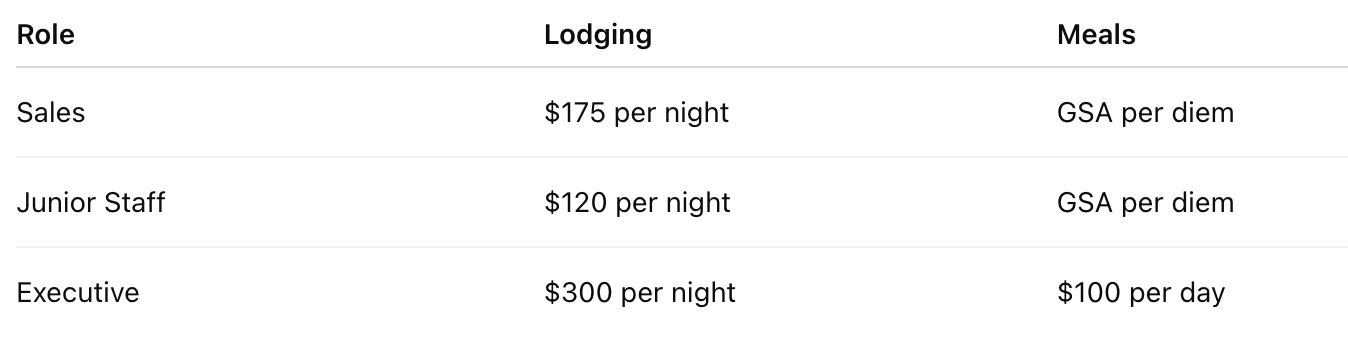
Download the editable table:
[DOWNLOAD: travel_expense_limits_template]
Per Diem vs Receipt-Based Reimbursements
Companies generally choose between two models.
Per Diem
Advantages
-
easier accounting
-
faster reimbursements
-
fewer receipts required
Disadvantages
-
may overpay or underpay depending on location
Receipt-Based
Advantages
-
precise expense tracking
-
better fraud prevention
Disadvantages
-
more administrative work
Recommended Approach for Small Businesses
Hybrid model:
-
Per diem for meals
-
Receipts for lodging and transportation
Travel Approval Workflow Examples
Travel approvals can range from simple to fully automated.
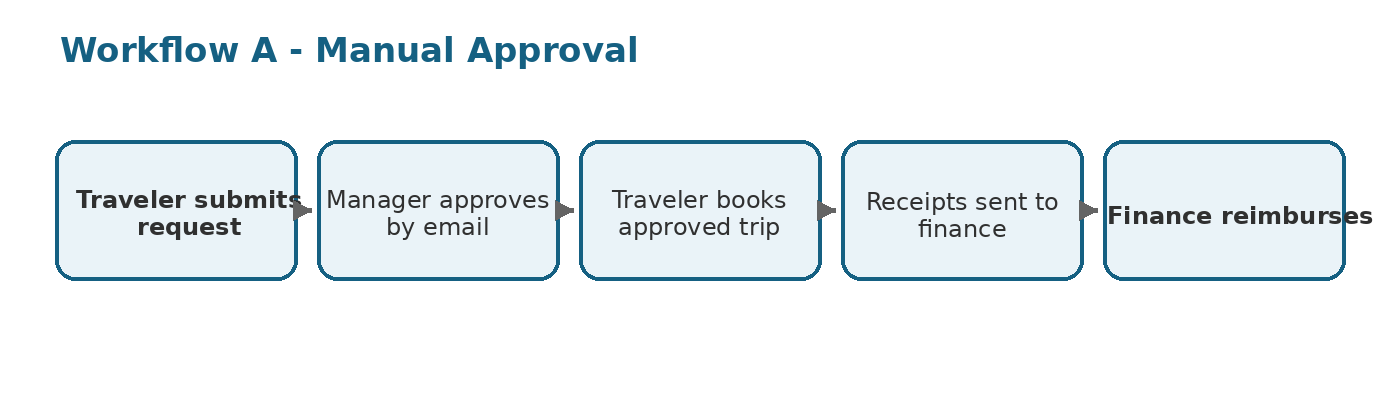
Manual Travel Approval Workflow
Best for companies with fewer than 20 employees.
Steps:
-
Employee submits travel request
-
Manager approves via email
-
Employee books travel
-
Receipts submitted after trip
-
Finance processes reimbursement
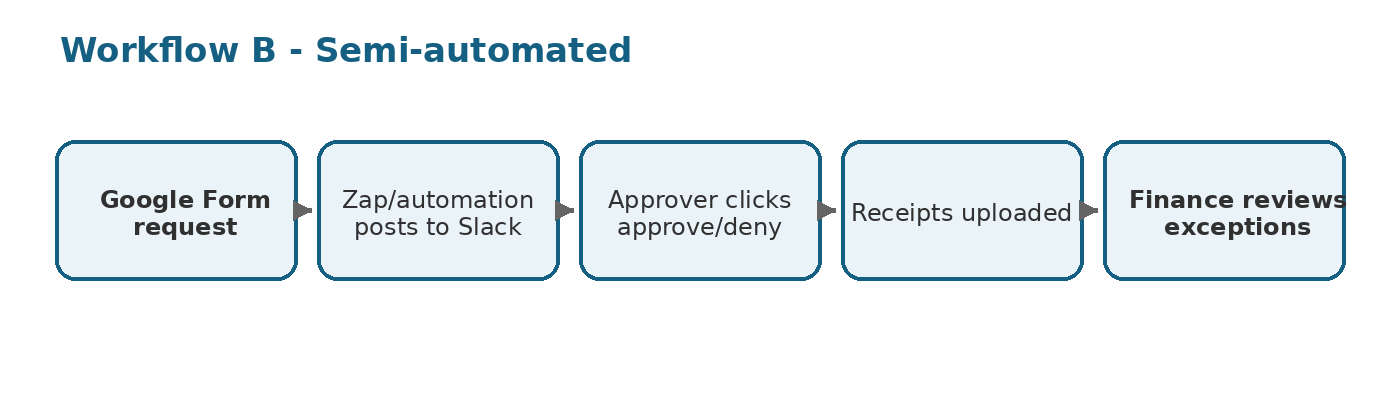
Semi-Automated Workflow
Example tools:
-
Google Forms
-
Slack
-
Zapier
Steps:
-
Employee submits form
-
Manager receives approval notification
-
Approval recorded automatically
-
Receipts uploaded to shared folder
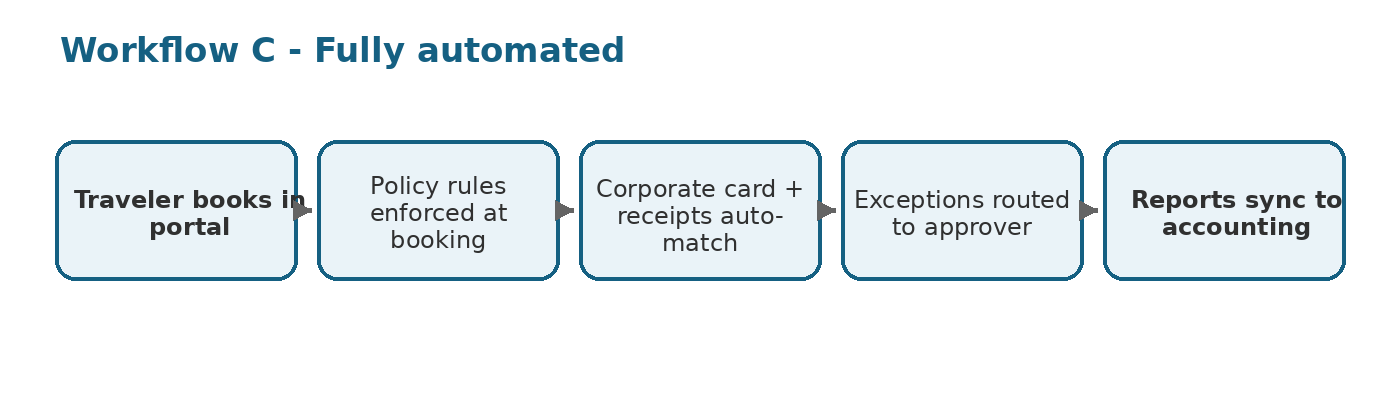
Fully Automated Workflow
Larger companies may use travel platforms such as:
-
Concur
-
Expensify
-
Navan
These platforms enforce policy rules automatically and simplify expense reporting.
Implementing a Travel Policy in a Small Business
Rolling out a policy gradually works best.
Download the rollout plan:
[DOWNLOAD: travel_policy_kpi_tracker]
30-Day Preparation
-
Draft travel policy
-
Define expense limits
-
choose pilot team
-
create approval workflow
-
prepare training materials
60-Day Pilot
-
run pilot with small group
-
collect feedback
-
adjust expense caps
-
refine booking procedures
90-Day Rollout
-
launch policy company-wide
-
train employees
-
track travel KPIs
-
perform first audit
Traveler Safety and Duty of Care
Duty of care means protecting employees during business travel.
Important policy elements include:
-
traveler registration
-
emergency contacts
-
travel advisories
-
medical evacuation coverage
Travel advisories can be checked at:
Health guidance for travelers is available at:
Incident Reporting Workflow
Download the incident template:
[DOWNLOAD: travel_incident_report_template]
Incident procedure:
-
traveler reports incident within 24 hours
-
manager notifies HR
-
HR coordinates assistance
-
incident documented for compliance
Travel Policy Compliance Checklist
Download the printable checklist:
[DOWNLOAD: corporate_travel_policy_template]
Typical audit checks include:
-
policy version documented
-
expense caps reviewed
-
vendor list updated
-
receipts retained
-
incident logs maintained
KPIs for Measuring Travel Policy Success
Download the KPI tracker:
[DOWNLOAD: travel_policy_kpi_tracker]
Recommended metrics:
| KPI | Target |
|---|---|
| Policy adherence | >90% |
| Approval time | <48 hours |
| Expense exceptions | <10% |
| Cost per trip | stable or declining |
Traveler Quick-Start Guide
Provide employees with a simple cheat sheet.
Download here:
[DOWNLOAD: traveler_quick_start_sheet]
Includes:
-
booking rules
-
expense limits
-
receipt guidelines
-
emergency contacts
Frequently Asked Questions
What should a corporate travel policy include?
A travel policy should define booking rules, approval requirements, expense limits, reimbursement procedures, and safety protocols for employees traveling on behalf of the company.
Can small businesses use GSA per diem rates?
Yes. Many small businesses use GSA per diem rates as a baseline for meal and incidental expenses because they are widely accepted and updated annually.
How often should a travel policy be updated?
Most companies review their travel policy once per year or whenever travel costs, company structure, or risk management requirements change.
What is duty of care in business travel?
Duty of care refers to a company’s responsibility to protect employees during work-related travel by providing safety guidance, emergency support, and travel risk monitoring.
Key Takeaways
A strong corporate travel policy should:
-
clearly define expense limits
-
establish approval workflows
-
protect employees through duty-of-care procedures
-
include measurable KPIs
-
be reviewed regularly
Start with a small pilot group, refine the policy, and then roll it out company-wide.
Download the Corporate Travel Policy Template Pack
Get the complete set of corporate_travel_policy_premium_bundle used in this guide.
Includes:
-
Corporate travel policy template
-
Expense limits spreadsheet
-
Travel approval form
-
Incident report template
-
Compliance checklist
-
KPI tracker